Home / Guides / How to read a record / East of the Cascades is a different state
East of the Cascades is a different state
East of the crest is a 6-to-30-year fire landscape. West of it is not. WA DNR, Fire-Resistant Plants for Eastern Washington (June 2021): historically wildfire burned an area every 6 to 30 years east of the Cascades, a frequent interval since the continental glaciers retreated more than 10,000 years ago. There is no absolutely fire-proof vegetation. Fire-resistant does not mean fireproof. Junipers, pines, spruces, and firs are resinous and highly flammable. Landscape Zone 1: nothing flammable 5 feet out with one-hour flame-resistant siding, 10 feet without. The compilers list only plants already in other Firewise documents and did not perform empirical research. This directory stores the PDF as Tier 2 corroboration, not an independent lineage. Pinus ponderosa currently computes as avoid and includes WA.
You are treating a Chelan lot like a Puget Sound woodland because both are “Washington.” The rain shadow is the planting boundary. PNW 590 is the joint Oregon–Washington–Idaho list. This DNR book is a compilation of that class of list for eastern counties. It is not a second vote. See the Steward rule.
This is not a Washington doorway. Kittitas IWUIC is a construction book on unincorporated land. It does not rate the pine.
Why it matters
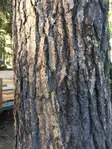
Embers travel more than a mile in this PDF. More homes burn from firebrands than from flame contact. Eastern Washington’s 6-to-30-year interval is not a west-side rainforest story. Zone 0 is still empty: this guide already says nothing flammable in LZ1 and no wood or bark mulch within 3 to 5 feet. Black Hills ponderosa and what MSU actually rated are the same mix-up: forest pine is not a foundation tree.
This site’s Washington plant evidence currently holds 593 occurrence records. That is range evidence, including both sides of the Cascades. 46 exact owners cite the eastern DNR compilation and 82 cite the Puget Sound list; their union is 121 regional plants because some taxa appear in both.
How it works
What the June 2021 PDF actually says:
- Title: Fire-Resistant Plants for Eastern Washington. DNR communications design. Al Murphy, project coordinator and author. WSU Chelan/Douglas Master Gardener volunteers compiled. DNR staff acknowledged.
- Audience: Eastern Washington counties.
- Fire interval 6 to 30 years. Fire is essential to the ecosystem.
- All vegetation is potential fuel. No absolutely fire-proof vegetation.
- FIRE-RESISTANT DOES NOT MEAN FIREPROOF. Maintenance (pruning, watering, cleanup) has a greater impact on ignition than species.
- Fire-resistant traits: high leaf moisture, little dead accumulation, open branching, fewer branches and leaves, slow growth, non-resinous. Junipers, pines, spruces, and firs are resinous and highly flammable.
- Firebrands: more homes burn from embers than from any other cause; lofted more than a mile.
- Organic bark mulch can carry firebrands. Do not use wood or bark mulches within 3 to 5 feet. Inorganic rock, scoria, pavers.
- LZ1: 5 feet (one-hour flame-resistant siding) or 10 feet (without). Nothing flammable: trees, brush, tall grass, leaves, firewood, bark mulch. Desired: groundcovers, vines, sod, bulbs, annuals and perennials. Summary table: within 10 feet, plant no trees or shrubs; inorganic mulch only.
- LZ2: 5–30 feet. Well-kept lawn. Avoid evergreens that ignite easily. Trees 30 feet from the house at mature size. 10–15 feet between crowns.
- LZ3: 30–100 feet (farther downhill on slopes >20%). Native conifers and shrubs acceptable if well spaced. 10–15 feet between crowns. Keep ignitions low intensity.
- Sagebrush: removal works best.
- Acknowledgments, verbatim: this publication lists only fire-resistant plants that are in other Firewise documents. Master Gardener volunteers did not perform any empirical research.
- Unfavorable trees (printed list): pine, firs, larch, spruce, Douglas-fir, yew, arborvitae, hemlock, cedar/juniper. Unfavorable shrubs: bitterbrush, sagebrush, mugo pine, arborvitae, juniper, yew.
- Reference section names PNW 590 as Fire-Resistant Plants for Home Landscaping, “a list and description of plants for Oregon and Washington.”
- The same reference section names Chumstick Wildfire Stewardship Coalition as an eastern Washington Firewise community example and Tolt Firewise as a western Washington example.
West-side list, opened: Firewise Plants for the Puget Sound Basin 2011 (King County DNRP library). Native plants suited to the site. Resinous cedar, spruce, and pine: special care if retained within 30 feet. Salal, oceanspray, vine maple. Its 82 exact owners now surface only as Puget Sound regional context; that is not the 6-to-30-year eastern interval or statewide suitability.
This directory:
wa-dnr-eastern-wais stored Tier 2, compiled, lineage unknown. Corroboration only. Never an independent Tier 1 vote. Notes already flag likely overlap with the PNW 590 tree.- Pinus ponderosa avoid, WA. Not a recommend row on this compilation, which is a fire-resistant-plant list.
- Juniperus scopulorum avoid, WA.
- Artemisia tridentata avoid, WA. The PDF: removal works best for sagebrush.
- Acer glabrum on-list, WA, and cites the eastern compilation.
- Populus tremuloides on-list, WA.
- Larix occidentalis candidate, WA. The PDF’s unfavorable-trees line includes larch. Candidate is not a DNR recommend row.
Washington WUI code status: WAC 51-55 reserved statewide. Kittitas KCC 20.10 already adopts IWUIC locally. Construction, not a plant table.
The paths
| Claim | Opened source | What it is not |
|---|---|---|
| 6–30 year fire interval | June 2021 PDF, fire occurrence | A west-side rainforest |
| No fire-proof vegetation | Same PDF | A fireproof maple cultivar |
| Nothing flammable 5 or 10 feet | LZ1 | A ponderosa by the deck |
| No bark mulch 3–5 feet | Mulch paragraph | Rubber mulch as a substitute (explicitly not acceptable in the 10-foot summary) |
| Juniper, pine, spruce, fir highly flammable | Fire-resistance page | LZ3 spacing as a foundation permit |
| Compilation only | Acknowledgments | A new empirical rating |
| PNW 590 in the reference list | Same PDF, further reading | A second independent lineage |
| Puget Sound 2011 native list | Opened King County DNRP PDF | The eastern compilation |
| 46 eastern / 82 Puget owners | This directory | 592 Washington occurrence records |
| Kittitas IWUIC | Washington WUI code status | A plant list |
What people mix up
- Eastern Washington with a Puget Sound planting list. This DNR PDF is titled Eastern Washington. The opened King County 2011 sheet is a west-side native list. Salal is not a Chelan foundation answer.
- A Master Gardener compilation with PNW 590 as a second lineage.
- Forest ponderosa that lives through fire with on-list at 10 feet. SDSU and MSU already ran that sentence.
- LZ3 “native conifers acceptable” with Zone 0.
- Kittitas IWUIC with a DNR plant rating.
- 592 occurrence rows as either regional table.
- Fire-resistant with fireproof. The PDF already printed the correction.
How to check
- Open the June 2021 PDF. Read 6 to 30 years, no absolutely fire-proof vegetation, LZ1 nothing flammable, and the acknowledgments sentence about no empirical research.
- Open the 2011 Puget Sound sheet. Read native-first and within 30 feet for resinous cedar, spruce, and pine.
- Open Pinus ponderosa.
- Open how Oregon got the deepest page for PNW 590.
- Open Washington WUI code status if the question is Kittitas construction.
- Open Washington plant evidence.
- Do not plant in Zone 0.
Limits
This page quotes the opened June 2021 DNR PDF (CreationDate 27 August 2021) and the opened King County DNRP-hosted 2011 Puget Sound PDF (CreationDate 21 May 2013; footer 2011). The current King County wildfire page still links the basin list. The 2011 sheet does not print a department byline on the two pages; the URL is the King County DNRP library path. PNW 590 was named from DNR’s reference section. The 46, 82, 121, and 592 counts are stored relationships as of this writing. Kittitas construction facts are the already-published Washington WUI code status page. Zone 0 is not a planting list.
Related records
Plant records this page rests on
Questions
Is the eastern Washington DNR plant guide a new rating?
No. The June 2021 publication states that it lists only fire-resistant plants that are in other Firewise documents. Master Gardener volunteers did not perform any empirical research; they compiled existing information about plants likely to thrive in Eastern Washington. This directory stores it as Tier 2 compiled corroboration with unknown lineage, likely overlapping PNW 590. It is not a second PNW 590 vote.
What does the guide say you cannot plant next to the house?
Landscape Zone 1: nothing flammable 5 feet out from a house with one-hour flame-resistant siding, and 10 feet out without that siding. That includes trees, brush, tall grass, leaves, firewood piles, bark mulch, and other flammable materials. Do not use wood or bark mulches within 3 to 5 feet of the house. Junipers, pines, spruces, and firs are named as resinous and highly flammable. Native conifers are acceptable only in Landscape Zone 3 (30–100 feet), well spaced.
Does Kittitas County’s IWUIC rewrite the plant table?
No. KCC 20.10 adopts the current IWUIC on unincorporated land. That is a construction book. The eastern Washington plant PDF is a compiled landscape guide. See Washington WUI code status. Do not mint a Kittitas doorway.
Is this a Washington doorway page?
No. The object is the rain-shadow fire interval versus two separately bounded regional source lists. Place claims sit on whereThisDiffers. The Washington plant page keeps 592 occurrence records, exact PNW 590 evidence, 46 eastern owners, and 82 Puget Sound owners distinct.