Enter your ZIP to see whether this is legal to plant in your state, and whether it survives your winter.
No, loblolly pine is not fire resistant; published findings consistently call it highly flammable or say it should be avoided.
The USDA Forest Service and state Firewise programs give loblolly pine rating 4, “Not Firewise,” on their four-step scale. NC State Extension classifies it as high flammability and maps that class to avoid. Virginia Cooperative Extension assigns it H on its three-point scale, where H also means avoid. These findings all land on the same practical conclusion.
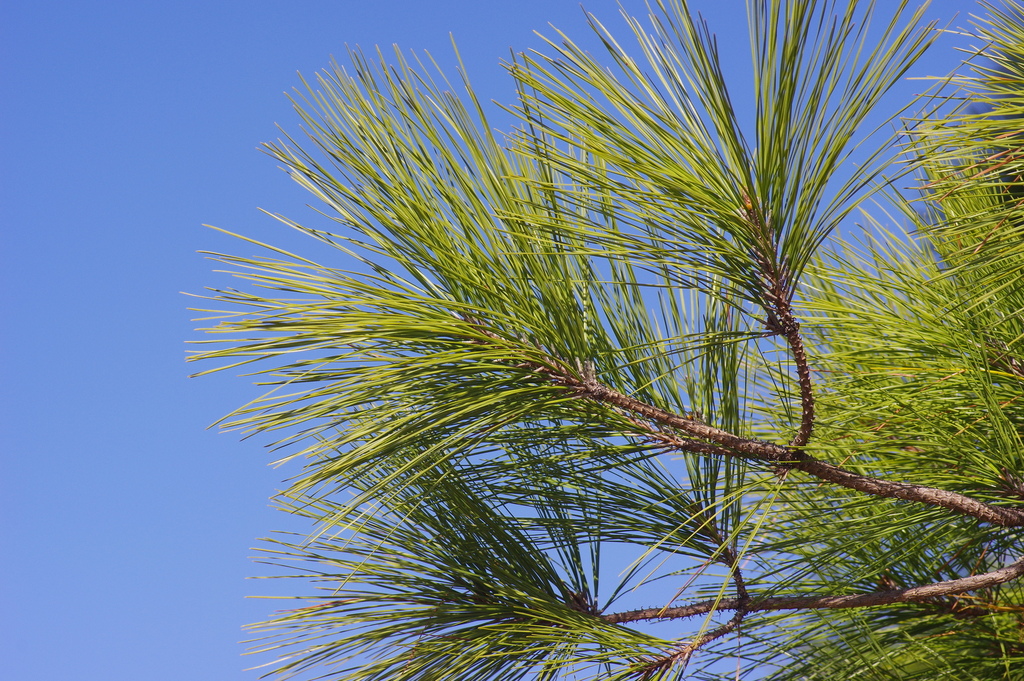
A replicated burn-plot trial published by Revista Brasileira de Ciências Agrárias adds measured fire behavior. Dried loblolly pine needles served as the high-flammability control in one-square-meter plots. Fire spread at 0.00584 meters per second, with flames 0.674 meters high and intensity of 110.843 kilowatts per meter. Those measurements describe dried needles under that plot design, not an entire mature tree, but the researchers explicitly interpreted the control as highly flammable.
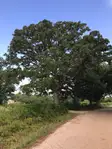
Loblolly pine is a tree that reaches about 75 feet at maturity. Given its consistent avoid ratings and the behavior of its dried needles in the burn trial, it does not belong near structures or in fire-resistant landscaping.
The Alabama Forestry Commission's five-page AFC-FP-04 booklet is an Alabama publication and contains 31 printed suggested or fire-prone plant occurrences. FireApproved publishes 27 exact species or genus owners and holds one infraspecific form plus two named cultivars; this historical source scope does not establish current site suitability for a particular Alabama property.
The complete three-table AG-874 plant list is explicitly for North Carolina and contains 202 low-, medium-, or high-flammability rows. FireApproved accounts for all source rows under its strict taxonomy and lineage rules; source scope does not establish local suitability at a particular North Carolina site.
Virginia Cooperative Extension's publication opens with Virginia wildfire conditions, identifies its Virginia Firewise Landscaping Task Force, and labels plants native to Virginia. FireApproved publishes 306 exact source owners. Publication scope does not establish parcel suitability or current endorsement of this archived 2009 list.
2. Why this plant is relevant here
State distribution
Documented in AL, AR, DC, DE, FL, GA, IL, KY, LA, MD, MO, MS, NC, NJ, OH, OK, PA, SC, TN, TX, VA, WV.
Native range
Current cited native range in AL, AR, DC, DE, FL, GA, KY, LA, MD, MS, NC, OK, SC, TN, TX, VA.
Introduced / established
2 sourced range or established records. This is not an invasive warning.
USDA hardiness
Documented minimum 6a; no upper limit is documented.
3. Legal, ecological, and broader status
Legal-list status
Seed-list status
Reported invasive here
1 ecological invasive report.
Broader regional context
Federal context
How to read this page
The status above is computed from the cited rows below: independent recommendations can support a fire-resistant result, an avoid row can produce keep-away, and disagreement stays visible as conflict. Placement notes preserve each source’s own scheme rather than translating unlike rules into one scale. This is evidence about a plant, not permission to plant it in every part of the defensible space; Zone 0 remains noncombustible.
Native and introduced range evidence
These are exact U.S. botanical-area records from the cited range source. Native and
introduced describe biogeographic relationship, not fire performance or planting approval.
Doubtful and extinct rows stay visible but do not count as current presence.
The lossless worldwide derivative is retained once in the research corpus; object pages repeat only exact U.S. areas needed by the local lens. The JSON twin carries the same page assertions.
Plant hardiness evidence
These values describe the plant source. Your ZIP zone comes from the separate 2023 USDA
Plant Hardiness Zone Map. Whole-zone values stay whole-zone, and a single unresolved value
is not treated as a tolerance range. Different source boundaries stay separate: overlapping
statements are compared independently, while only ranges with no shared zone are called a conflict.
Source prints 7 · single-value meaning unresolved · whole zone precision · source stated
Source taxon: Pinus taeda · exact match.
Source location: Cold Hardiness Zone field in the recovered selector record.
Not used for comparison: The recovered selector prints one Cold Hardiness Zone value but does not define it as a minimum threshold or a one-zone range.
Placement rules below use each source's own distances or named zones, tied to its rating.
They are not interchangeable with the directory's current Zone 0 guidance.
Eastern United States Fire Performance Plant Selector: Landscape Zone 3 — 10–30 ft from the structure; thin vegetation, remove debris, and minimize plant massing [Fire Performance Plant Selector landscape zone] (with its avoid rating)
North Carolina Extension Gardener Plant Toolbox: pinus-taeda [nc-toolbox-flammability-facet] (with its avoid rating)
Firewise Landscaping for Woodland Homes: Fire-prone plants to avoid within 30 feet of the house [Alabama Forestry Commission booklet section] (with its avoid rating)
The evidence
Grouped by what each source concluded. Primary evidence rated the plant itself
(a lab, field program, or original curation); corroboration compiled or
republished another source's rating and resolves to its root lineage.
60 cited rows from this source; its identity, lineage and tier are stated once.
Primary study Hough1969: Hough, W. A. (1969). Caloric Value of Some Forest Fuels of the Southern United States. Res. Note SE-120. Asheville, NC: U.S. Department of Agriculture, Forest Service, Southeastern Forest Experiment Station.
Primary study Kovalsyki2017: Kovalsyki, B., Takashina, I. K., Tres, A., Tetto, A .F., & Batista, A. C. (2016). Inflamabilidade de espécies arbóreas para uso em cortinas de segurança na prevenção de incêndios florestais. Pesquisa florestal brasileira, 36, 387-391.
Shared row context: plant part leaves; fuel live; predrying no; device epiradiator; site Kovalsyki2017-1; sampling ND.
Primary study Santos2018a: Santos, J. F. L., Batista, A. C., Tres, A., Tetto, A. F., & Kovalsyki, B. (2018a). Flammability and combustibility of potential species for use as fuel breaks. In: D. X. Viegas, Advances in Forest Fire Research 2018 (pp. 788-793), Portugal, University of Coimbra.
Shared row context: plant part twigs; fuel live; predrying no; device epiradiator; site Santos2018a-1; sampling ND.
Primary study Tran1992: Tran, H. C., & White, R. H. (1992). Burning rate of solid wood measured in a heat release rate calorimeter. Fire and materials, 16, 197-206.
Shared row context: plant part wood; fuel dead; predrying yes; device calorimeter; site Tran1992-1; sampling ND.
Primary study Varner2022: Varner, J. M., Shearman, T. M., Kane, J. M., Banwell, E., Jules, E., & Stambaugh, M. (2022). Understanding flammability and bark thickness in the genus Pinus using a phylogenetic approach. Scientific Reports, 12, 7384.
Shared row context: plant part litter; fuel all; predrying yes; device burning bench; site Varner2022-24; sampling ND.