88 cited rows from this source; its identity, lineage and tier are stated once.
-
Primary study Bianchi2019: Bianchi, L. O., Oddi, F .J., Muñoz, M., & Defossé, G. E. (2019). Comparison of leaf moisture content and ignition characteristics among native species and exotic conifers in Northwestern Patagonia, Argentina. Forest Science, 65, 375-386.
Shared row context: plant part leaves; fuel live; predrying no; device epiradiator; site Bianchi2019-1; sampling summer.
-
Shared measurement context: Ignitability measurement.
-
“time to flaming (s): 17.9”
FLAMITS record 684.
-
“flammability value: 2.8”
FLAMITS record 720.
-
“ignition frequency (%): 70”
FLAMITS record 738.
-
“burning duration (s): 10.4”
FLAMITS record 702; Sustainability measurement.
-
Primary study Blackhall2019: Blackhall, M., & Raffaele, E. (2019). Flammability of Patagonian invaders and natives: When exotic plant species affect live fine fuel ignitability in wildland-urban interfaces. Landscape and Urban Planning, 189, 1-10.
Shared row context: plant part twigs; fuel live; predrying no; device epiradiator; site Blackhall2019-1; sampling february.
-
Shared measurement context: Ignitability measurement.
-
Shared measurement context: Combustibility measurement.
-
“flaming duration (s): 41.7”
FLAMITS record 888; Sustainability measurement.
-
Primary study Cui2020a: Cui, X., Paterson, A. M., Wyse, S. V., Alam, M. A., Maurin, K. J. L., Pieper, R., ... Curran, T. J. (2020a). Shoot flammability of vascular plants is phylogenetically conserved and related to habitat fire-proneness and growth form. Nature Plants, 6, 355-359.
Shared row context: plant part branches; fuel all; predrying yes; device grill; site Cui2020a-1; sampling ND.
-
“ignition frequency (%): 79.5”
FLAMITS record 1462; Ignitability measurement.
-
“maximum sample temperature (°C): 371.6”
FLAMITS record 1656; Combustibility measurement.
-
“burning duration (s): 18.6”
FLAMITS record 1850; Sustainability measurement.
-
“estimated burnt biomass (%): 18.2”
FLAMITS record 2044; Consumability measurement.
-
Primary study Fonda2001: Fonda, R. W. (2001). Burning characteristics of needles from eight pine species. Forest Science, 47, 390-396.
Shared row context: plant part leaves; fuel live; predrying yes; device burning bench; site Fonda2001-7; sampling ND.
-
Shared measurement context: Combustibility measurement.
-
Shared measurement context: Sustainability measurement.
-
“burnt biomass (%): 81.4”
FLAMITS record 3375; Consumability measurement.
-
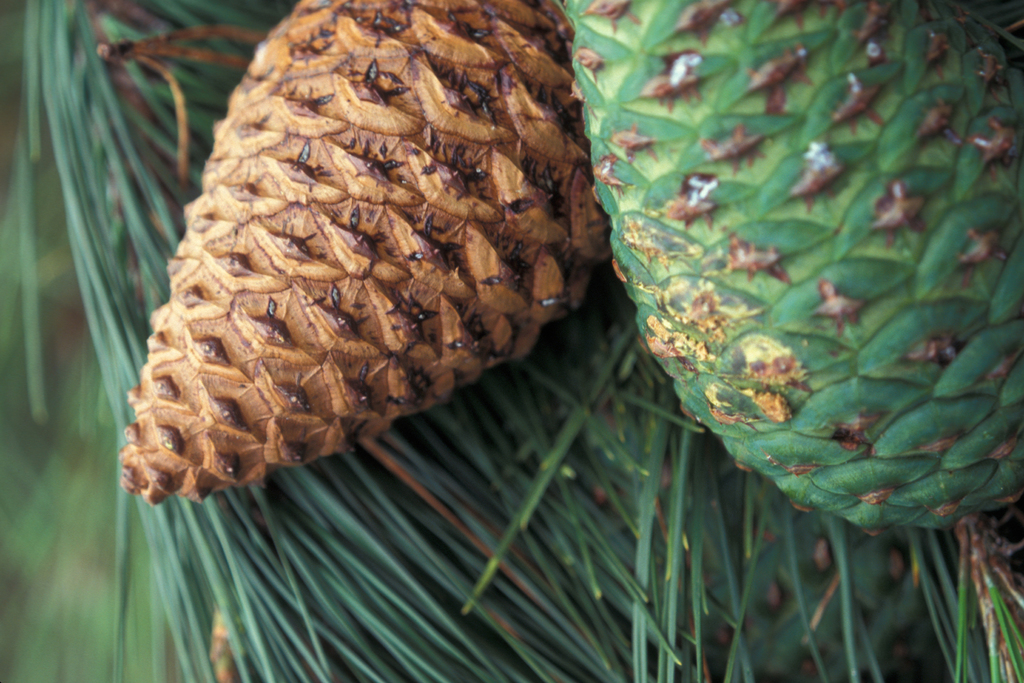
Primary study Fonda2004: Fonda, R., & Varner, J. (2004). Burning characteristics of cones from eight pine species. Northwest Science, 78, 322-333.
Shared row context: plant part cones; fuel dead; predrying yes; device burning bench; site Fonda2004-6; sampling august to october.
-
Shared measurement context: Combustibility measurement.
-
Shared measurement context: Sustainability measurement.
-
“flaming duration (s): 605”
FLAMITS record 3423.
-
“smouldering duration (s): 1652”
FLAMITS record 3424.
-
“burning duration (s): 2257”
FLAMITS record 3425.
-
“burnt biomass (%): 44”
FLAMITS record 3426; Consumability measurement.
-
Primary study Guerrero2021: Guerrero, F., Hernández, C., Toledo, M., Espinoza, L., Carrasco, Y., Arriagada, A., ... Carmona, C. (2021). Leaf thermal and chemical properties as natural drivers of plant flammability of native and exotic tree species of the valparaíso region, Chile. International journal of environmental research and public health, 18, 7191.
Shared row context: plant part leaves; fuel live; predrying no; device epiradiator; site Guerrero2021-1; sampling summer.
-
Shared measurement context: Ignitability measurement.
-
Shared measurement context: Sustainability measurement.
-
“calorific value (kcal/kg): 4972.77”
FLAMITS record 4645; Combustibility measurement.
-
Primary study Martin1989: Martín, E., & Miguel, L. (1989). Inflamabilidad y energía de las especies de sotobosque
Shared row context: plant part twigs; predrying yes; device epiradiator; site Martin1989-9.
-
Shared measurement context: Ignitability measurement; fuel live; sampling january.
-
Shared measurement context: Ignitability measurement; fuel dead; sampling january.
-
Shared measurement context: Combustibility measurement; fuel live; sampling ND.
-
Shared measurement context: Ignitability measurement; fuel live; sampling ND.
-
“flammability value: 3”
FLAMITS record 7958.
-
“flammability value: 5”
FLAMITS record 7959.
-
Primary study Msweli2020: Msweli, S. T., Potts, A. J., Fritz, H., & Kraaij, T. (2020). Fire weather effects on flammability of indigenous and invasive alien plants in coastal fynbos and thicket shrublands (Cape Floristic Region). PeerJ, 8, e10161.
Shared row context: plant part branches; fuel all; predrying yes; device grill; site Msweli2020-1; sampling february to november.
-
Shared measurement context: Ignitability measurement.
-
Shared measurement context: Combustibility measurement.
-
Shared measurement context: Consumability measurement.
-
Primary study Salvo2015: Salvo-Aires, F. (2015). Effects of woody weeds on fuels and fire behaviour in Eastern Australian forests and woodlands. PhD. Dissertation. University of Sydney.
Shared row context: plant part leaves; fuel live; predrying yes; device calorimeter; site Salvo2015-1; sampling ND.
-
“time to flaming (s): 33”
FLAMITS record 11656; Ignitability measurement.
-
Shared measurement context: Combustibility measurement.
-
“maximum energy flux (kW/m²): 201”
FLAMITS record 11693.
-
“mass loss rate (g/s): 0.17”
FLAMITS record 11767.
-
“calorific value (kcal/kg): 3623.29”
FLAMITS record 11841.
-
“energy flux (kW/m²): 138”
FLAMITS record 11878.
-
“flaming duration (s): 178”
FLAMITS record 11730; Sustainability measurement.
-
“burnt biomass (%): 85”
FLAMITS record 11804; Consumability measurement.
-
Primary study Wyse2016: Wyse, S. V., Perry, G. L. W., O'Connell, D. M., Holland, P. S., Wright, M. J., Hosted, C. L., ... Curran, T. J. (2016). A quantitative assessment of shoot flammability for 60 tree and shrub species supports rankings based on expert opinion. International Journal of Wildland Fire, 25, 466-477.
Shared row context: plant part branches; fuel all; predrying yes; device grill; site Wyse2016-3; sampling ND.
-
“ignition frequency (%): 66.7”
FLAMITS record 14364; Ignitability measurement.
-
“maximum sample temperature (°C): 234”
FLAMITS record 14424; Combustibility measurement.
-
“burning duration (s): 10.5”
FLAMITS record 14484; Sustainability measurement.
-
“estimated burnt biomass (%): 10.6”
FLAMITS record 14544; Consumability measurement.
-
Primary study Varner2022: Varner, J. M., Shearman, T. M., Kane, J. M., Banwell, E., Jules, E., & Stambaugh, M. (2022). Understanding flammability and bark thickness in the genus Pinus using a phylogenetic approach. Scientific Reports, 12, 7384.
Shared row context: plant part litter; fuel all; predrying yes; device burning bench; site Varner2022-19; sampling ND.
-
“flame height (cm): 72”
FLAMITS record 15721; Combustibility measurement.
-
Shared measurement context: Sustainability measurement.
-
“burnt biomass (%): 92.2”
FLAMITS record 15724; Consumability measurement.
-
Primary study Belcher2017: Belcher, C. M., & Hudspith, V. A. (2017). Changes to Cretaceous surface fire behaviour influenced the spread of the early angiosperms. New Phytologist, 213, 1521-1532.
Shared row context: plant part litter; fuel all; predrying no; device calorimeter; site Belcher2017-1; sampling .
-
Shared measurement context: Ignitability measurement.
-
“calorific value (kcal/kg): 14.84”
FLAMITS record 15855; Combustibility measurement.
-
Primary study Miller2022: Miller, T. S., Filkov, A. I., & Penman, T. D. (2022). Improved laboratory method to test flammability metrics of live plants under dynamic conditions and future implications. International Journal of Wildland Fire, 32, 277-295.
Shared row context: plant part leaves; fuel live; predrying yes; device radiant panel; site Miller2022-1; sampling may 2019.
-
Primary study Valdivieso2014: Valdivieso, J.P., & Rivera, J.D.D. (2014). Effect of Wind on Smoldering Combustion Limits of Moist Pine Needle Beds. Fire Technology, 50, 15891605.
Shared row context: Sustainability measurement; plant part leaves; fuel dead; predrying no; device scale wind tunnel; site Valdivieso2014-1; sampling ND.
-
“rate of burning spread (cm/s): 0.12”
FLAMITS record 17634.
-
“rate of burning spread (cm/s): 0.18”
FLAMITS record 17635.
-
“rate of burning spread (cm/s): 0.06”
FLAMITS record 17636.
-
“rate of burning spread (cm/s): 0.13”
FLAMITS record 17637.
-
“rate of burning spread (cm/s): 0.21”
FLAMITS record 17638.
-
“rate of burning spread (cm/s): 0.16”
FLAMITS record 17639.
-
“rate of burning spread (cm/s): 0.11”
FLAMITS record 17640.
-
“rate of burning spread (cm/s): 0.11”
FLAMITS record 17641.
-
“rate of burning spread (cm/s): 0.15”
FLAMITS record 17642.
-
“rate of burning spread (cm/s): 0.07”
FLAMITS record 17643.