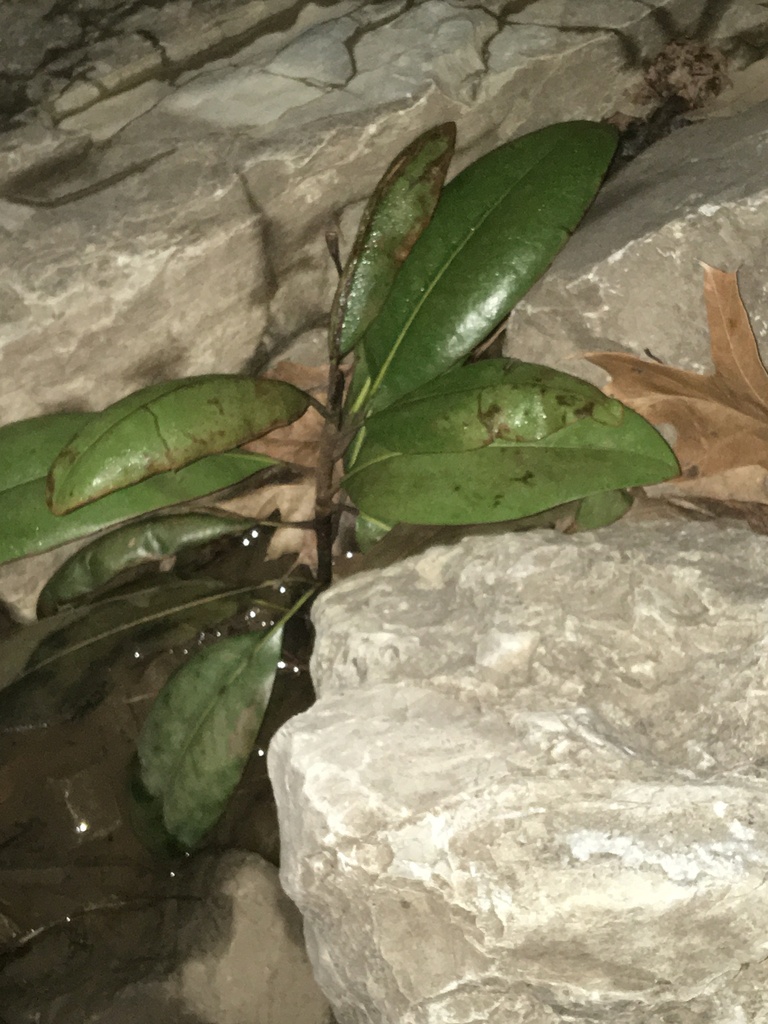
United States / Grow / southern magnolia

southern magnolia (Magnolia grandiflora)
Photo: (c) Joseph McPhail, some rights reserved (CC BY) (CC BY), via iNaturalist. Species-typical, not necessarily this cultivar.

southern magnolia

Magnolia grandiflora · Magnoliaceae · all Magnolia records · Wikipedia

View Saved

Is this one for your yard?

Enter your ZIP to see whether this is legal to plant in your state, and whether it survives your winter.

Southern magnolia is highly flammable and does not belong near structures because most sources rate it unsuitable.

Five of six assessments advise against using the tree for fire-resistant landscaping. A USDA Forest Service laboratory test classified live leaves and thin branches as highly flammable, with a mean ignition time of 12.5 seconds and a mean flame length of 25.22 centimeters. Ohio State University Extension placed southern magnolia in the H band, the fourth of its five flammability bands, and Virginia Cooperative Extension also rated it H on its three-point scale. Both cited considerable litter. Eastern Firewise programs called it Not Firewise, their least favorable rating, and noted that it produces much debris. A Japanese classification published by Kyoritsu Shuppan and reproduced by Kagoshima Prefecture found it unsuitable for fire protection.

The disagreement comes from a Catalonian guide published by the Diputació de Girona and the regional fire service, which calls southern magnolia recommended. Its judgment addresses broader garden suitability by combining fire evidence with fuel structure, maintenance, origin, invasiveness, species-specific care, and fire-service experience. That is a wider premise than laboratory flammability or an extension service’s fire-risk rating. For a tree reaching about 75 feet at maturity, the measured ignition and flame length, repeated high ratings, and warnings about litter and debris support keeping it away from a house despite that single recommendation.

Fire-resistant trees instead

Form
tree
Mature height
~75 ft
Light
Full sun
Water need
high
Rated in
Australian Capital Territory, Australia; Catalonia, Spain; Curitiba, Paraná, Brazil; Global +9
On this lot

1. Fire evidence and conditions

Fire evidence
Highly flammable — location does not change the cited classification.
Fire-performance conditions
1 condition stated in cited fire-evidence rows.
Placement evidence
7 source placement records; source schemes remain separate.
Evidence regions
Australian Capital Territory, Australia; Catalonia, Spain; Curitiba, Paraná, Brazil; Global; Japan; NC; New Zealand; North Carolina; North Carolina / southeastern US; Ohio / Midwest; Tasmania, Australia; Virginia / Mid-Atlantic; eastern US
Typed publication scope: 3 scopes across 3 cited fire sources
  • Fire-Resistant Landscaping in North Carolina (AG-874) · Official scoped edition
    • NC; complete normalized coverage · 2025-03-26

      The complete three-table AG-874 plant list is explicitly for North Carolina and contains 202 low-, medium-, or high-flammability rows. FireApproved accounts for all source rows under its strict taxonomy and lineage rules; source scope does not establish local suitability at a particular North Carolina site.

  • Firewise Landscaping (OSU Extension Bulletin 921) · Official scoped edition
    • OH; partial normalized coverage · 2006-03-01

      Ohio State University Extension Bulletin 921 is an Ohio publication that describes Ohio fire seasons and landscape conditions and labels nativity to Ohio. FireApproved publishes 352 exact source-owning plant records from its eight rated tables. This historical publication scope does not assert current extension endorsement or that a listed plant suits every Ohio site.

  • Virginia Firescapes — Firewise Landscaping for Woodland Homes (430-300) · Official scoped edition
    • VA; partial normalized coverage · 2009-04-15

      Virginia Cooperative Extension's publication opens with Virginia wildfire conditions, identifies its Virginia Firewise Landscaping Task Force, and labels plants native to Virginia. FireApproved publishes 306 exact source owners. Publication scope does not establish parcel suitability or current endorsement of this archived 2009 list.

2. Why this plant is relevant here

State distribution
Documented in AL, AR, DC, DE, FL, GA, KY, LA, MD, MS, NC, NJ, OH, PA, PR, SC, TN, TX, VA, WV.
Native range
Current cited native range in AL, FL, GA, LA, MS, NC, SC, TX.
Introduced / established
6 sourced range or established records. This is not an invasive warning.
USDA hardiness
Documented minimum 7b; no upper limit is documented.

3. Legal, ecological, and broader status

How to read this page

The status above is computed from the cited rows below: independent recommendations can support a fire-resistant result, an avoid row can produce keep-away, and disagreement stays visible as conflict. Placement notes preserve each source’s own scheme rather than translating unlike rules into one scale. This is evidence about a plant, not permission to plant it in every part of the defensible space; Zone 0 remains noncombustible.

Native and introduced range evidence

These are exact U.S. botanical-area records from the cited range source. Native and introduced describe biogeographic relationship, not fire performance or planting approval. Doubtful and extinct rows stay visible but do not count as current presence.

Current native

8

exact source areas

Current introduced

6

exact source areas

Qualified

0

doubtful or extinct source rows

8 native source areas · World Checklist of Vascular Plants, version 16 v16, as of 2026-06-04
  • Alabama (AL)
  • Florida (FL)
  • Georgia (GA)
  • Louisiana (LA)
  • Mississippi (MS)
  • North Carolina (NC)
  • South Carolina (SC)
  • Texas (TX)
6 introduced source areas · World Checklist of Vascular Plants, version 16 v16, as of 2026-06-04
  • Arkansas (AR)
  • Kentucky (KY)
  • Maryland (MD)
  • Puerto Rico (PR)
  • Tennessee (TN)
  • Virginia (VA)

The lossless worldwide derivative is retained once in the research corpus; object pages repeat only exact U.S. areas needed by the local lens. The JSON twin carries the same page assertions.

Plant hardiness evidence

These values describe the plant source. Your ZIP zone comes from the separate 2023 USDA Plant Hardiness Zone Map. Whole-zone values stay whole-zone, and a single unresolved value is not treated as a tolerance range. Different source boundaries stay separate: overlapping statements are compared independently, while only ranges with no shared zone are called a conflict.

Conditions in the fire evidence

These describe tested or rated plant material. They are not horticultural maintenance instructions.

Where its sources say to plant it

Placement rules below use each source's own distances or named zones, tied to its rating. They are not interchangeable with the directory's current Zone 0 guidance.

The evidence

Grouped by what each source concluded. Primary evidence rated the plant itself (a lab, field program, or original curation); corroboration compiled or republished another source's rating and resolves to its root lineage.

Recommends (2)

Corroboration (1 rows from 1 source)
  • Canberra Plant Selector — fire-retardant attribute — ACT Government / Everyday Climate Choices · live tool capture 2026-08-25 · original source Corroboration Compilation lineage: act-fire-retardant-plants-canberra

    “Fire Retardant — Yes — Magnolia grandiflora”

    The live Canberra Plant Selector marks “Magnolia grandiflora” as “Fire Retardant: Yes.”

Avoids (5)

Mid-scale / conditional (5)

Corroboration (1 rows from 1 source)
Listed without a rating (23)
Corroboration (23 rows from 1 source)
  • FLAMITS: FLAMmability plant traiTS database — Dryad / Global Ecology and Biogeography · Dryad version 9 · original source Corroboration Trait database lineage: meta-aggregator

    23 cited rows from this source; its identity, lineage and tier are stated once.

    • Primary study Batista2012: Batista, C., Biondi, D., França, A., de Assunção, R., Tres, A., Costa, R., ... Kovalsyki, B. (2012). Evaluación de la Inflamabilidad de Árboles y Arbustos Utilizados en la Implementación de Barreras Verdes en el Sur del Brasil. Cuarto Simposio Internacional Sobre Políticas, Planificación y Economía de los Incendios Forestales: Cambio Climático e Incendios Forestales, Ciudad de México, México.

      Shared row context: plant part twigs; fuel live; predrying no; device epiradiator; site Batista2012-1; sampling ND.

      • Shared measurement context: Ignitability measurement.

        • “time to flaming (s): 12.5”

          FLAMITS record 440.

        • “flammability value: 4”

          FLAMITS record 450.

      • “burning duration (s): 7.44”

        FLAMITS record 445; Sustainability measurement.

      • “flame height (cm): 25.22”

        FLAMITS record 455; Combustibility measurement.

    • Primary study Cui2020a: Cui, X., Paterson, A. M., Wyse, S. V., Alam, M. A., Maurin, K. J. L., Pieper, R., ... Curran, T. J. (2020a). Shoot flammability of vascular plants is phylogenetically conserved and related to habitat fire-proneness and growth form. Nature Plants, 6, 355-359.

      Shared row context: plant part branches; fuel all; predrying yes; device grill; site Cui2020a-1; sampling ND.

      • “ignition frequency (%): 100”

        FLAMITS record 1428; Ignitability measurement.

      • “maximum sample temperature (°C): 476”

        FLAMITS record 1622; Combustibility measurement.

      • “burning duration (s): 24.5”

        FLAMITS record 1816; Sustainability measurement.

      • “estimated burnt biomass (%): 12.5”

        FLAMITS record 2010; Consumability measurement.

    • Primary study Mola2014: Mola, J. M., Varner, J. M., Jules, E. S., & Spector, T. (2014). Altered Community Flammability in Florida's Apalachicola Ravines and Implications for the Persistence of the Endangered Conifer Torreya taxifolia. Plos One, 9, 8.

      Shared row context: plant part litter; fuel all; predrying no; device burning bench; site Mola2014-1; sampling may and june.

      • “flame height (cm): 5.87”

        FLAMITS record 9226; Combustibility measurement.

      • “flaming duration (s): 55.2”

        FLAMITS record 9243; Sustainability measurement.

      • “burnt biomass (%): 99.13”

        FLAMITS record 9260; Consumability measurement.

      • “time to smouldering (s): 123.2”

        FLAMITS record 9277; Ignitability measurement.

    • Primary study Santos2018a: Santos, J. F. L., Batista, A. C., Tres, A., Tetto, A. F., & Kovalsyki, B. (2018a). Flammability and combustibility of potential species for use as fuel breaks. In: D. X. Viegas, Advances in Forest Fire Research 2018 (pp. 788-793), Portugal, University of Coimbra.

      Shared row context: plant part twigs; fuel live; predrying no; device epiradiator; site Santos2018a-1; sampling ND.

      • Shared measurement context: Ignitability measurement.

        • “time to flaming (s): 12.5”

          FLAMITS record 11931.

        • “flammability value: 4”

          FLAMITS record 11949.

      • Shared measurement context: Combustibility measurement.

        • “flame height (cm): 5.41”

          FLAMITS record 11940.

        • “flame height (cm): 40”

          FLAMITS record 11967.

        • “calorific value (kcal/kg): 4259.3”

          FLAMITS record 11985.

      • Shared measurement context: Sustainability measurement.

        • “burning duration (s): 7.4”

          FLAMITS record 11958.

        • “rate of burning spread (cm/s): 44.5”

          FLAMITS record 11976.

    • Primary study Murray2023: Murray, B. R., Hawthorne, T., Curran, T. J., Krix, D. W., Wallace, M. I., Young, K., ... & Webb, J. K. (2023). Shoot flammability patterns among plant species of the wildland–urban interface in the fire-prone Greater Blue Mountains World Heritage Area. International Journal of Wildland Fire, Online early.

      Shared row context: plant part branches; fuel all; predrying yes; device grill; site Murray2023-1; sampling ND.

      • “time to flaming (s): 6”

        FLAMITS record 19417; Ignitability measurement.

      • “burning duration (s): 1.16”

        FLAMITS record 19418; Sustainability measurement.

      • “maximum flame temperature (°C): 204.5”

        FLAMITS record 19419; Combustibility measurement.

      • “estimated burnt biomass (%): 2”

        FLAMITS record 19420; Consumability measurement.

Fire-resistant trees instead

Fire-resistant trees listed above

Guides that discuss this plant

Last verified 2026-08-23. JSON (CC BY 4.0)

Profiles: USDA PLANTS · GBIF · iNaturalist · Wikidata · Wikipedia · ITIS

Magnolia grandiflora (Southern magnolia). FireApproved. https://fireapproved.com/plants/magnolia-grandiflora/. Last verified 2026-08-23.