United States / Grow / Junipers
Junipers
No juniper is rated fire resistant, and ten of the eighteen Juniperus species assessed are rated keep away.
The other eight have been assessed too; the sources have not taken a side, which leaves them unrated, not cleared.
Cade juniper is rated "MUY DESACONSEJADA" under a garden-suitability method weighing fire evidence, fuel structure, maintenance and origin. Eastern redcedar draws the same rating: its assessment calls all-zone plantings highly flammable from volatile oils and says zone-1 entries should be held to zones 2 or 3. Chinese juniper carries the rating too, though its assessment says little more than that it is a common landscape plant in blue and yellow-green forms. A separate assessment, filed as juniper, names small needle-like leaves, resin and unshed dead branches as what raises the risk.
Invasiveness recurs in three of the genus's own assessments, and maintenance and irrigation, foliage moisture and volatile oils each recur in two. Junipers, in the cypress family, are grown as shrub, groundcover and tree; among eight members measured, height runs from about a foot to fifty feet, and among two members zoned, hardiness spans USDA zones 3b to 4a. Native to the north-central, south-central, northwestern and southwestern United States.
A Forest Service review of one member, Rocky Mountain juniper, found that volatile oil in its lower branches makes that species more flammable, that plants up to three or four feet tall are easily killed by fire, and that it returns only from seed rather than resprouting. The review says this describes that species, not the genus. For a juniper near a house, the ten keep-away ratings and the pattern behind them are the starting point; the eight species without a verdict remain unresolved, not cleared.
 Rated as a group: juniper Juniperus spp. Keep away Consensus 16 sources rate the genus as a
whole. Species evidence never rolls upward into a genus verdict, and genus claims never
override a species record.
›
Rated as a group: juniper Juniperus spp. Keep away Consensus 16 sources rate the genus as a
whole. Species evidence never rolls upward into a genus verdict, and genus claims never
override a species record.
› Keep away: 9 species
-
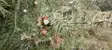 cade juniper Keep away Juniperus oxycedrus
 -
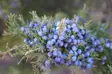 eastern redcedar Keep away Juniperus virginiana
 -
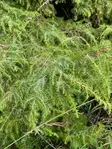 common juniper Keep away Juniperus communis
 -
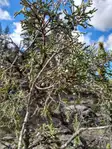 Rocky Mountain juniper Keep away Juniperus scopulorum
 -
 creeping juniper Keep away Juniperus horizontalis
 -
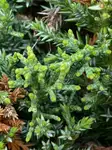 Chinese juniper Keep away Juniperus chinensis
 -
 oneseed juniper Keep away Juniperus monosperma
 -
 Creeping Juniper Keep away Juniperus procumbens
 -
 temple juniper Keep away Juniperus conferta
Awaiting evidence: 8 species
-
 Ashe's juniper Awaiting evidence Juniperus ashei
 - Pinchot's juniper Awaiting evidence Juniperus pinchotii
- Incense Juniper Awaiting evidence Juniperus thurifera
- Phoenician juniper Awaiting evidence Juniperus phoenicea
- western juniper Awaiting evidence Juniperus occidentalis
- cade juniper Awaiting evidence Juniperus oxycedrus
- Utah juniper Awaiting evidence Juniperus osteosperma
- western juniper Awaiting evidence Juniperus occidentalis var. occidentalis
About junipers
Directory notes
FEIS-reviewed species in this group (1)
More about Juniperus: Wikipedia — external references; not evidence sources.

The answer for junipers is no. Here is what to plant instead.
Alternatives matched by form and place, each carrying its own evidence.