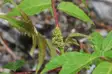
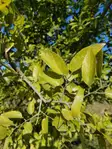
Juniperus occidentalis var. occidentalis (accepted: Juniperus occidentalis) · Cupressaceae · all Juniperus records · also called Juniper, western/Sierra · Wikipedia
The Place chip compares this record with your lot.
Enter your ZIP to see whether this is legal to plant in your state, and whether it survives your winter.
Western juniper has a fire-hazard rating, but it does not settle whether the tree is fire resistant.
For the Lake Tahoe Basin in Nevada and California, the Nevada Division of Forestry and University of Nevada Cooperative Extension rates western juniper “high”. Its Fire Hazard scale uses low, moderate, high, and unknown; a high rating maps to advice to avoid the plant.
The source also places a firm boundary around that conclusion. The guide says the ratings draw on a variety of sources, are not based on scientific trials, and offer only rough estimates of potential flammability. The high label is therefore practical landscaping guidance, not a controlled measurement of how readily western juniper ignites or burns.
Western juniper, Juniperus occidentalis var. occidentalis, is a low-water tree in the cypress family. At maturity, this low-water tree is about 33 feet tall; it is hardy to USDA zone 3b. Its high regional hazard rating is reason enough for caution in Lake Tahoe landscaping.
Form
tree
Mature height
~33 ft
Water need
low
Rated in
Lake Tahoe Basin, Nevada and California
On this lot
1. Fire evidence and conditions
Fire evidence
Mixed evidence — location does not change the cited classification.
Nevada Division of Forestry and University of Nevada Cooperative Extension publish Bulletin 06-01 for the Lake Tahoe Basin and vicinity. FireApproved publishes 83 exact rated owners as basin context across Nevada and California. Rough estimates are not statewide or site ratings.
2. Why this plant is relevant here
State distribution
Documented in CA, ID, NV, OR, WA.
Native range
Introduced / established
USDA hardiness
Documented minimum 3b; no upper limit is documented.
3. Legal, ecological, and broader status
Legal-list status
Seed-list status
Reported invasive here
Broader regional context
Federal context
How to read this page
The status above is computed from the cited rows below: independent recommendations can support a fire-resistant result, an avoid row can produce keep-away, and disagreement stays visible as conflict. Placement notes preserve each source’s own scheme rather than translating unlike rules into one scale. This is evidence about a plant, not permission to plant it in every part of the defensible space; Zone 0 remains noncombustible.
Plant hardiness evidence
These values describe the plant source. Your ZIP zone comes from the separate 2023 USDA
Plant Hardiness Zone Map. Whole-zone values stay whole-zone, and a single unresolved value
is not treated as a tolerance range. Different source boundaries stay separate: overlapping
statements are compared independently, while only ranges with no shared zone are called a conflict.
Minimum 3b · no upper limit documented · half zone precision · derived containing band
Exact source measurement: -33°F; mapped only to its containing half-zone.
Source taxon: Juniperus occidentalis var. occidentalis · source identifier match.
Source location: PlantCharacteristics record 15223, Temperature, Minimum (°F).
Where its sources say to plant it
Placement rules below use each source's own distances or named zones, tied to its rating.
They are not interchangeable with the directory's current Zone 0 guidance.
Home Landscaping Guide for Lake Tahoe and Vicinity: Fire Hazard column: high [tahoe-guide-2006] (with its avoid rating)
The evidence
Grouped by what each source concluded. Primary evidence rated the plant itself
(a lab, field program, or original curation); corroboration compiled or
republished another source's rating and resolves to its root lineage.
“high — Juniper, western/Sierra — Juniperus occidentalis var. occidentalis”
Table 1's Fire Hazard column prints “high” for this taxon. The guide calls the rating a rough estimate of potential flammability, not a result of scientific trials. Its footnote says plants that turn brown often become high fire hazards and tells readers to mow grasses and forbs when they begin to turn brown.
Juniperus occidentalis var. occidentalis (Juniper, western/Sierra). FireApproved. https://fireapproved.com/plants/juniperus-occidentalis/. Last verified 2026-08-25.