Enter your ZIP to see whether this is legal to plant in your state, and whether it survives your winter.
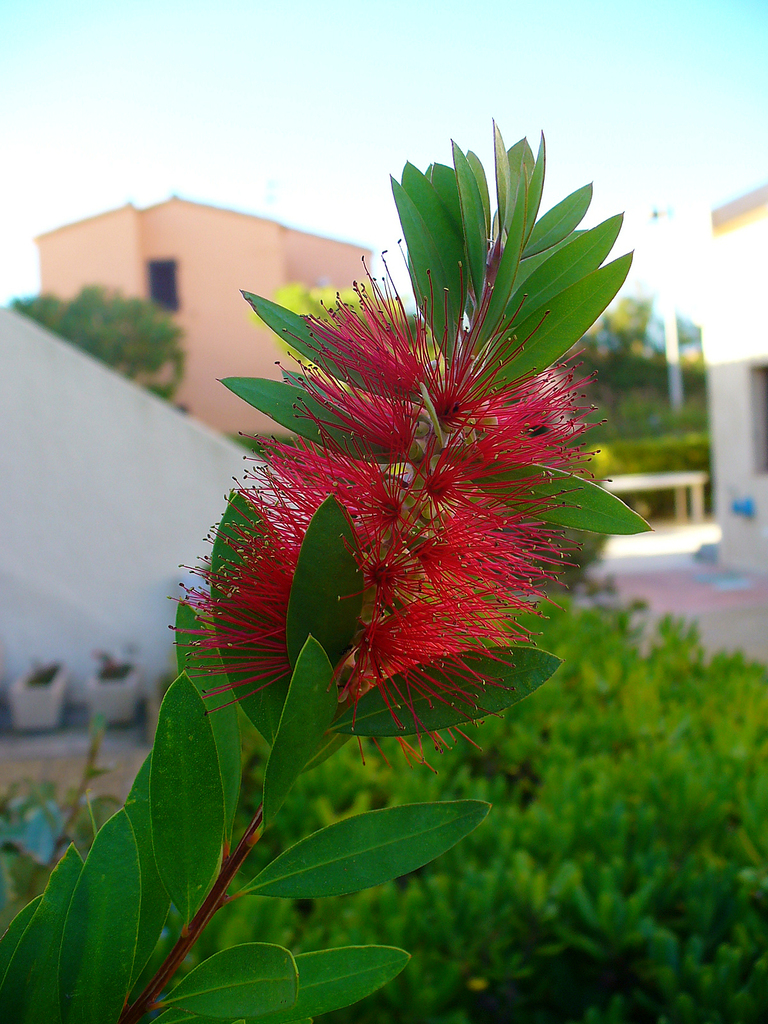
Bottlebrush is a conflict in the cited evidence. 1 ecological invasive report is recorded beside that split but remains separate from the fire tally. The distinction matters because the ecological report and the disagreeing recommendation rows answer different questions about Callistemon citrinus.
These source positions stay available on the evidence table rather than being collapsed into one answer. If the conflict changes the intended planting, related plants presents cited same-form alternatives. Each alternative keeps its supporting rows on its own record, so this bottlebrush's ecological report is not carried into another choice.
Questions
Why does this record show a conflict?
The computed recommendation is conflict. One ecological invasive report sits beside that split; it is not a second fire recommendation. Same-form alternatives are cited on the related list.
Sun City Texas, Georgetown (TX footprint); partial normalized coverage · 2015-01-14
The guide is authored for the Sun City Texas community in Georgetown. FireApproved publishes 142 exact owners only as community-level context. It is an archived HOA exhibit with unknown rating lineage, not a current statewide Texas source or an independent Tier 1 determination.
Travis County, Austin area (TX footprint); partial normalized coverage · 2024-01-16
Texas A&M AgriLife Extension publishes this page through its Travis County horticulture program. FireApproved publishes 56 exact owners and retains the source's zone and warning conditions. This is county/Austin regional context, not a second statewide Texas table or site clearance.
2. Why this plant is relevant here
State distribution
Documented in DC, DE, LA, MD, NJ, OH, PA, PR, WV.
Native range
Introduced / established
USDA hardiness
Only uncertain or inapplicable hardiness rows are cited; no primary zone is projected.
3. Legal, ecological, and broader status
Legal-list status
Seed-list status
Reported invasive here
1 ecological invasive report.
Broader regional context
Federal context
How to read this page
The status above is computed from the cited rows below: independent recommendations can support a fire-resistant result, an avoid row can produce keep-away, and disagreement stays visible as conflict. Placement notes preserve each source’s own scheme rather than translating unlike rules into one scale. This is evidence about a plant, not permission to plant it in every part of the defensible space; Zone 0 remains noncombustible.
Plant hardiness evidence
These values describe the plant source. Your ZIP zone comes from the separate 2023 USDA
Plant Hardiness Zone Map. Whole-zone values stay whole-zone, and a single unresolved value
is not treated as a tolerance range. Different source boundaries stay separate: overlapping
statements are compared independently, while only ranges with no shared zone are called a conflict.
Source prints 7 · single-value meaning unresolved · whole zone precision · source stated
Source taxon: Callistemon citrinus · exact match.
Source location: Cold Hardiness Zone field in the recovered selector record.
Not used for comparison: The recovered selector prints one Cold Hardiness Zone value but does not define it as a minimum threshold or a one-zone range.
Where its sources say to plant it
Placement rules below use each source's own distances or named zones, tied to its rating.
They are not interchangeable with the directory's current Zone 0 guidance.
Eastern United States Fire Performance Plant Selector: Landscape Zone 2 — 5–10 ft from the structure; maintained lawn or fuel breaks, with easily ignited evergreens avoided [Fire Performance Plant Selector landscape zone] (mid-scale rating)
Fire Resisting Garden Plants for the Urban Fringe and Rur…: remove from the Building Protection Zone; avoid in the Fuel Modified Zone [Texas Building Protection Zone] (with its avoid rating)
Guía de pirojardinería: suitable inside or outside the 25-metre maximum-risk zone [girona-2020-iuf-25m-suitability] (with its recommendation)
Firewise Landscaping: Small Shrubs [Travis County Firewise page sections] (with its avoid rating)
Firewise Plant Guide: Shrubs [Sun City plant-table sections] (mid-scale rating)
The evidence
Grouped by what each source concluded. Primary evidence rated the plant itself
(a lab, field program, or original curation); corroboration compiled or
republished another source's rating and resolves to its root lineage.
Callistemon citrinus is rated “RECOMENDADA” by the guide's qualitative IUF garden-suitability method. The method assumes species-specific care and integrates fire evidence with fuel structure, maintenance, origin, invasiveness, and expert fire-service experience.
“Plants to Avoid for Zone 1 (within 30′ of Structure)”
Listed as Bottlebrush — Callistemon citrinus. The page says Zone 1 entries should be restricted to zones 2 or 3; all-zone entries are highly flammable due to volatile oils or growth habit.
The table rates Bottlebrush, Dwarf — Callistemon citrinus medium for flammability hazard, defined as the ease a plant can burn at high temperatures for a prolonged time.
Listed without a rating (14)Corroboration (14 rows from 1 source)
14 cited rows from this source; its identity, lineage and tier are stated once.
Primary study Gill1996: Gill, M., & Moore, P. (1996). Ignitibility of leaves of Australian plants. Centre for Plant Biodiversity Research, CSIRO Plant Industry.
Shared row context: Ignitability measurement; plant part leaves; fuel live; device muffle furnace; site Gill1996-1; sampling march to april.
“time to flaming (s): 22.61”
FLAMITS record 3822; predrying no.
“time to flaming (s): 7.46”
FLAMITS record 3870; predrying yes.
Primary study Krix2022: Krix, D. W., & Murray, B. R. A. (2022). Predictive Model of Leaf Flammability Using Leaf Traits and Radiant Heat Flux for Plants of Fire-Prone Dry Sclerophyll Forest. Forests, 13, 152.
Shared row context: plant part leaves; fuel live; predrying no; device muffle furnace; site Krix2022-1; sampling .
Primary study Murray2023: Murray, B. R., Hawthorne, T., Curran, T. J., Krix, D. W., Wallace, M. I., Young, K., ... & Webb, J. K. (2023). Shoot flammability patterns among plant species of the wildlandurban interface in the fire-prone Greater Blue Mountains World Heritage Area. International Journal of Wildland Fire, Online early.
Shared row context: plant part branches; fuel all; predrying yes; device grill; site Murray2023-1; sampling ND.