Enter your ZIP to see whether this is legal to plant in your state, and whether it survives your winter.
Pomegranate is rated fire resistant overall, although one eastern U.S.
program places it in its “At Risk” band.
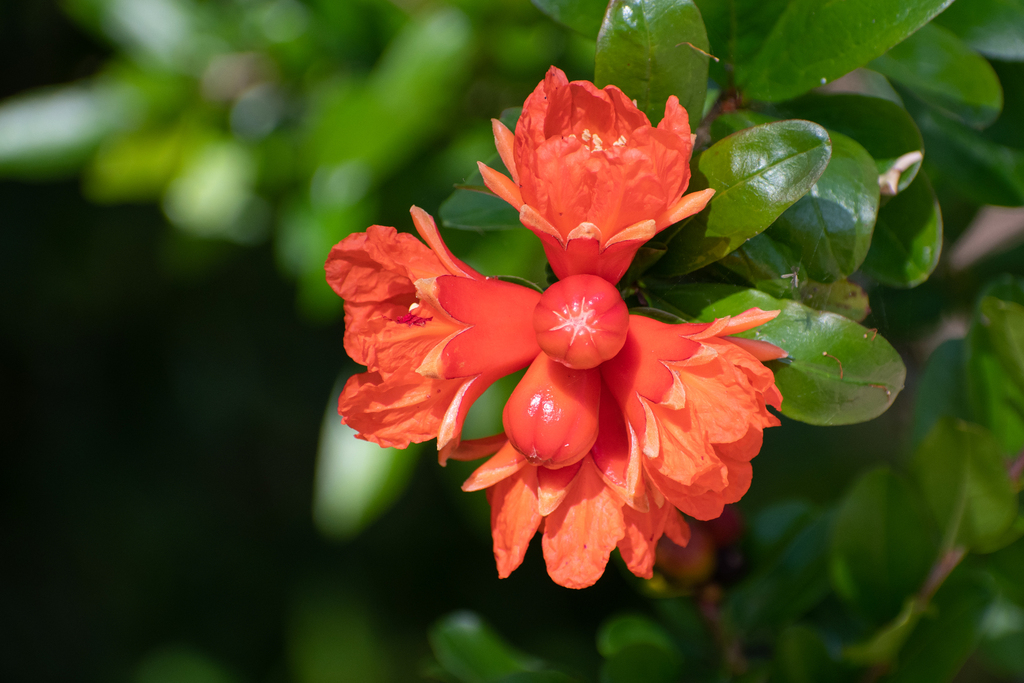
Four of five sources that give a recommendation favor it. Valencia’s regional government includes pomegranate among low-flammability choices for interface gardens. Fire Safe Marin lists it as fire resistant while stressing placement, spacing, irrigation, and removal of dead material. Diputació de Girona and Bombers de la Generalitat de Catalunya recommend pomegranate under a garden-suitability method that assumes species-specific care. Their assessment combines fire literature and fire-service experience with judgments about fuel structure, maintenance, origin, and invasiveness. The Diablo Firesafe Council likewise reports favorable fire performance in at least three references and cites six for pomegranate.
The sources use different rating systems. The eastern plant selector uses a four-step Firewise scale, where 3 means “At Risk.” The other sources use curated recommendations or broader qualitative judgments, so their labels do not measure one identical property.
One laboratory result adds context without settling the choice. Pomegranate leaf litter that had not been dried before testing reached a maximum flame temperature of 545.68°C. That figure describes how hot the tested litter’s flame became, not a threshold separating safe plants from unsafe ones. Pomegranate is therefore a defensible fire-resistant shrub, not a fireproof one, and the favorable rating still depends on suitable care around the home.
Form
shrub
Mature height
~8 ft
Light
Full sun
Water need
moderate
Rated in
California; Catalonia, Spain; Global; Marin County, California +2
On this lot
1. Fire evidence and conditions
Fire evidence
Fire-resistant — location does not change the cited classification.
The guide presents itself as fire performance ratings for common landscape plants in a fire-prone California setting. FireApproved publishes 104 exact owners as republished California context. It is not an independent rating, a current endorsement, or parcel suitability.
Marin County (CA footprint); partial normalized coverage · 2019-01-01
The publication is explicitly limited to plants common to Marin County. FireApproved publishes 104 exact owners as Marin regional context while retaining its placement, spacing, irrigation, and maintenance boundary. It is not statewide California guidance or parcel suitability.
2. Why this plant is relevant here
State distribution
Documented in AL, AZ, CA, DC, DE, FL, LA, MD, NC, NJ, OH, PA, PR, TX, UT, VI, WV.
Native range
Introduced / established
6 sourced range or established records. This is not an invasive warning.
USDA hardiness
Documented minimum 5b; no upper limit is documented.
3. Legal, ecological, and broader status
Legal-list status
Seed-list status
Reported invasive here
Broader regional context
Federal context
How to read this page
The status above is computed from the cited rows below: independent recommendations can support a fire-resistant result, an avoid row can produce keep-away, and disagreement stays visible as conflict. Placement notes preserve each source’s own scheme rather than translating unlike rules into one scale. This is evidence about a plant, not permission to plant it in every part of the defensible space; Zone 0 remains noncombustible.
Native and introduced range evidence
These are exact U.S. botanical-area records from the cited range source. Native and
introduced describe biogeographic relationship, not fire performance or planting approval.
Doubtful and extinct rows stay visible but do not count as current presence.
The lossless worldwide derivative is retained once in the research corpus; object pages repeat only exact U.S. areas needed by the local lens. The JSON twin carries the same page assertions.
Plant hardiness evidence
These values describe the plant source. Your ZIP zone comes from the separate 2023 USDA
Plant Hardiness Zone Map. Whole-zone values stay whole-zone, and a single unresolved value
is not treated as a tolerance range. Different source boundaries stay separate: overlapping
statements are compared independently, while only ranges with no shared zone are called a conflict.
Source prints 6 · single-value meaning unresolved · whole zone precision · source stated
Source taxon: Punica granatum · exact match.
Source location: Cold Hardiness Zone field in the recovered selector record.
Not used for comparison: The recovered selector prints one Cold Hardiness Zone value but does not define it as a minimum threshold or a one-zone range.
Placement rules below use each source's own distances or named zones, tied to its rating.
They are not interchangeable with the directory's current Zone 0 guidance.
Eastern United States Fire Performance Plant Selector: Landscape Zone 2 — 5–10 ft from the structure; maintained lawn or fuel breaks, with easily ignited evergreens avoided [Fire Performance Plant Selector landscape zone] (mid-scale rating)
Guía de pirojardinería: suitable inside or outside the 25-metre maximum-risk zone [girona-2020-iuf-25m-suitability] (with its recommendation)
Fire Performance of Common Plants: Table 1 (favorable in 3 or more references) [diablo-guide-to-plants-three-reference-vote] (with its recommendation)
The evidence
Grouped by what each source concluded. Primary evidence rated the plant itself
(a lab, field program, or original curation); corroboration compiled or
republished another source's rating and resolves to its root lineage.
Punica granatum is rated “RECOMENDADA” by the guide's qualitative IUF garden-suitability method. The method assumes species-specific care and integrates fire evidence with fuel structure, maintenance, origin, invasiveness, and expert fire-service experience.
Fire Safe Marin lists this taxon among fire-resistant plants common to Marin County.
Fire Performance of Common Plants (Guide to Plants) — Diablo Firesafe Council · live page captured 2026-08-29 · original sourceCorroborationMirrorlineage: ucfpl-berkeley resolves to Defensible Space Landscaping in the Urban/Wildland Interface: A Compilation of Fire Performance Ratings of Residential Landscape Plants
“Table 1: favorable fire performance rating in 3 or more references (refs 11,30,40,41,42,53)”
The Diablo Firesafe Council Guide to Plants lists Punica granatum (Pomegranate) as shrub, deciduous, in Table 1: plants with a favorable fire performance rating in 3 or more references. The guide cites 6 of its 57 numbered references for this row (11,30,40,41,42,53). The guide states the ranking terms in its underlying references were mostly undefined and makes no attempt to rank within the list, and that fire performance is compromised without maintenance.
11 cited rows from this source; its identity, lineage and tier are stated once.
Primary study Kauf2015: Kauf, Z., Fangmeier, A., Rosavec, R., & panjol, . (2015). Seasonal and local differences in leaf litter flammability of six Mediterranean tree species. environmental management, 55, 687-701.
Shared row context: plant part litter; fuel all; predrying no; device epiradiator; sampling may, july, september and october.
“maximum flame temperature (°C): 545.68”
FLAMITS record 5599; Combustibility measurement; site Kauf2015-1.
Shared measurement context: Ignitability measurement; site Kauf2015-1.
“temperature at flaming (°C): 418”
FLAMITS record 5605.
“time to flaming (s): 11.49”
FLAMITS record 5618.
“time to flaming (s): 12.69”
FLAMITS record 5619; Ignitability measurement; site Kauf2015-3.
Shared measurement context: Sustainability measurement; site Kauf2015-1.
“flaming duration (s): 24.02”
FLAMITS record 5634.
“burning duration (s): 35.19”
FLAMITS record 5650.
Shared measurement context: Sustainability measurement; site Kauf2015-3.
“flaming duration (s): 23.26”
FLAMITS record 5635.
“burning duration (s): 35.49”
FLAMITS record 5651.
Primary study Pacheco2022: Pacheco, A. S., Goodman, H. D., Hankenson, L., Fisk, J. J., Ortiz, A., Marinace, H. M., ... Tng, D. Y. P. (2022). Fighting fire with food: Assessing the flammability of crop plant species for building fire resilient agroforestry systems. in review, preprint.
Shared row context: plant part branches; fuel all; predrying yes; device grill; site Pacheco2022-1; sampling october to november 2022.