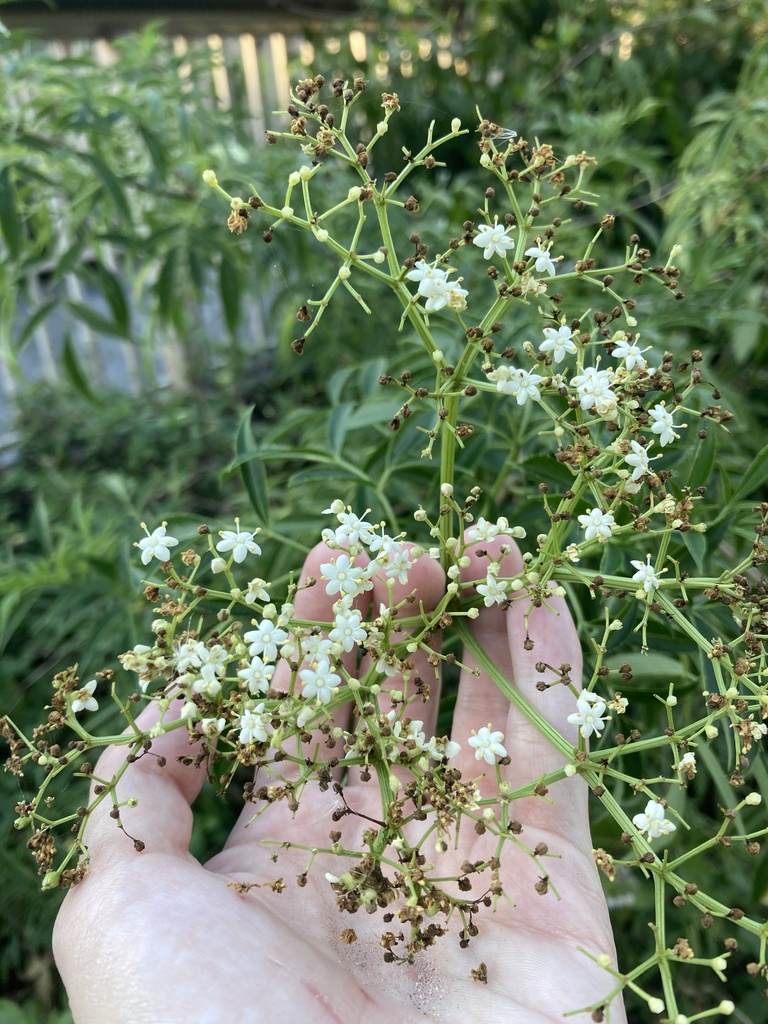
American black elderberry
Sambucus canadensis
A genus split is not a placement verdict.
Is this one for your yard?
Enter your ZIP to see whether this is legal to plant in your state, and whether it survives your winter.
American black elderberry is fire resistant, with six extension and forestry assessments pointing to low flammability or resistance.
NC State rated the shrub low in 2005 on a four-level scale and again in 2025 among plants classified as low rather than medium or high. Ohio State University Extension gave it an L, one of the two recommended bands on its five-point scale, and noted that it tolerates wet and dry soils and shade. Virginia Cooperative Extension also gave it an L, the lowest rating on its three-point scale, while noting tolerance of wet and dry soils.
Other sources reach the same practical conclusion without using those scales. Oregon State University Extension Service profiled American black elderberry among fire-resistant plants that thrive in Willamette Valley growing conditions and printed a USDA hardiness range of zones 3 through 9. Forestry agencies in Maryland, New Jersey, and West Virginia called it relatively resistant to fire and included it among species showing stronger resistance to wildfire ignition, with tolerance of wet and dry soils.
American black elderberry is a shrub that reaches about 8 feet at maturity and is listed for full sun and moderate water. The repeated favorable findings across several regional sources make it a well-supported fire-resistant landscape choice.
- Form
- shrub
- Mature height
- ~8 ft
- Light
- Full sun
- Water need
- moderate
- Rated in
- Alabama; Maine; Maryland, New Jersey, and West Virginia; NC +5