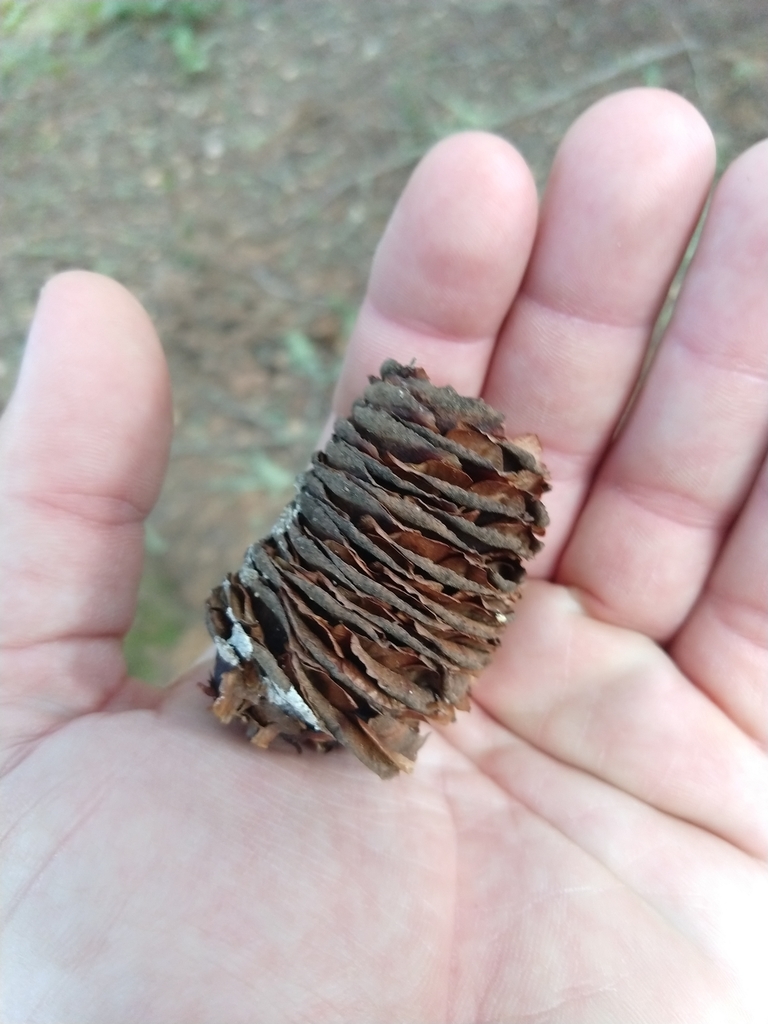
Enter your ZIP to see whether this is legal to plant in your state, and whether it survives your winter.
Fir is not fire resistant; fire-safety authorities consistently identify Abies as flammable and advise against planting it near structures.
Fire Safe Marin lists fir among common fire-prone plants in Marin County. Utah’s forestry agency and extension service identify it as a common tree pyrophyte and advise against planting it in a firewise landscape, especially in Zone 2. The University of Arizona Cooperative Extension says fire-prone plants may ignite readily and burn intensely. Alaska’s forestry program gives a reason for concern by naming fir as a resinous example among plants that ignite and burn readily.
The City of Ashland’s 2025 code edition goes beyond advice. It calls fir a prohibited flammable plant and restricts new planting or propagation within 30 feet of any structure, including a structure on an adjacent lot. A University of California Forest Products Laboratory compilation likewise found that four earlier references did not recommend fir for high-fire-risk areas. Its authors cautioned that many underlying lists lacked a scientific basis or used undefined terms, so the compilation does not provide a precise experimental measure of flammability.
Across six sources, the practical judgment is consistent despite differences in authority and method. Fir is a tree in the pine family, but for landscaping decisions near a building, it should be treated as highly flammable and kept away from structures.
Alaska Division of Forestry opens with the wildfire threat to Alaskans and publishes Alaska firewise-landscape examples. FireApproved publishes 58 exact source owners from its 60 taxon entries and holds the taxon-free fern label. State publication scope does not establish suitability for every Alaska climate, site, or home-ignition-zone placement.
City of Ashland (OR footprint); partial normalized coverage · 2026-08-26
This is a City of Ashland adoption fact, not statewide Oregon guidance or an experimental flammability result. FireApproved publishes 24 taxonomy-safe owners as city-level regulatory context. It applies to new planting and propagation within 30 feet of structures, including structures on adjacent lots; it is not projected as a blanket removal order for every established listed plant.
Marin County (CA footprint); partial normalized coverage · 2019-01-01
The publication is explicitly limited to plants common to Marin County. FireApproved publishes 104 exact owners as Marin regional context while retaining its placement, spacing, irrigation, and maintenance boundary. It is not statewide California guidance or parcel suitability.
The UC Forest Products Laboratory says the guide covers properties of common California landscaping plants and was prepared for California fire agencies. FireApproved publishes 130 exact owners at historical California publication scope. The report is a 1997 compilation, not a current endorsement, site rating, or independent test of every row.
Western South Dakota, Black Hills (SD footprint); partial normalized coverage · 2026-04-08
The current SDSU Extension page explicitly addresses western South Dakota, particularly the Black Hills. FireApproved publishes its four exact genus owners. This is current bounded regional context, not statewide South Dakota coverage or a finding that every member of a genus behaves alike.
Yavapai County (AZ footprint); partial normalized coverage · 2025-03-14
University of Arizona Cooperative Extension authors Bulletin 34 for Yavapai County. FireApproved publishes 198 exact source owners from its resistant and prone tables and keeps the county boundary visible. County publication scope is regional Arizona context, never statewide scope.
2. Why this plant is relevant here
State distribution
Documented in AZ.
Native range
Introduced / established
USDA hardiness
3. Legal, ecological, and broader status
Legal-list status
Seed-list status
Reported invasive here
Broader regional context
Federal context
How to read this page
The status above is computed from the cited rows below: independent recommendations can support a fire-resistant result, an avoid row can produce keep-away, and disagreement stays visible as conflict. Placement notes preserve each source’s own scheme rather than translating unlike rules into one scale. This is evidence about a plant, not permission to plant it in every part of the defensible space; Zone 0 remains noncombustible.
Where its sources say to plant it
Placement rules below use each source's own distances or named zones, tied to its rating.
They are not interchangeable with the directory's current Zone 0 guidance.
Prohibited Flammable Plants: new planting or propagation restricted within 30 ft of any structure [Ashland Municipal Code setback] (with its avoid rating)
Firewise Landscaping for Utah: PLANTS TO AVOID (PDF page 15) [ffsl-2007-section] (with its avoid rating)
Defensible Space Landscaping in the Urban/Wildland Interf…: Chapter 4, Landscape Vegetation Database [ucfpl-1997] (with its avoid rating)
Protect Your Home from Wildfire: Characteristics of plants that ignite and burn readily [Alaska DNR brochure sections] (with its avoid rating)
Protecting Your Home and Landscape Against Wildfires: Intermediate Zone [Home Ignition Zone] (with its avoid rating)
The evidence
Grouped by what each source concluded. Primary evidence rated the plant itself
(a lab, field program, or original curation); corroboration compiled or
republished another source's rating and resolves to its root lineage.
Listed as Fir — Abies sp.. The bulletin says fire-resistant plants tend to resist ignition when irrigated and maintained, while fire-prone plants may ignite readily and burn intensely.
20 cited rows from this source; its identity, lineage and tier are stated once.
Primary study Renner2023: Renner, J. S., Mensah, R. A., Jiang, L., & Xu, Q. (2023). A critical assessment of the fire properties of different wood species and bark from small-and bench-scale fire experiments. Journal of Thermal Analysis and Calorimetry, 148, 1423-1434.
Shared row context: Combustibility measurement; plant part wood; fuel live; predrying yes; device calorimeter; site Renner2023-1; sampling ND.
“maximum flame temperature (°C): 395.43”
FLAMITS record 19537.
“maximum flame temperature (°C): 391.54”
FLAMITS record 19538.
“maximum flame temperature (°C): 370.64”
FLAMITS record 19546.
“maximum flame temperature (°C): 370.23”
FLAMITS record 19547.
“calorific value (kcal/kg): 2863.29188”
FLAMITS record 19555.
“calorific value (kcal/kg): 2165.39436”
FLAMITS record 19556.
“calorific value (kcal/kg): 3169.21956”
FLAMITS record 19564.
“calorific value (kcal/kg): 3097.51776”
FLAMITS record 19565.
Primary study Batiot2014: Batiot, B., Luche, J., & Rogaume, T. (2014). Thermal and chemical analysis of flammability and combustibility of fir wood in cone calorimeter coupled to FTIR apparatus. Fire and materials, 38, 418-431.
Shared row context: Ignitability measurement; plant part wood; fuel dead; predrying yes; device calorimeter; site Batiot2014-1; sampling ND.