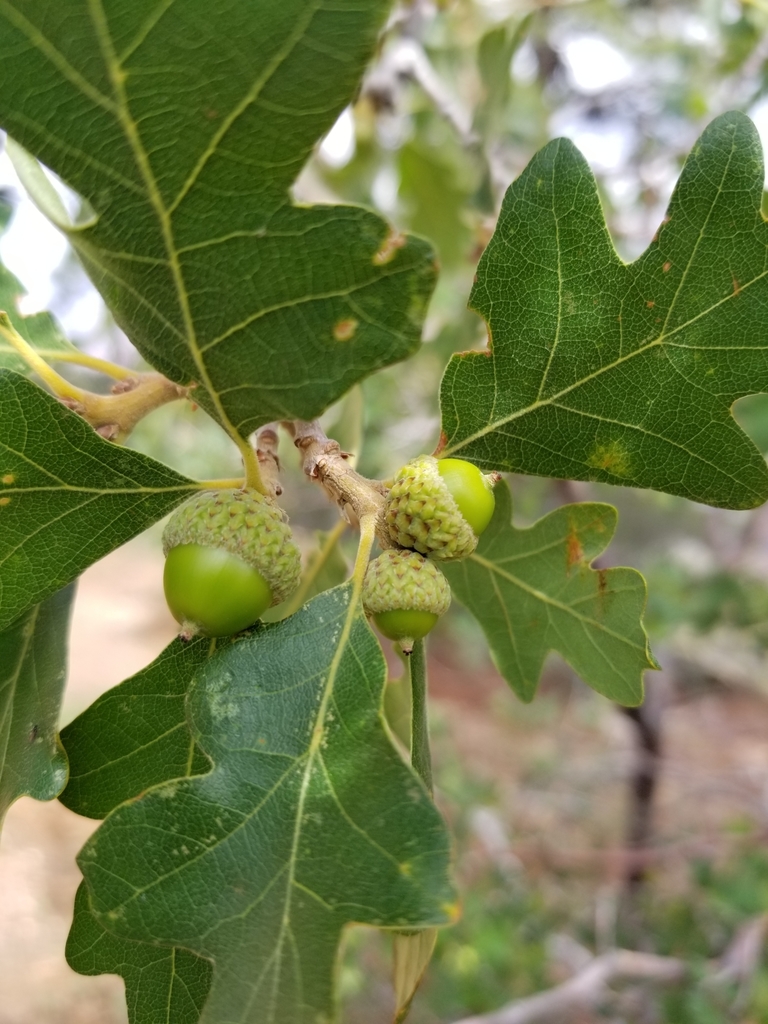
One FEIS context is available under fire ecology. The evidence table retains the cited laboratory row, keeping that experiment separate from the FEIS material. This organization leaves the green condition, limited pack, and ecology context attached to gambelii; neither evidence route substitutes for the other within the named oak record. The species card is the boundary for that combined reading of the selected facts.
Form
tree
Mature height
~40 ft
Water need
low
Rated in
Colorado, California, and northeastern United States; Global; southern Idaho / Intermountain
On this lot
1. Fire evidence and conditions
Fire evidence
Fire-resistant — location does not change the cited classification.
Fire-performance conditions
1 condition stated in cited fire-evidence rows.
Fire ecology context
3 cited FEIS topics across 3 dimensions; context only, never a rating vote.
Southern Idaho (ID footprint); partial normalized coverage · 2013-11-08
The official database labels itself "For Southern Idaho" and describes Idaho residents at the urban-rangeland interface. FireApproved publishes 419 existing plant owners that cite its scored rows. This bounded Southern Idaho scope is regional context, not statewide coverage or a conclusion that the score transfers unchanged to every Idaho site.
2. Why this plant is relevant here
State distribution
Documented in AZ, CO, ID, NM, NV, OK, SD, TX, UT, WY.
Native range
Current cited native range in AZ, CO, NM, NV, OK, TX, UT, WY.
Introduced / established
USDA hardiness
Documented minimum 2b; no upper limit is documented.
3. Legal, ecological, and broader status
Legal-list status
Seed-list status
Reported invasive here
Broader regional context
Federal context
How to read this page
The status above is computed from the cited rows below: independent recommendations can support a fire-resistant result, an avoid row can produce keep-away, and disagreement stays visible as conflict. Placement notes preserve each source’s own scheme rather than translating unlike rules into one scale. This is evidence about a plant, not permission to plant it in every part of the defensible space; Zone 0 remains noncombustible.
Native and introduced range evidence
These are exact U.S. botanical-area records from the cited range source. Native and
introduced describe biogeographic relationship, not fire performance or planting approval.
Doubtful and extinct rows stay visible but do not count as current presence.
The lossless worldwide derivative is retained once in the research corpus; object pages repeat only exact U.S. areas needed by the local lens. The JSON twin carries the same page assertions.
Plant hardiness evidence
These values describe the plant source. Your ZIP zone comes from the separate 2023 USDA
Plant Hardiness Zone Map. Whole-zone values stay whole-zone, and a single unresolved value
is not treated as a tolerance range. Different source boundaries stay separate: overlapping
statements are compared independently, while only ranges with no shared zone are called a conflict.
The Forest Service's Fire Effects Information System synthesizes how this exact taxon responds
to wildland fire and occurs in fire-shaped ecosystems. This literature context does not rate a
maintained landscape plant, does not change the computed classification above, and is not a
substitute for building-adjacent placement guidance.
USDA Forest Service FEIS · review QUEGAM
Quercus gambelii, Gambel oak
Immediate fire effect. Fire may top-kill Gambel oak; tree forms are less susceptible in low-severity fire than shrubs whose branches sit near surface fuels. (Immediate Fire Effects)
Postfire response. Fire commonly stimulates vigorous sprouting from protected rhizomes and lignotubers, often beginning in the first growing season. (Plant Response to Fire)
Fuels and condition. Dense understories can function as ladder fuels beneath ponderosa pine, while conifer encroachment adds resinous foliage and persistent litter. (Fire Ecology and Fire Adaptations)
Source taxon: Quercus gambelii · exact scientific name ·
review written 2000-02 · page updated 2025-05-30 ·
source record
Where its sources say to plant it
Placement rules below use each source's own distances or named zones, tied to its rating.
They are not interchangeable with the directory's current Zone 0 guidance.
Fire Resistance of Plants Master Database: plantable at 50' from home [Idaho minimum planting distance] (mid-scale rating)
The evidence
Grouped by what each source concluded. Primary evidence rated the plant itself
(a lab, field program, or original curation); corroboration compiled or
republished another source's rating and resolves to its root lineage.
66 cited rows from this source; its identity, lineage and tier are stated once.
Primary study Fletcher2007: Fletcher, T. H., Pickett, B. M., Smith, S. G., Spittle, G. S., Woodhouse, M. M., Haake, E., & Weise, D. R. (2007). Effects of moisture on ignition behavior of moist California chaparral and Utah leaves. Combustion Science and Technology, 179, 1183-1203.
Shared row context: Ignitability measurement; plant part leaves; fuel live; predrying no; device flat flame burner; site Fletcher2007-1; sampling ND.
“temperature at flaming (°C): 225.34”
FLAMITS record 3345.
“time to flaming (s): 39”
FLAMITS record 3351.
Primary study McAllister2017: McAllister, S., & Weise, D. (2017). Effects of season on ignition of live wildland fuels using the forced ignition and flame spread test apparatus. Combustion Science and Technology, 189, 231-247.
Shared row context: Ignitability measurement; plant part leaves; fuel live; predrying no; device scale wind tunnel; site McAllister2017-1.
“time to flaming (s): 9.04”
FLAMITS record 9119; sampling may.
“time to flaming (s): 8.25”
FLAMITS record 9120; sampling june.
“time to flaming (s): 10.16”
FLAMITS record 9121; sampling july.
“time to flaming (s): 9.99”
FLAMITS record 9122; sampling august.
“time to flaming (s): 10.21”
FLAMITS record 9123; sampling september.
“time to flaming (s): 10.52”
FLAMITS record 9124; sampling october.
“time to flaming (s): 9.71”
FLAMITS record 9125; sampling november.
Primary study Pickett2009: Pickett, B. M., Isackson, C., Wunder, R., Fletcher, T. H., Butler, B. W., & Weise, D. R. (2009). Flame interactions and burning characteristics of two live leaf samples1. International Journal of Wildland Fire, 18, 865-874.
Shared row context: plant part leaves; fuel live; predrying no; device flat flame burner; site Pickett2009-1.
Primary study White2002: White, R. H., Weise, D. R., Mackes, K., & Dibble, A. C. (2002). Cone calorimeter testing of vegetation--an update. Ninth International Conference on Electrical and Electronic Products. Columbus, Ohio, USA.
Shared row context: Combustibility measurement; plant part leaves; fuel live; device calorimeter; site White2002-2; sampling ND.
“maximum energy flux (kW/m²): 41”
FLAMITS record 14144; predrying no.
Shared measurement context: predrying yes.
“calorific value (kcal/kg): 3391.61”
FLAMITS record 14197.
“calorific value (kcal/kg): 3296.07”
FLAMITS record 14289.
Primary study Smith2005: Smith, S. G. (2005). Effects of Moisture on Combustion Characteristics of Live California Chaparral and Utah Foliage. Master dissertations. Brigham Young University - Provo.
Shared row context: Ignitability measurement; plant part leaves; fuel live; predrying no; device flat flame burner; site Smith2005-1; sampling ND.
“temperature at flaming (°C): 277”
FLAMITS record 16701.
“time to flaming (s): 0.53”
FLAMITS record 16702.
Primary study Pickett2010: Pickett, B. M., Isackson, C., Wunder, R., Fletcher, T. H., Butler, B. W., & Weise, D. R. (2010). Experimental measurements during combustion of moist individual foliage samples. International Journal of Wildland Fire, 19, 153-162 .
Shared row context: Combustibility measurement; plant part twigs; fuel live; predrying no; device flat flame burner; site Pickett2010-2; sampling ND.