Home / Guides / How to read a record / What the NC Toolbox rates that surprises people
What the NC Toolbox rates that surprises people
The surprise is on Table 5. AG-874 (Kays, Fawcett, Query, Thompson-Welch, Bardon; revised 26 March 2025): there are no fireproof plants. Defensible space at least 100 feet. At least 5 feet of noncombustible mulch (river rock or pea gravel). Do not plant vines or ornamental grasses in the defensible space. Switchgrass is extremely flammable. Table 5 rates American holly, longleaf pine, mountain laurel, and eastern redcedar high. The NC Plant Toolbox is corroboration, not a second independent vote. This directory currently stores 202 plant records citing AG-874. Ilex opaca, Pinus palustris, and Kalmia latifolia currently compute as avoid and include NC.
You are in the Piedmont putting mountain laurel and switchgrass against the foundation because both are native and the Toolbox has a pretty photo. AG-874’s nearest-house rule is the lowest flammability table. Table 5 is the other list.
This is not a North Carolina doorway. Live AG-874 HTML is a JavaScript viewer; this page quotes the opened 2025 PDF.
Why it matters
“NC natives are firewise” is easy to hear as Table 3 only. AG-874 prints three tables. Southeast humidity is FEIS longleaf as a forest tree. This page is AG-874 Table 5. The Toolbox does not document who assigned its tags, so this site does not let it cast a sole Tier-1 vote. How to read a plant page is the lineage rule. Zone 0 is still not a planting list.
This site’s North Carolina plant evidence currently holds 688 USDA-distribution records. That is occurrence, not AG-874.
How it works
What AG-874 actually says:
- All vegetation can burn. No fireproof plants. Choice, spacing, and maintenance.
- Defensible space: at least 100 feet from the home and attached fences or decks. Steeper than 20 percent: as far as 200 feet. Ask NC Forest Service or Extension.
- At least 30 feet clear of dead vegetation and flammable debris. At least 5 feet noncombustible mulch.
- 5–30 feet: minimum 18 feet between treetops.
- Do not plant vines or ornamental grasses in the defensible space, particularly near the home. Switchgrass (Panicum virgatum) is extremely flammable. Thatch becomes ladder fuel.
- For areas nearest the house, select the lowest flammability rating. If you still want a moderate or high plant, put it as far from the home as possible and surround it with fuel breaks.
- Many NC natives are well suited. Not all are suitable in coastal plain, piedmont, and mountains. Use the region columns.
Table 5 (high), opened:
- Tall trees: Atlantic white cedar, American holly, eastern redcedar, shortleaf, longleaf, eastern white pine, loblolly, live oak, eastern hemlock.
- Small shrubs: inkberry, Carolina laurel, mountain laurel, doghobble, Catawba rhododendron.
- Grasses: bushy bluestem, wiregrass, switchcane, switchgrass.
- Vines: Virginia creeper, grape, trumpet vine, coral honeysuckle, and others.
Wildlife-value columns sit on the same high table. Winter cover is not a five-foot permit.
The Toolbox:
- Per-plant low / medium / high / extreme tags.
- This site: corroboration only, never sole Tier 1. Three plants carry both high and extreme tags; both values are stored.
- 217 records currently cite
nc-plant-toolbox. - Bardon 2005 is the root for unchanged classes. AG-874 dropped the extreme class; former extremes reappear as high.
This directory:
- North Carolina: 688 records. 369 on-list, 91 avoid, 18 conflict, 210 candidate.
- 202 records cite
ncsu-ag874. - Ilex opaca avoid, NC, AG-874 high.
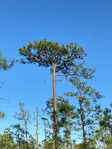
- Pinus palustris avoid, NC, AG-874 high.
- Kalmia latifolia avoid, NC, AG-874 high.
- Panicum virgatum avoid, NC.
- Juniperus virginiana avoid, NC.
- Quercus alba on-list, NC. On-list is not Zone 0.
- Rhododendron maximum conflict, NC. Table 5 names R. catawbiense, not R. maximum. Do not merge the taxa.
See source-verbatim names for why the letters stay as printed.
The paths
| Claim | Opened source | What it is not |
|---|---|---|
| 100-foot defensible space | AG-874 | A 30-foot-only state |
| 5-foot noncombustible | River rock or pea gravel | Pine-straw mulch |
| No vines or ornamental grasses near the house | Switchgrass named | A prairie-planting exemption |
| Table 5 high natives | Holly, longleaf, mountain laurel, redcedar | Proof natives are low |
| Toolbox tags | Corroboration | A third independent vote |
| 202 AG-874 rows | This directory | The Toolbox facet count |
| Longleaf avoid | Computed + Table 5 | Forest fire-adapted as on-list |
| 687 North Carolina records | USDA distribution | AG-874 |
What people mix up
- Native with low flammability.
- Toolbox photo with a Tier-1 vote.
- Bardon 2005, AG-874, and Toolbox as three lineages. They are one family.
- Longleaf’s forest fire ecology with Table 5 high.
- Mountain laurel’s wildlife column with a foundation planting.
- Rhododendron catawbiense (Table 5) with R. maximum (conflict on this site).
- New Jersey’s mountain-laurel ban with AG-874’s high table. Same instinct, different documents.
- Montana MontGuide with AG-874. Both are state lists. Neither is Zone 0.
How to check
- Open AG-874. Use the PDF. Read “no fireproof plants.” Read the switchgrass sentence. Open Table 5.
- Open the Toolbox. Read a flammability tag. Read this site’s plant-source note: corroboration only.
- Open Kalmia latifolia, Pinus palustris, Panicum virgatum.
- Open North Carolina plant evidence. Distribution is not Table 3.
- Do not plant in Zone 0.
Limits
This page quotes the opened AG-874 2025 PDF. The live CES HTML is a JavaScript PDF viewer and is not the quoted text. The PDF twin used here is the 2025 ingest copy of that publication. Toolbox facet counts from 2026-08-23 are stored on the plant-source file; this page does not re-scrape all 240 rated plants tonight. 202 and 217 are counts of stored YAML rows citing those sources, not NCSU’s table lengths. 687 is a USDA-distribution count. Table 5 names Rhododendron catawbiense; this site’s R. maximum conflict is a different taxon. Zone 0 is not a planting list.
Related records
- Ilex opaca
- Pinus palustris
- Kalmia latifolia
- Panicum virgatum
- North Carolina plant evidence
- Southeast humidity and firewise planting
- Glossary: Zone 0
Plant records this page rests on
Questions
What does the NC Toolbox rate that surprises people?
Natives that wildlife chapters love and AG-874 Table 5 rates high. NC State Extension AG-874 (Kays, Fawcett, Query, Thompson-Welch, Bardon; revised 26 March 2025): there are no fireproof plants. For areas nearest the house, select plants with the lowest flammability rating. Do not plant vines or ornamental grasses in the defensible space; switchgrass (Panicum virgatum) is extremely flammable. Table 5 high-flammability natives include American holly, longleaf pine, eastern redcedar, mountain laurel, Catawba rhododendron, and switchgrass. The NC Extension Gardener Plant Toolbox carries flammability tags, but this site’s plant-source file treats those tags as corroboration only, never sole Tier-1 support. This directory currently stores 202 plant records citing AG-874.
Is the Toolbox a second independent vote?
No. The Toolbox does not document who assigned its flammability values. Rows already rated by Bardon 2005 resolve to that lineage. AG-874 is the 2025 successor to Bardon 2005 on the same nc-tree lineage. Do not count Toolbox, AG-874, and Bardon as three votes.
Does native-to-North-Carolina mean low flammability?
No. AG-874 says many of North Carolina’s native plants are well suited for fire-resistant landscaping, then prints three tables. Table 5 is high. Not all natives are suitable in the coastal plain, piedmont, and mountains. Choose the region column.
Is this a North Carolina doorway page?
No. The object is AG-874’s high table versus the Toolbox’s corroboration role. Place claims sit on whereThisDiffers. The North Carolina plant evidence list is USDA distribution, not this article.