Home / Guides / How to read a record / The Pine Barrens are a fire forest next to the house
The Pine Barrens are a fire forest next to the house
The Barrens are the fuel. The house is in them. New Jersey Pinelands Commission: the Pinelands is naturally fire prone. We live in one of the most fire prone regions of the United States. In 1963, close to 183,000 acres burned in one fire, 186 homes, 197 buildings, seven dead. N.J.A.C. 7:50-6.123 and 6.124 set the fuel break at 30, 75, or 100 feet by vegetation class. Do not use rhododendron, mountain laurel, or other highly flammable evergreens as foundation plantings. Pinus rigida and Kalmia latifolia currently compute as avoid and include NJ.
You are in a mature pine-oak lot off a Pinelands road putting mountain laurel against the siding because it is native. The Commission’s table for that vegetation class is 75 feet, not a foundation bed.
The statewide list and the Pinelands rule now meet on this page, but they do not collapse into one answer. The list helps shortlist plants; the Commission’s placement rules still govern the landscape pattern around a Pinelands home.
Why it matters
“Fire forest” is easy to hear as “the plants belong here, including against the house.” The opened Commission sheet is 1963’s acres and deaths, then a CMP fuel-break table, then named foundation plants not to use. What Plymouth-area yards should know is Massachusetts pitch pine with a species page. This page is New Jersey’s 30/75/100 plus laurel and rhododendron. Zone 0 is still not a planting list.
This site’s New Jersey plant evidence currently composes 855 occurrence records with 169 owners from the official New Jersey Firewise edition. Occurrence is not a recommendation, and presence on the Firewise list is not permission to put a plant against a Pinelands foundation.
How it works
The fire forest (Pinelands Commission):
- Naturally fire prone. Fire shaped the landscape.
- One of the most fire prone regions of the United States.
- Growing WUI: communities that were once wooded.
- 1963: ~183,000 acres, 186 homes, 197 buildings, seven dead.
The CMP distances (N.J.A.C. 7:50-6.123 and 6.124, as printed):
| Class | Fuel break | Vegetation as printed |
|---|---|---|
| Moderate | 30 feet | Non-Pine Barrens forest and prescribed burned areas |
| High | 75 feet | Mature pine, pine-oak, and oak-pine |
| Extreme high | 100 feet | Immature or dwarf pine-oak or oak-pine; pine-scrub oak; pine-lowland |
Minimum not less than 30 feet around all structures proposed for human use. Thin yearly.
The foundation sentence:
- Fire-resistive, low growing, low sap or resin, do not accumulate dead leaves, branches, or needles.
- Do not use rhododendron, mountain laurel, or other highly flammable evergreens as foundation plantings.
- Ornamentals and shade trees 15 feet apart. Prune to 15 feet.
- Class-A roof. Do not use cedar shake shingles. Stucco or masonry instead of vinyl that can melt.
- Clean pine needles off roof and gutters. Firewood 30 feet from the house.
The Alliance reprint:
- Gardening with Nature Fire Safety section reprints the same 30/75/100 and the same mountain laurel / rhododendron foundation warning, and points at the Commission PDF.
- Earlier in that booklet, mountain laurel is named for wildlife shelter. That is not the fire-safety paragraph.
The statewide plant-list layer:
- New Jersey DEP’s official edition says its listed plants can be grown in New Jersey and are relatively resistant to fire.
- The 180 printed taxon occurrences reconcile to 169 conservative plant owners. One botanical-form row is held rather than broadened beyond what the source names.
- Maryland, New Jersey, and West Virginia publish the same table lineage, down to a Maryland-specific Rudbeckia hirta comment. FireApproved therefore projects one normalized evidence set into three exact-state scopes; it does not count three corroborating votes.
- The list is a shortlist layer. It does not cancel the Pinelands Commission’s 30/75/100-foot spacing context or its named foundation warning.
This directory:
- New Jersey: 855 occurrence records. 465 on-list, 139 avoid, 44 conflict, 207 candidate; 169 owners have exact-state Firewise list context.
- Pinus rigida avoid, consensus, NJ.
- Kalmia latifolia avoid, consensus, NJ.
- Rhododendron maximum conflict, NJ. The Commission still names rhododendron as a foundation plant not to use.
- Ilex opaca avoid, NJ.
- Chamaecyparis thyoides avoid, NJ. Atlantic white cedar is a Barrens canopy tree in the Alliance guide, not a five-foot planting.
- Quercus alba on-list, NJ. On-list is not Zone 0.
The paths
| Claim | Opened source | What it is not |
|---|---|---|
| Most fire-prone region | Pinelands Commission | A census rank for “densest state” |
| 183,000 acres / 7 dead | 1963, same sheet | Proof the suburbs are safe now |
| 30 / 75 / 100 feet | N.J.A.C. 7:50-6.123 and 6.124 as printed | IBHS 0–5, and not Zone 0 |
| No mountain laurel at the foundation | Commission + Alliance fire section | A wildlife-shelter permit against the siding |
| Pitch pine avoid | Computed evidence | Forest fire-adapted as on-list |
| Rhododendron maximum conflict | Computed | A Commission exemption |
| 855 New Jersey occurrence records | USDA distribution | A recommendation or foundation palette |
| 169 New Jersey Firewise-list owners | One official state-edition lineage | Three independent state votes or site-specific approval |
What people mix up
- A fire-adapted forest with a foundation planting.
- Native mountain laurel with on-list.
- The Alliance wildlife paragraph with the Alliance fire-safety paragraph.
- Massachusetts Plymouth pitch pine with New Jersey’s CMP distance table.
- 30-foot minimum with 75-foot high-hazard pine-oak.
- Conflict on R. maximum with a yes. The Commission’s sentence is still do not use.
- Cedar-shake roofs with Class A. The sheet says do not.
- Connecticut’s low-count with Pinelands 183,000 acres.
How to check
- Open Protecting Your Home from Wildfire. Read 1963. Read 30/75/100. Read mountain laurel.
- Open N.J.A.C. 7:50-6.123 and 6.124 for the vegetation classes the sheet cites.
- Open Pinus rigida and Kalmia latifolia.
- Open New Jersey’s official Firewise plant edition, then compare its shortlist with the Commission’s placement rule.
- Open New Jersey plant evidence. Distribution, exact-state list evidence, and a foundation placement are three different layers.
- Do not plant in Zone 0.
Limits
This page quotes the opened Pinelands Commission PDF, the opened Pinelands Preservation Alliance gardening PDF, and New Jersey DEP’s official Firewise plant-list edition. The live list URL intermittently blocked automated retrieval; the reviewed exact-path archive capture is 246,492 bytes, SHA-256 a3c129e3bc973a164e1062677393433d730cc92edc6c4bb03dfefc1a47604657. The 855 occurrence count and derived status counts describe stored directory data as of this writing, not Commission statistics. The three state editions are one shared lineage, not independent corroboration. Zone 0 is not a planting list.
Related records
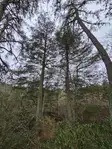
- Pinus rigida
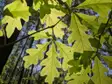
- Kalmia latifolia
- New Jersey plant evidence
- What Plymouth-area yards should know
- Glossary: Zone 0
Plant records this page rests on
Questions
Are the Pine Barrens a fire forest next to the house?
Yes, and the opened Pinelands Commission fact sheet treats that as the starting condition. The Pinelands is naturally fire prone, and fire has shaped the landscape over the past centuries. We live in one of the most fire prone regions of the United States. In 1963, close to 183,000 acres burned in one fire, consuming 186 homes and 197 buildings. Seven people lost their lives. N.J.A.C. 7:50-6.123 and 6.124 classify the fuel break: 30 feet in moderate (non-Pine Barrens forest and prescribed burned areas), 75 feet in high (mature pine, pine-oak, and oak-pine), 100 feet in extreme (immature or dwarf pine-oak or oak-pine, pine-scrub oak, and pine-lowland). Do not use rhododendron, mountain laurel, or other highly flammable evergreens as foundation plantings.
Does a fire-adapted pitch pine belong against the wall?
No. Pinus rigida currently computes as avoid and includes NJ. Forest fire-adapted is not on-list at the foundation. See what Plymouth-area yards should know for the Massachusetts pitch-pine record. This page is the Pinelands Commission’s 30/75/100-foot table plus named foundation plants.
What about mountain laurel, which is native in the Barrens?
Kalmia latifolia currently computes as avoid and includes NJ. The Commission: do not use it as a foundation planting. Pinelands Preservation Alliance’s gardening guide repeats that fire-safety line and, elsewhere in the same booklet, names mountain laurel as wildlife shelter. Those are not the same sentence. Native is not on-list at the wall.
Is this a New Jersey doorway page?
No. The object is the decision boundary between a statewide 169-owner Firewise plant list and the Pinelands Commission's local 30/75/100-foot fuel-break and foundation-plant rules. New Jersey's 855 occurrence records answer a third question: whether a taxon occurs in the state.