Home / Guides / How to read a record / Southeast humidity does not make firewise planting pointless
Southeast humidity does not make firewise planting pointless
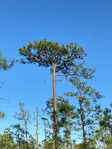
Humidity does not cancel embers. Carey 1992 puts longleaf pine (Pinus palustris) in a warm, wet, temperate climate with 43 to 69 inches of annual precipitation and still calls the species fire-resistant in a high-frequency, low-severity surface-fire regime. This directory’s Pinus palustris record currently computes as avoid. A rainy July in Alabama is not a planting permit against the wall.
You are looking at longleaf country, at a humid summer, and at a Firewise PDF, and concluding that “plants don’t burn here.” FEIS is about a forest that needs fire. The plant page is about a resinous pine next to a house. Those are not the same sentence.
The Alabama Forestry Commission PDFs named for this row (Is_Home_Protected.pdf, Firewise_Landscaping.pdf) did not connect this session. This page does not quote them. Alabama plant evidence is the state list on this site.
Why it matters
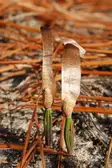
People hear humidity and skip defensible space. Longleaf’s own ecology argues the other way: the species makes fire. FEIS: long, resin-filled needles form a highly flammable, well-aerated litter. Resin is concentrated in the bole and roots of older trees. Lightning-struck trees can smolder and ignite the ground days later. Crown fires are rare because stands are open — not because the air is wet.
Fire-resistant is not fireproof. Forest fire-adapted is not on-list.
How it works
FEIS, the forest tree (Carey 1992):
- Climate: warm, wet, temperate. Precipitation 43 to 69 inches.
- Fire: classified fire-resistant. Ideally suited to high-frequency, low-severity surface fire. Natural interval every year to every 5 to 10 years, mostly lightning, late spring and summer.
- Grass-stage seedlings are fire-resistant; height-growth seedlings 1 to 3 feet are extremely vulnerable; after about 10 feet the tree is very fire tolerant.
- Without frequent fire, hardwoods and other southern pines replace it.
- Alabama is in the distribution (Piedmont and Valley-and-Ridge) and in Golden 1979 forest community types.
This directory, the house plant:
- Pinus palustris stores independent avoid rows: FPS NOT Firewise (4) in LZ4, Bardon High, Virginia Firescapes H, NCSU rows that resolve to Bardon.
- Computed status: avoid, highly flammable, consensus.
- USDA distribution includes AL. That is occurrence, not a recommendation. See how to read a plant page.
The same Latin name, two jobs. A savanna that burns on purpose is not a foundation planting.
The paths
| Claim | What the opened sources do | What they do not do |
|---|---|---|
| Humidity makes firewise pointless | FEIS still describes frequent surface fire in a 43–69 inch climate | Cancel embers at the house |
| Longleaf is fire-resistant | FEIS: forest classification, surface-fire regime | On-list at the wall |
| Longleaf is keep-away | This directory: avoid, consensus | A ban on longleaf in a TREASURE Forest |
| Alabama has no plant evidence | /plants/state/alabama/ lists every record whose USDA distribution includes AL | A state planting code |
| Zone 0 in a humid county | Still hardscape | A succulent exception |
What people mix up
- Wet climate as a fireproof climate.
- FEIS “fire-resistant” as this site’s on-list badge.
- Prescribed fire in a longleaf stand as a reason to plant pine against the siding.
- USDA distribution on the Alabama list as a recommendation.
- This page as an Alabama Forestry Commission reprint. Those PDFs did not open.
How to check
- Open Carey 1992. Read climate and Fire Adaptations.
- Open Pinus palustris. Read the computed status and every evidence row.
- Open Alabama. Distribution is not a planting list.
- Do not put the pine in Zone 0.
- If you have a live AFC Firewise sheet, read that sheet. This page does not quote it.
Limits
This page quotes the opened FEIS review and the stored P. palustris record. Alabama Forestry Commission hosts timed out (curl 75s, no TLS). It does not reprint the Alabama plant table. It does not decide a prescribed-burn permit or a planting. Zone 0 is not a planting list.
Related records
- Pinus palustris
- Pinus genus
- Alabama plant evidence
- Fire-resistant is not fireproof
- How to read a plant page
Plant records this page rests on
Questions
Does a humid Southeast climate cancel firewise planting?
No. Carey 1992 (FEIS) places longleaf pine in a warm, wet, temperate climate with 43 to 69 inches of annual precipitation and still classifies the species as fire-resistant in a high-frequency, low-severity surface-fire regime. Wet climate is not a house that will not ignite.
Is longleaf pine fire-resistant or a keep-away plant?
Both, in different documents. FEIS says it is ideally suited to frequent surface fire and is classified fire-resistant as a forest tree. This directory’s Pinus palustris record computes as avoid from independent planting-list lineages (FPS NOT Firewise, Bardon high, Virginia H). Forest fire-adapted is not on-list at the wall.
Why would a pine that survives fire be avoid next to a house?
Because it is pyrogenic. FEIS records that long, resin-filled needles form a highly flammable, well-aerated litter, and that resin is concentrated in the bole and roots of older trees. Surviving a surface fire in a savanna is not the same as a low-ember shrub in the first thirty feet.
Is Alabama’s humidity a Zone 0 exception?
No. Zone 0 is still not a planting list. This page does not open a live Alabama Forestry Commission PDF; that host timed out this session.
Where do I see what grows in Alabama on this site?
Open the Alabama plant evidence list. Distribution is not a planting recommendation.