Enter your ZIP to see whether this is legal to plant in your state, and whether it survives your winter.
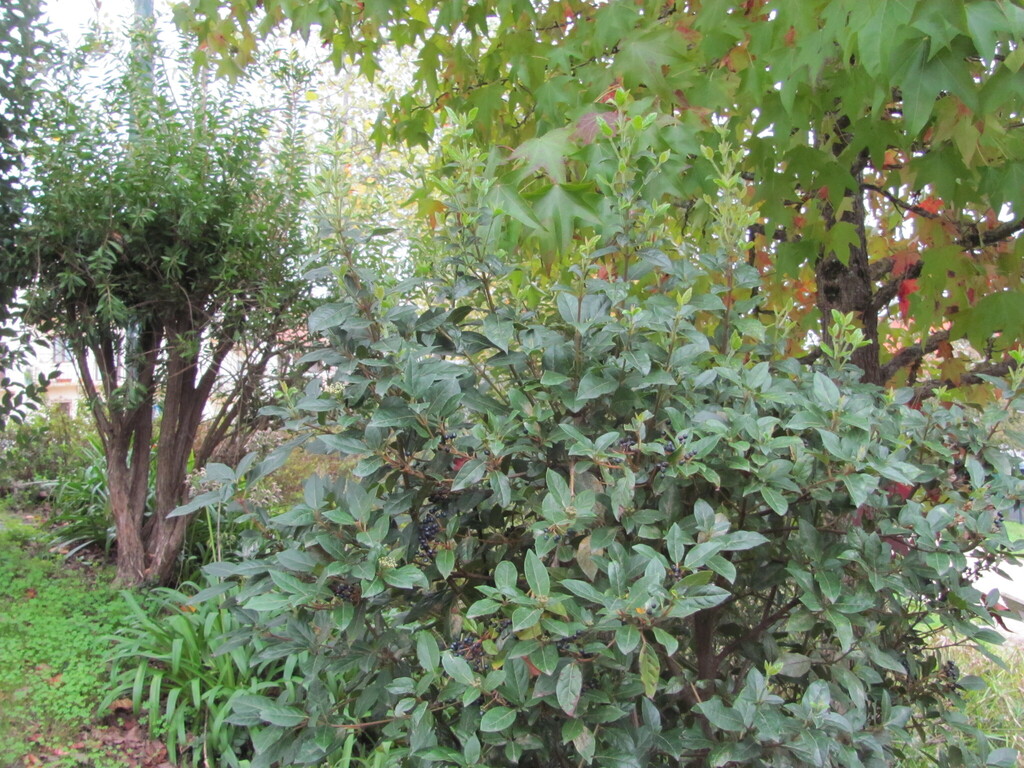
Laurustinus cannot be called reliably fire resistant because reputable sources reach opposing conclusions.
Three sources favor it, while two rate its fire behavior unfavorably. Valencia’s regional government recommends it among low-flammability hedge species, Fire Safe Marin lists it as fire resistant, and Barcelona’s provincial government and CREAF place it among the less-flammable plants to retain first in perimeter protection strips.
The contrary findings are substantial. France’s National Forest Office rated laurustinus as strongly fire-sensitive based on bench measurements of inflammability, intensity, and combustion combined with foresters’ observations of fire damage. Fire and Emergency New Zealand classifies it as having moderate/high flammability through a seven-level system grounded in shoot-flammability testing. These sources differ in method and region, but the available findings do not establish why their conclusions diverge. Laurustinus is a Viburnaceae shrub introduced in California, Oregon, and Washington.
Fire Safe Marin says its fire-resistant plants need irrigation and removal of dead material; careful placement and spacing remain necessary too. The fairest conclusion is that laurustinus has support as a lower-flammability choice in some Mediterranean and California guidance, yet direct testing and fire-damage observations give good reason for caution.
Marin County (CA footprint); partial normalized coverage · 2019-01-01
The publication is explicitly limited to plants common to Marin County. FireApproved publishes 104 exact owners as Marin regional context while retaining its placement, spacing, irrigation, and maintenance boundary. It is not statewide California guidance or parcel suitability.
2. Why this plant is relevant here
State distribution
Documented in CA, OR, WA.
Native range
Introduced / established
3 sourced range or established records. This is not an invasive warning.
USDA hardiness
3. Legal, ecological, and broader status
Legal-list status
Seed-list status
Reported invasive here
Broader regional context
Federal context
How to read this page
The status above is computed from the cited rows below: independent recommendations can support a fire-resistant result, an avoid row can produce keep-away, and disagreement stays visible as conflict. Placement notes preserve each source’s own scheme rather than translating unlike rules into one scale. This is evidence about a plant, not permission to plant it in every part of the defensible space; Zone 0 remains noncombustible.
Native and introduced range evidence
These are exact U.S. botanical-area records from the cited range source. Native and
introduced describe biogeographic relationship, not fire performance or planting approval.
Doubtful and extinct rows stay visible but do not count as current presence.
The lossless worldwide derivative is retained once in the research corpus; object pages repeat only exact U.S. areas needed by the local lens. The JSON twin carries the same page assertions.
Conditions in the fire evidence
These describe tested or rated plant material. They are not horticultural maintenance instructions.
Placement rules below use each source's own distances or named zones, tied to its rating.
They are not interchangeable with the directory's current Zone 0 guidance.
Guía de pirojardinería: not suitable inside the 25-metre maximum-risk zone [girona-2020-iuf-25m-suitability] (with its avoid rating)
Guía de pirojardinería: suitable inside or outside the 25-metre maximum-risk zone [girona-2020-iuf-25m-suitability] (with its recommendation)
Les franges perimetrals de protecció contra els incendis …: page 4 species-selection panel [catalonia-perimeter-strip-maintain-remove] (with its recommendation)
The evidence
Grouped by what each source concluded. Primary evidence rated the plant itself
(a lab, field program, or original curation); corroboration compiled or
republished another source's rating and resolves to its root lineage.
Viburnum tinus is rated “RECOMENDADA” by the guide's qualitative IUF garden-suitability method. The method assumes species-specific care and integrates fire evidence with fuel structure, maintenance, origin, invasiveness, and expert fire-service experience.
The fiche's overall sensitivity combines experimental-bench inflammability, intensity, and combustion measurements with foresters' observations of fire damage.
Viburnum lucidum is rated “DESACONSEJADA” by the guide's qualitative IUF garden-suitability method. The method assumes species-specific care and integrates fire evidence with fuel structure, maintenance, origin, invasiveness, and expert fire-service experience.
Mid-scale / conditional (1)
Low Flammability Plants directory — Fire and Emergency New Zealand (plant flammability testing at Lincoln University) · 2026 · original sourcePrimary evidenceLab-testedlineage: lincoln-nz-tree
“Moderate/high flammability”
Moderate/high flammability classification.
Listed without a rating (19)Corroboration (19 rows from 1 source)
19 cited rows from this source; its identity, lineage and tier are stated once.
Primary study Cui2020a: Cui, X., Paterson, A. M., Wyse, S. V., Alam, M. A., Maurin, K. J. L., Pieper, R., ... Curran, T. J. (2020a). Shoot flammability of vascular plants is phylogenetically conserved and related to habitat fire-proneness and growth form. Nature Plants, 6, 355-359.
Shared row context: plant part branches; fuel all; predrying yes; device grill; site Cui2020a-1; sampling ND.
“ignition frequency (%): 100”
FLAMITS record 1510; Ignitability measurement.
“maximum sample temperature (°C): 626.2”
FLAMITS record 1704; Combustibility measurement.
“burning duration (s): 18”
FLAMITS record 1898; Sustainability measurement.
“estimated burnt biomass (%): 30”
FLAMITS record 2092; Consumability measurement.
Primary study Essaghi2017: Essaghi, S., Hachmi, M. H., Yessef, M., Dehhaoui, M., & El Amarty, F. (2017). Assessment of Flammability of Moroccan Forest Fuels: New Approach to Estimate the Flammability Index. Forests, 8, 443.
Shared row context: Ignitability measurement; plant part twigs; fuel all; predrying no; device epiradiator; site Essaghi2017-5; sampling january.
“flammability value: 7.41”
FLAMITS record 3316.
“flammability value: 15.01”
FLAMITS record 3329.
Primary study Ganteaume2018: Ganteaume, A. (2018). Does plant flammability differ between leaf and litter bed scale? Role of fuel characteristics and consequences for flammability assessment. International Journal of Wildland Fire, 27, 342-352.
Shared row context: plant part leaves; device epiradiator; site Ganteaume2018-1; sampling summer.
FLAMITS record 3741; Sustainability measurement; fuel live; predrying no.
Primary study Hachmi2011: Hachmi, M. H., Sesbou, A., Benjelloun, H., El Handouz, N., & Bouanane, F. (2011). A Simple Technique to Estimate the Flammability Index of Moroccan Forest Fuels. Journal of Combustion, 2011, 1-11.
Shared row context: plant part twigs; fuel live; predrying no; device epiradiator; site Hachmi2011-1; sampling ND.
Primary study Rosavec2013: Rosavec, R., ikic, Z., panjol, ., & Barcic, D. (2013). Utjecaj meteorolokih ?imbenika na zapaljivost nekih sredozemnih vrsta. umarski list, 137, 583-590.