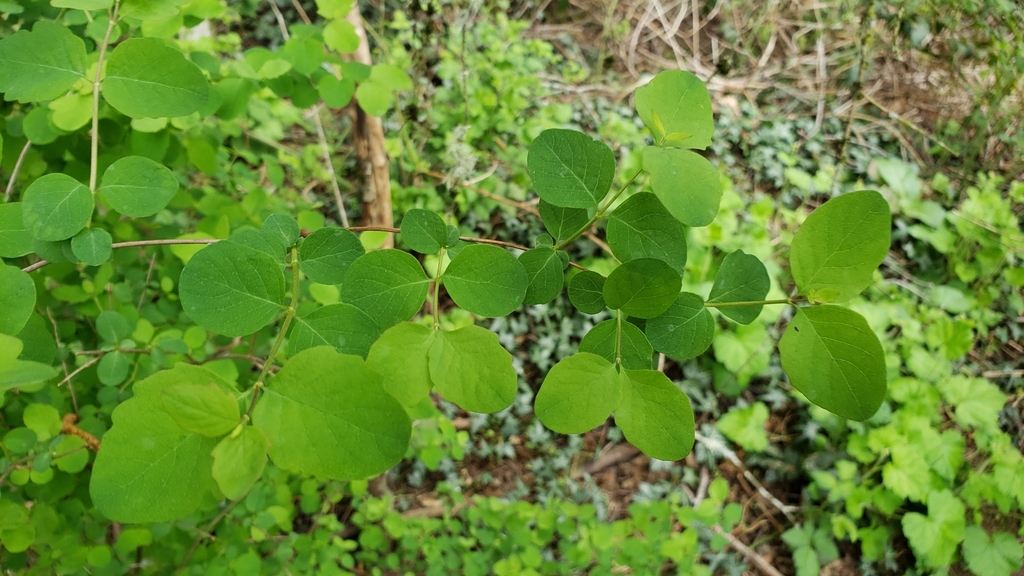
United States / Grow / common snowberry

common snowberry (Symphoricarpos albus)
Photo: (c) Gavin Slater, some rights reserved (CC BY) (CC BY), via iNaturalist. Species-typical, not necessarily this cultivar.

common snowberry

Symphoricarpos albus · Caprifoliaceae · all Symphoricarpos records · also called Snowberry · Wikipedia

View Saved

Is this one for your yard?

Enter your ZIP to see whether this is legal to plant in your state, and whether it survives your winter.

Yes, common snowberry is fire resistant, with six sources placing it on the favorable side of their scales.

Oregon State, Washington State, and University of Idaho extension services list it as fire resistant, while King County includes it among fire-resistant landscape shrubs.

Idaho Firewise gave common snowberry an 8 out of 10 in field trials, within the recommended band of 8 to 10 under Colorado State University’s published thresholds. FireSmart BC also approves it as a fire-resistant plant, although it flags the species as needing more research. The University of Nevada’s extension compilation found it favorably listed by at least two cited sources, with four source lists marked for snowberry.

Laboratory testing adds a measured reason for those recommendations. The USDA Forest Service named common snowberry a low-relative-flammability plant. Its green foliage measured 154 percent moisture and reached a peak heat-release rate of 52 kilowatts per square metre. Dry samples produced 15.6 megajoules per kilogram of effective heat of combustion, a measure of energy released after burning begins rather than how readily the plant ignites.

Common snowberry is a shrub in the honeysuckle family, reaching about three feet at maturity and requiring moderate water. It is suited to USDA zones 3a through 7b. The FireSmart research flag leaves room for refinement, but the extension recommendations, field score, and Forest Service testing all support treating common snowberry as a fire-resistant landscape choice.

Form
shrub
Mature height
~3 ft
Water need
moderate
Rated in
British Columbia; Colorado / Rocky Mountain Front Range; Colorado, California, and northeastern United States; Global +10
On this lot

1. Fire evidence and conditions

Fire evidence
Fire-resistant — location does not change the cited classification.
Fire-performance conditions
1 condition stated in cited fire-evidence rows.
Placement evidence
6 source placement records; source schemes remain separate.
Evidence regions
British Columbia; Colorado / Rocky Mountain Front Range; Colorado, California, and northeastern United States; Global; Michigan / Great Lakes; Nevada / Great Basin; New Zealand; OR/WA/ID; Oregon; Oregon (Willamette Valley); Pacific Northwest (Oregon / Washington / Idaho); eastern US; southern Idaho / Intermountain; western WA
Typed publication scope: 7 scopes across 7 cited fire sources
  • Ignition-Resistant Landscape Plants (Fact Sheet 6.305) · Official scoped edition
    • CO; partial normalized coverage · 2025-07-01

      Colorado State University Extension and the Colorado State Forest Service publish Fact Sheet 6.305 for Colorado's WUI and varied ecosystems. FireApproved exposes all 114 exact source owners at Colorado publication scope while retaining score, elevation, water, and Idaho-carrier lineage. Publication scope is not suitability for every Colorado site or zone.

  • Fire Resistance of Plants Master Database · Official scoped edition
    • Southern Idaho (ID footprint); partial normalized coverage · 2013-11-08

      The official database labels itself "For Southern Idaho" and describes Idaho residents at the urban-rangeland interface. FireApproved publishes 419 existing plant owners that cite its scored rows. This bounded Southern Idaho scope is regional context, not statewide coverage or a conclusion that the score transfers unchanged to every Idaho site.

  • Firewise Plants for the Puget Sound Basin · Official scoped edition
    • Puget Sound Basin (WA footprint); partial normalized coverage · 2011-01-01

      King County's current wildfire page links this list for the Puget Sound Basin. FireApproved publishes 82 exact source owners as basin context, not statewide Washington guidance or a site-specific recommendation.

  • Wildfire-resistant Landscape Plants for Michigan (Extension Bulletin E2948) · Official scoped edition
    • MI; partial normalized coverage · 2007-01-01

      Michigan State University Extension Bulletin E2948 is explicitly a list of wildfire-resistant landscape plants for Michigan and includes a Michigan-native field. FireApproved publishes 221 exact GBIF owners from 226 represented source rows and holds 15 complex or non-exact rows. This dated publication scope is not a current site-suitability determination.

  • Fire-resistant Landscape Plants for the Willamette Valley (EM 9103) · Official scoped edition
    • Willamette Valley (OR footprint); partial normalized coverage · 2015-02-01

      OSU Extension says EM 9103 highlights fire-resistant plants that thrive under Willamette Valley growing conditions. FireApproved publishes 172 exact owners only as valley context. The guide shares the PNW 590 lineage and is not a second independent vote or statewide site clearance.

  • Fire-Resistant Plants for Home Landscapes (PNW 590) · Official scoped edition
    • ID, OR, WA; partial normalized coverage · 2023-10-01

      The October 2023 joint Pacific Northwest Extension publication explicitly names Oregon, Washington, and Idaho and publishes more than 150 plant profiles. FireApproved has normalized 155 exact plant records from the source; publication scope does not assert that every listed plant suits every site within the three states.

  • A Compilation of Good Plant Choices for Nevada's High Fire Hazard Areas (SP-05-16) · Official scoped edition
    • NV; partial normalized coverage · 2005-01-01

      University of Nevada Cooperative Extension compiled plants suited to Nevada climate zones and reported favorably by at least two upstream firewise lists. FireApproved publishes 126 exact source owners at Nevada publication scope. The source explicitly makes no independent flammability determination, so these rows remain corroborative.

2. Why this plant is relevant here

State distribution
Documented in AK, CA, CO, CT, DC, DE, IA, ID, IL, IN, KY, MA, MD, ME, MI, MN, MO, MT, NC, ND, NE, NH, NJ, NM, NY, OH, OR, PA, RI, SD, TN, UT, VA, VT, WA, WI, WV, WY.
Native range
Current cited native range in AK, CA, CO, CT, DC, DE, IA, ID, IL, IN, KY, MA, MD, ME, MI, MN, MO, MT, NC, ND, NE, NH, NJ, NM, NY, OH, OR, PA, RI, SD, UT, VA, VT, WA, WI, WV, WY.
USDA hardiness
4 applicable cited hardiness statements overlap but have different boundaries; compare each complete source row.

3. Legal, ecological, and broader status

How to read this page

The status above is computed from the cited rows below: independent recommendations can support a fire-resistant result, an avoid row can produce keep-away, and disagreement stays visible as conflict. Placement notes preserve each source’s own scheme rather than translating unlike rules into one scale. This is evidence about a plant, not permission to plant it in every part of the defensible space; Zone 0 remains noncombustible.

Native and introduced range evidence

These are exact U.S. botanical-area records from the cited range source. Native and introduced describe biogeographic relationship, not fire performance or planting approval. Doubtful and extinct rows stay visible but do not count as current presence.

Current native

37

exact source areas

Current introduced

0

exact source areas

Qualified

0

doubtful or extinct source rows

37 native source areas · World Checklist of Vascular Plants, version 16 v16, as of 2026-06-04
  • Alaska (AK)
  • California (CA)
  • Colorado (CO)
  • Connecticut (CT)
  • District of Columbia (DC)
  • Delaware (DE)
  • Iowa (IA)
  • Idaho (ID)
  • Illinois (IL)
  • Indiana (IN)
  • Kentucky (KY)
  • Massachusetts (MA)
  • Maryland (MD)
  • Maine (ME)
  • Michigan (MI)
  • Minnesota (MN)
  • Missouri (MO)
  • Montana (MT)
  • North Carolina (NC)
  • North Dakota (ND)
  • Nebraska (NE)
  • New Hampshire (NH)
  • New Jersey (NJ)
  • New Mexico (NM)
  • New York (NY)
  • Ohio (OH)
  • Oregon (OR)
  • Pennsylvania (PA)
  • Rhode I. (RI)
  • South Dakota (SD)
  • Utah (UT)
  • Virginia (VA)
  • Vermont (VT)
  • Washington (WA)
  • Wisconsin (WI)
  • West Virginia (WV)
  • Wyoming (WY)

The lossless worldwide derivative is retained once in the research corpus; object pages repeat only exact U.S. areas needed by the local lens. The JSON twin carries the same page assertions.

Plant hardiness evidence

These values describe the plant source. Your ZIP zone comes from the separate 2023 USDA Plant Hardiness Zone Map. Whole-zone values stay whole-zone, and a single unresolved value is not treated as a tolerance range. Different source boundaries stay separate: overlapping statements are compared independently, while only ranges with no shared zone are called a conflict.

Conditions in the fire evidence

These describe tested or rated plant material. They are not horticultural maintenance instructions.

Where its sources say to plant it

Placement rules below use each source's own distances or named zones, tied to its rating. They are not interchangeable with the directory's current Zone 0 guidance.

The evidence

Grouped by what each source concluded. Primary evidence rated the plant itself (a lab, field program, or original curation); corroboration compiled or republished another source's rating and resolves to its root lineage.

Recommends (11)

Corroboration (2 rows from 2 sources)

Mid-scale / conditional (2)

Listed without a rating (3)
Corroboration (3 rows from 1 source)
  • FLAMITS: FLAMmability plant traiTS database — Dryad / Global Ecology and Biogeography · Dryad version 9 · original source Corroboration Trait database lineage: meta-aggregator

    3 cited rows from this source; its identity, lineage and tier are stated once.

    • Primary study White2002: White, R. H., Weise, D. R., Mackes, K., & Dibble, A. C. (2002). Cone calorimeter testing of vegetation--an update. Ninth International Conference on Electrical and Electronic Products. Columbus, Ohio, USA.

      Shared row context: Combustibility measurement; plant part leaves; fuel live; device calorimeter; site White2002-2; sampling ND.

      • “maximum energy flux (kW/m²): 52”

        FLAMITS record 14143; predrying no.

      • Shared measurement context: predrying yes.

        • “calorific value (kcal/kg): 3726”

          FLAMITS record 14196.

        • “calorific value (kcal/kg): 3391.61”

          FLAMITS record 14288.

Last verified 2026-08-23. JSON (CC BY 4.0)

Profiles: USDA PLANTS · GBIF · iNaturalist · Wikidata · Wikipedia · ITIS

Symphoricarpos albus (Snowberry). FireApproved. https://fireapproved.com/plants/symphoricarpos-albus/. Last verified 2026-08-23.