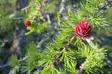
Enter your ZIP to see whether this is legal to plant in your state, and whether it survives your winter.
No.
The arar tree is highly flammable and does not belong near structures.
Two laboratory studies reach the same practical conclusion. Annals of Forest Science explicitly placed arar among its highly flammable species after examining combustibility and sustained burning in fresh and dried fuels. The European Scientific Journal also gave the tree its high-flammability rating, note 3. On that study’s scale, note 3 applies when fresh material ignites within 65 seconds.
A related measurement helps show what that finding looks like under controlled conditions. The FLAMITS database reports that a live leaf sample took 15 seconds to produce flames in a calorimeter during September sampling. That figure measures time to flaming for one prepared sample under one test setup. It is not by itself a universal prediction of how every arar tree will behave outdoors, and FLAMITS does not turn unlike measurements into a single recommendation.
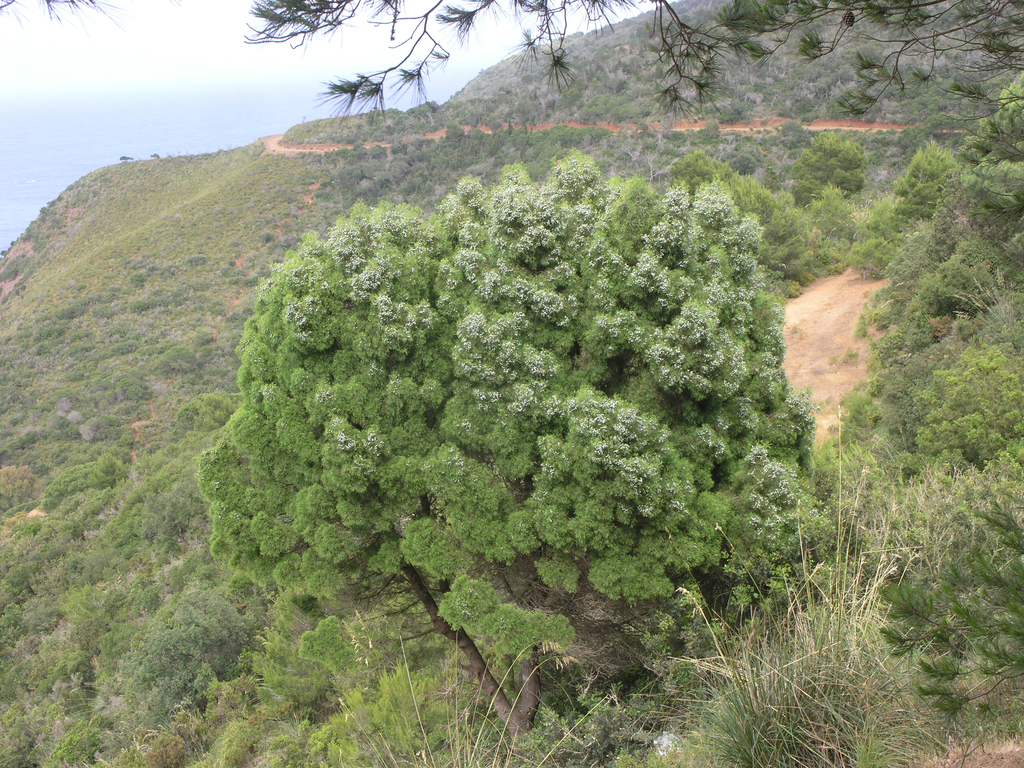
Arar, or Tetraclinis articulata, is a tree in the cypress family. Here the recommendation does not rest on the database number alone: the two published laboratory classifications identify high flammability directly. For landscaping near a building, those findings support choosing something else and keeping arar away from structures.
Global; Tlemcen Mountains, western Algeria; Tlemcen, western Algeria
Maintenance
2. Why this plant is relevant here
State distribution
Native range
Introduced / established
USDA hardiness
3. Legal, ecological, and broader status
Legal-list status
Seed-list status
Reported invasive here
Broader regional context
Federal context
How to read this page
The status above is computed from the cited rows below: independent recommendations can support a fire-resistant result, an avoid row can produce keep-away, and disagreement stays visible as conflict. Placement notes preserve each source’s own scheme rather than translating unlike rules into one scale. This is evidence about a plant, not permission to plant it in every part of the defensible space; Zone 0 remains noncombustible.
Conditions in the fire evidence
These describe tested or rated plant material. They are not horticultural maintenance instructions.
Placement rules below use each source's own distances or named zones, tied to its rating.
They are not interchangeable with the directory's current Zone 0 guidance.
The fire risk of the plant groupings with Cistus in the a…: Table 1 [henaoui-2013-fresh-material-flammability] (with its avoid rating)
The evidence
Grouped by what each source concluded. Primary evidence rated the plant itself
(a lab, field program, or original curation); corroboration compiled or
republished another source's rating and resolves to its root lineage.
18 cited rows from this source; its identity, lineage and tier are stated once.
Primary study Dehane2017: Dehane, B., Hernando, C., Guijarro, M., & Madrigal, J. (2017). Flammability of some companion species in cork oak (Quercus suber L.) forests. Annals of Forest Science, 74, 60.
Shared row context: plant part leaves; fuel live; device calorimeter; site Dehane2017-1; sampling september.
“time to flaming (s): 15”
FLAMITS record 2298; Ignitability measurement; predrying yes.
FLAMITS record 2368; Consumability measurement; predrying no.
Primary study Hachmi2011: Hachmi, M. H., Sesbou, A., Benjelloun, H., El Handouz, N., & Bouanane, F. (2011). A Simple Technique to Estimate the Flammability Index of Moroccan Forest Fuels. Journal of Combustion, 2011, 1-11.
Shared row context: plant part twigs; fuel live; predrying no; device epiradiator; site Hachmi2011-1; sampling ND.
“time to flaming (s): 10.1”
FLAMITS record 4724; Ignitability measurement.
“flame height (cm): 10”
FLAMITS record 4783; Combustibility measurement.
“burning duration (s): 13.4”
FLAMITS record 4784; Sustainability measurement.
Primary study Henaoui2013: Henaoui, S. E. -A., Bouazza, M., & Amara, M. (2013). The fire risk of the plant groupings with Cistus in the area of Tlemcen (Western Algeria). European Scientific Journal, 9, 84-103.
Shared row context: plant part twigs; fuel live; predrying yes; device infrared burner; site Henaoui2013-1; sampling spring.
“flame height (cm): 27.18”
FLAMITS record 4900; Combustibility measurement.
“time to flaming (s): 17.96”
FLAMITS record 4938; Ignitability measurement.
“burning duration (s): 85.95”
FLAMITS record 4976; Sustainability measurement.
Primary study Benhalima2019: Benhalima, Y., & Dehane, B. (2019). Flammability of certain conifers and oak species of north west Algeria. Proceedings of the X International Scientific Agricultural Symposium Agrosym 2019. Jahorina.
Shared row context: plant part twigs; fuel live; predrying no; device calorimeter; site Benhalima2019-1; sampling september 2017.