Enter your ZIP to see whether this is legal to plant in your state, and whether it survives your winter.
Kitchen sage has no clear primary fire-resistance verdict; Colorado’s 7.5 score falls below its recommended near-structure planting scores.
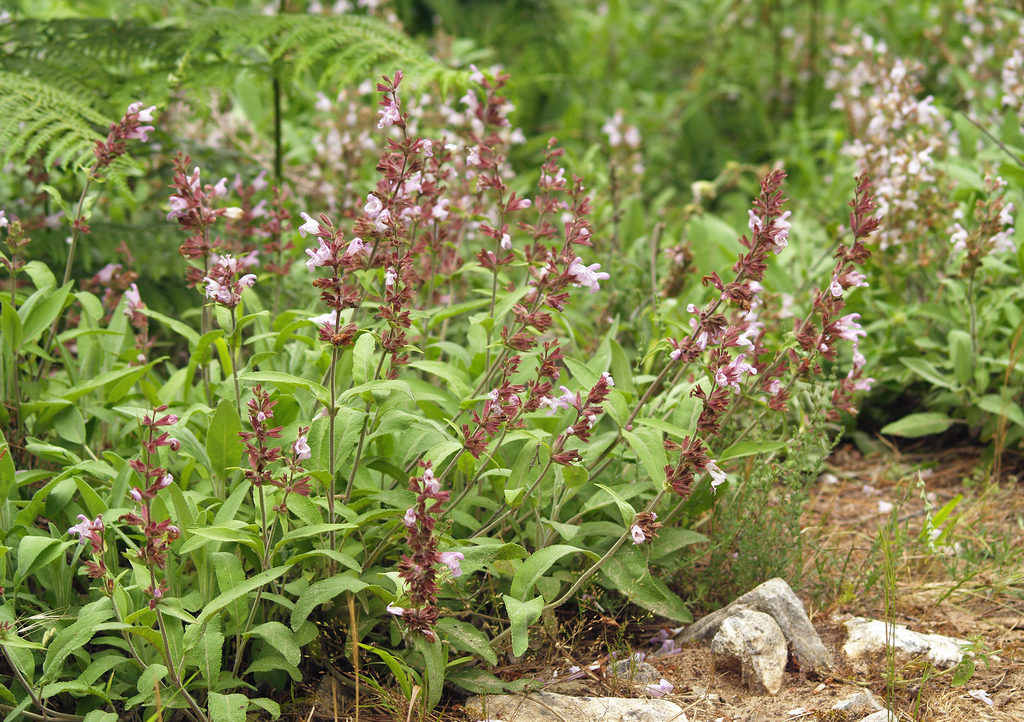
The July 2025 Colorado publication scores Salvia officinalis, common or garden sage, using plant characteristics. Its scale runs from 0, most ignitable, to 10, least ignitable. The score is not a measured ignition probability. For the highest degree of protection, the publication recommends planting only scores 8, 9 and 10 in its first two zones: 0–5 feet and 5–30 feet from the structure edge. Common sage’s inclusion in the list does not make its lower score meet that recommendation.
Existing sage is a different decision. CSU refers existing vegetation scoring below 8 to Fact Sheet 6.303; the passage does not order automatic removal. Its low-to-moderate water-need entry also leaves maintenance relevant. Regular watering, keeping dead material from building up, and maintaining clearance between limbs and the ground remain part of the guidance, alongside plant choice and spacing. These are the Colorado document’s conditions, not a placement rule borrowed from another regional list.
A separate FLAMITS entry records 7% “burnt biomass” for predried leaves in a thermal analyzer. That label belongs to stage I, with a heating rate of 5°C/min and no preheating recorded. It does not establish the total proportion of a whole plant that would burn, or a fire-resistance grade. The database fields preserve a limited laboratory observation; they do not supply an independent reason to disregard CSU’s new-planting threshold.
Form
perennial
Water need
low
Rated in
Colorado / Rocky Mountain Front Range; Global
On this lot
1. Fire evidence and conditions
Fire evidence
Mixed evidence — location does not change the cited classification.
Colorado State University Extension and the Colorado State Forest Service publish Fact Sheet 6.305 for Colorado's WUI and varied ecosystems. FireApproved exposes all 114 exact source owners at Colorado publication scope while retaining score, elevation, water, and Idaho-carrier lineage. Publication scope is not suitability for every Colorado site or zone.
2. Why this plant is relevant here
State distribution
Documented in AL, CA, CO, CT, GA, ID, KY, ME, MI, NJ, NY, OH, OR, PA, RI, TN, UT, VA, VT, WA, WV.
Native range
Introduced / established
21 sourced range or established records. This is not an invasive warning.
USDA hardiness
3. Legal, ecological, and broader status
Legal-list status
Seed-list status
Reported invasive here
Broader regional context
Federal context
How to read this page
The status above is computed from the cited rows below: independent recommendations can support a fire-resistant result, an avoid row can produce keep-away, and disagreement stays visible as conflict. Placement notes preserve each source’s own scheme rather than translating unlike rules into one scale. This is evidence about a plant, not permission to plant it in every part of the defensible space; Zone 0 remains noncombustible.
Native and introduced range evidence
These are exact U.S. botanical-area records from the cited range source. Native and
introduced describe biogeographic relationship, not fire performance or planting approval.
Doubtful and extinct rows stay visible but do not count as current presence.
The lossless worldwide derivative is retained once in the research corpus; object pages repeat only exact U.S. areas needed by the local lens. The JSON twin carries the same page assertions.
Where its sources say to plant it
Placement rules below use each source's own distances or named zones, tied to its rating.
They are not interchangeable with the directory's current Zone 0 guidance.
Ignition-Resistant Landscape Plants: below the source's score-8 threshold for zones 1-2 [CSU defensible-space zone] (mid-scale rating)
The evidence
Grouped by what each source concluded. Primary evidence rated the plant itself
(a lab, field program, or original curation); corroboration compiled or
republished another source's rating and resolves to its root lineage.
24 cited rows from this source; its identity, lineage and tier are stated once.
Primary study Wesolowski2003: Weso?owski, M., & Konieczynski, P. (2003). Thermal decomposition and elemental composition of medicinal plant materialsLeaves and flowers Principal component analysis of the results. Thermochimica Acta, 397, 171180.
Shared row context: plant part leaves; fuel live; predrying yes; device thermal analyzer; site Wesolowski2003-1; sampling ND.