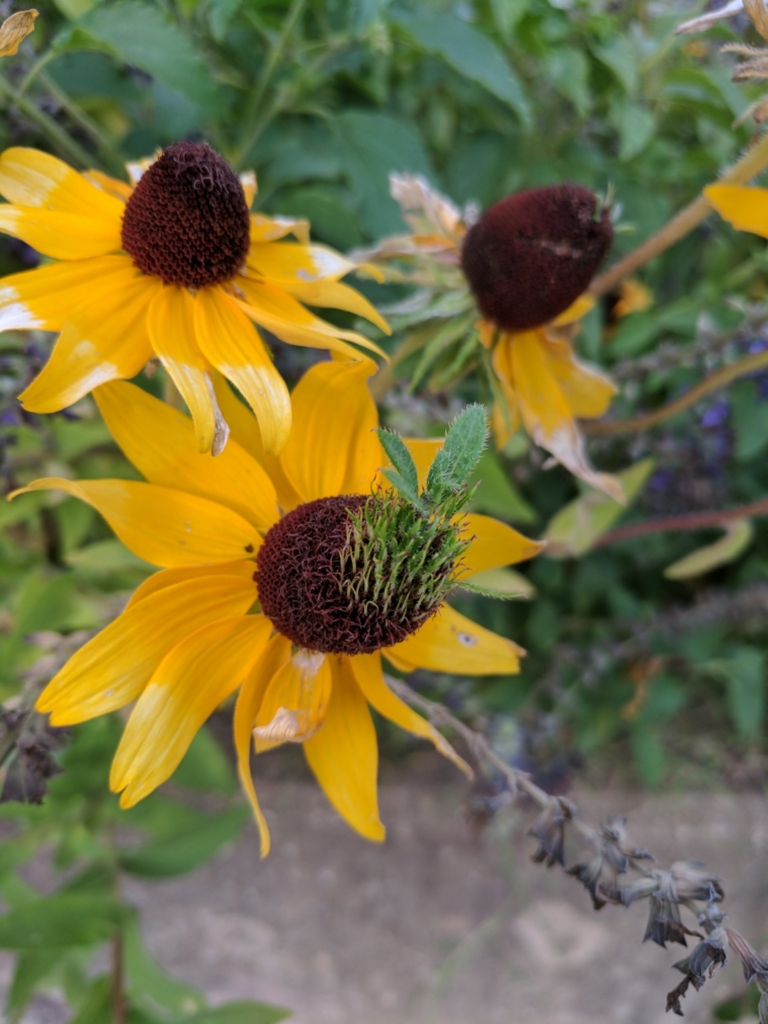
United States / Grow / blackeyed Susan

blackeyed Susan (Rudbeckia hirta)
Photo: (c) Alison Northup, some rights reserved (CC BY) (CC BY), via iNaturalist. Species-typical, not necessarily this cultivar.

blackeyed Susan

Rudbeckia hirta · Asteraceae · all Rudbeckia records · also called Black-eyed Susan · Wikipedia

View Saved

Is this one for your yard?

Enter your ZIP to see whether this is legal to plant in your state, and whether it survives your winter.

Black-eyed Susan (Rudbeckia hirta) is rated fire resistant, although Idaho's score carries a suggested forty-foot separation.

The Southern Idaho database gives the species a seven and links that score to a suggested minimum distance of forty feet from a home. It lists the named Cherry Brandy hybrid separately. That species-specific guidance needs its botanical name: the common name black-eyed Susan also appears in guidance about Rudbeckia fulgida.

Dovetail's northeast Minnesota guide assigns Rudbeckia hirta low flammability. Its planting advice permits low-flammability selections from three to thirty feet from a building. That distance belongs to Dovetail's regional planting system and does not replace Idaho's guidance. Dovetail describes this perennial as a plant for sun and medium soil moisture, and credits the University of Florida's assessment method for the flammability classification.

Fremont County and Maryland also list Rudbeckia hirta favorably. Those selections add regional landscape recommendations without giving the plant another comparative score. Fremont makes plant choice, spacing and maintenance central to retaining Firewise properties.

For this black-eyed Susan, the usable conclusion combines the favorable listings with their conditions. For perennials, Idaho specifies a late-winter cutback followed by removal of the dead growth. Keep that cleanup and the source-specific spacing attached to the plant selection.

Form
perennial
Mature height
~1 ft
Water need
moderate
Rated in
British Columbia; Fremont County, Wyoming; Maryland, New Jersey, and West Virginia; northeastern Minnesota +1
On this lot

1. Fire evidence and conditions

Fire evidence
Fire-resistant — location does not change the cited classification.
Placement evidence
4 source placement records; source schemes remain separate.
Evidence regions
British Columbia; Fremont County, Wyoming; Maryland, New Jersey, and West Virginia; northeastern Minnesota; southern Idaho / Intermountain
Typed publication scope: 6 scopes across 4 cited fire sources
  • Landscaping for Wildfire Defensible Space in Northeastern Minnesota (Firewise) · Official scoped edition
    • Northeastern Minnesota (MN footprint); partial normalized coverage · 2017-01-01

      Dovetail applies the UF/IFAS flammability key to northeastern Minnesota natives and publishes placement for 38 exact source owners. FireApproved exposes those rows only as northeastern Minnesota regional context and preserves the 3-to-30-foot versus beyond-30-foot source placement.

  • Fremont County Firewise Plant List · Official scoped edition
    • Fremont County (WY footprint); partial normalized coverage · 2011-02-25

      The source identifies itself as the Fremont County Firewise Plant List. FireApproved publishes its 92 exact source owners as Fremont County regional context. No methodology, current county endorsement, statewide Wyoming scope, or site-specific suitability is inferred.

  • Fire Resistance of Plants Master Database · Official scoped edition
    • Southern Idaho (ID footprint); partial normalized coverage · 2013-11-08

      The official database labels itself "For Southern Idaho" and describes Idaho residents at the urban-rangeland interface. FireApproved publishes 419 existing plant owners that cite its scored rows. This bounded Southern Idaho scope is regional context, not statewide coverage or a conclusion that the score transfers unchanged to every Idaho site.

  • Firewise Landscaping Plants (Maryland, New Jersey, and West Virginia editions) · Official scoped edition
    • MD; partial normalized coverage · 2015-01-08

      Maryland Forest Service says the list contains plants that can be grown in Maryland and identifies Maryland natives. FireApproved publishes 169 exact source owners from the 180 printed rows; an unrepresentable form and duplicate-owner rows are not broadened. The list calls itself non-comprehensive and does not establish suitability for every Maryland site.

    • NJ; partial normalized coverage

      New Jersey DEP publishes a state edition saying the listed plants can be grown in New Jersey and are relatively resistant to fire. Its same 180 printed taxon occurrences map to the 169 conservative owners already normalized for the template family. The list is non-comprehensive and does not establish suitability for every New Jersey site or override the Pinelands Commission's separate placement and fuel-break rules.

    • WV; partial normalized coverage · 2026-08-26

      West Virginia Division of Forestry publishes a state edition saying the listed plants can be grown in West Virginia and are relatively resistant to fire. Its same 180 printed taxon occurrences map to the 169 conservative owners already normalized for the template family. The list is non-comprehensive and provides no comparative or site-specific rating.

2. Why this plant is relevant here

State distribution
Documented in AK, AL, AR, CA, CO, CT, DC, DE, FL, GA, IA, ID, IL, IN, KS, KY, LA, MA, MD, ME, MI, MN, MO, MS, MT, NC, ND, NE, NH, NJ, NM, NY, OH, OK, OR, PA, RI, SC, SD, TN, TX, UT, VA, VT, WA, WI, WV, WY.
Native range
Current cited native range in AL, AR, CA, CO, CT, DC, DE, FL, GA, IA, ID, IL, IN, KS, KY, LA, MA, MD, ME, MI, MN, MO, MS, NC, ND, NE, NH, NJ, NM, NY, OH, OK, OR, PA, SC, SD, TN, TX, UT, VA, VT, WA, WI, WV, WY.
Introduced / established
1 sourced range or established record. This is not an invasive warning.
USDA hardiness
2 applicable cited hardiness statements overlap but have different boundaries; compare each complete source row.

3. Legal, ecological, and broader status

How to read this page

The status above is computed from the cited rows below: independent recommendations can support a fire-resistant result, an avoid row can produce keep-away, and disagreement stays visible as conflict. Placement notes preserve each source’s own scheme rather than translating unlike rules into one scale. This is evidence about a plant, not permission to plant it in every part of the defensible space; Zone 0 remains noncombustible.

Native and introduced range evidence

These are exact U.S. botanical-area records from the cited range source. Native and introduced describe biogeographic relationship, not fire performance or planting approval. Doubtful and extinct rows stay visible but do not count as current presence.

Current native

45

exact source areas

Current introduced

1

exact source area

Qualified

0

doubtful or extinct source rows

45 native source areas · World Checklist of Vascular Plants, version 16 v16, as of 2026-06-04
  • Alabama (AL)
  • Arkansas (AR)
  • California (CA)
  • Colorado (CO)
  • Connecticut (CT)
  • District of Columbia (DC)
  • Delaware (DE)
  • Florida (FL)
  • Georgia (GA)
  • Iowa (IA)
  • Idaho (ID)
  • Illinois (IL)
  • Indiana (IN)
  • Kansas (KS)
  • Kentucky (KY)
  • Louisiana (LA)
  • Massachusetts (MA)
  • Maryland (MD)
  • Maine (ME)
  • Michigan (MI)
  • Minnesota (MN)
  • Missouri (MO)
  • Mississippi (MS)
  • North Carolina (NC)
  • North Dakota (ND)
  • Nebraska (NE)
  • New Hampshire (NH)
  • New Jersey (NJ)
  • New Mexico (NM)
  • New York (NY)
  • Ohio (OH)
  • Oklahoma (OK)
  • Oregon (OR)
  • Pennsylvania (PA)
  • South Carolina (SC)
  • South Dakota (SD)
  • Tennessee (TN)
  • Texas (TX)
  • Utah (UT)
  • Virginia (VA)
  • Vermont (VT)
  • Washington (WA)
  • Wisconsin (WI)
  • West Virginia (WV)
  • Wyoming (WY)
1 introduced source area · World Checklist of Vascular Plants, version 16 v16, as of 2026-06-04
  • Rhode I. (RI)

The lossless worldwide derivative is retained once in the research corpus; object pages repeat only exact U.S. areas needed by the local lens. The JSON twin carries the same page assertions.

Plant hardiness evidence

These values describe the plant source. Your ZIP zone comes from the separate 2023 USDA Plant Hardiness Zone Map. Whole-zone values stay whole-zone, and a single unresolved value is not treated as a tolerance range. Different source boundaries stay separate: overlapping statements are compared independently, while only ranges with no shared zone are called a conflict.

Where its sources say to plant it

Placement rules below use each source's own distances or named zones, tied to its rating. They are not interchangeable with the directory's current Zone 0 guidance.

The evidence

Grouped by what each source concluded. Primary evidence rated the plant itself (a lab, field program, or original curation); corroboration compiled or republished another source's rating and resolves to its root lineage.

Recommends (4)

Corroboration (3 rows from 3 sources)

Mid-scale / conditional (1)

Guides that discuss this plant

Last verified 2026-08-23. JSON (CC BY 4.0)

Profiles: USDA PLANTS · GBIF · iNaturalist · Wikidata · Wikipedia · ITIS

Rudbeckia hirta (Black-eyed Susan). FireApproved. https://fireapproved.com/plants/rudbeckia-hirta/. Last verified 2026-08-23.