Enter your ZIP to see whether this is legal to plant in your state, and whether it survives your winter.
On mahonia aquifolium, Mahonia aquifolium cites conflict. Mahonia aquifolium then and high moisture for aquifolium. The citations do not collapse on mahonia aquifolium. Mahonia aquifolium keeps conflict with high moisture for aquifolium.
On mahonia aquifolium, Mahonia aquifolium also carries 4 hardiness rows for aquifolium. On mahonia aquifolium, Mahonia aquifolium also carries irrigated, green test condition for aquifolium. On mahonia aquifolium, Mahonia aquifolium also carries same form alternatives for aquifolium.
Use evidence on mahonia aquifolium for aquifolium. Mahonia aquifolium keeps the sourced table for aquifolium. On mahonia aquifolium, conflict sits with high moisture on Mahonia aquifolium for aquifolium.
City of Ashland (OR footprint); partial normalized coverage · 2026-08-26
This is a City of Ashland adoption fact, not statewide Oregon guidance or an experimental flammability result. FireApproved publishes 24 taxonomy-safe owners as city-level regulatory context. It applies to new planting and propagation within 30 feet of structures, including structures on adjacent lots; it is not projected as a blanket removal order for every established listed plant.
Marin County (CA footprint); partial normalized coverage · 2019-01-01
The publication is explicitly limited to plants common to Marin County. FireApproved publishes 104 exact owners as Marin regional context while retaining its placement, spacing, irrigation, and maintenance boundary. It is not statewide California guidance or parcel suitability.
Southern Idaho (ID footprint); partial normalized coverage · 2013-11-08
The official database labels itself "For Southern Idaho" and describes Idaho residents at the urban-rangeland interface. FireApproved publishes 419 existing plant owners that cite its scored rows. This bounded Southern Idaho scope is regional context, not statewide coverage or a conclusion that the score transfers unchanged to every Idaho site.
Michigan State University Extension Bulletin E2948 is explicitly a list of wildfire-resistant landscape plants for Michigan and includes a Michigan-native field. FireApproved publishes 221 exact GBIF owners from 226 represented source rows and holds 15 complex or non-exact rows. This dated publication scope is not a current site-suitability determination.
Ohio State University Extension Bulletin 921 is an Ohio publication that describes Ohio fire seasons and landscape conditions and labels nativity to Ohio. FireApproved publishes 352 exact source-owning plant records from its eight rated tables. This historical publication scope does not assert current extension endorsement or that a listed plant suits every Ohio site.
Willamette Valley (OR footprint); partial normalized coverage · 2015-02-01
OSU Extension says EM 9103 highlights fire-resistant plants that thrive under Willamette Valley growing conditions. FireApproved publishes 172 exact owners only as valley context. The guide shares the PNW 590 lineage and is not a second independent vote or statewide site clearance.
The October 2023 joint Pacific Northwest Extension publication explicitly names Oregon, Washington, and Idaho and publishes more than 150 plant profiles. FireApproved has normalized 155 exact plant records from the source; publication scope does not assert that every listed plant suits every site within the three states.
University of Nevada Cooperative Extension compiled plants suited to Nevada climate zones and reported favorably by at least two upstream firewise lists. FireApproved publishes 126 exact source owners at Nevada publication scope. The source explicitly makes no independent flammability determination, so these rows remain corroborative.
Virginia Cooperative Extension's publication opens with Virginia wildfire conditions, identifies its Virginia Firewise Landscaping Task Force, and labels plants native to Virginia. FireApproved publishes 306 exact source owners. Publication scope does not establish parcel suitability or current endorsement of this archived 2009 list.
2. Why this plant is relevant here
State distribution
Documented in CA, DC, GA, ID, KY, MI, MT, NJ, NY, OH, OR, WA.
Native range
Introduced / established
USDA hardiness
3 applicable cited hardiness statements overlap but have different boundaries; compare each complete source row.
3. Legal, ecological, and broader status
Legal-list status
Seed-list status
Reported invasive here
Broader regional context
Federal context
How to read this page
The status above is computed from the cited rows below: independent recommendations can support a fire-resistant result, an avoid row can produce keep-away, and disagreement stays visible as conflict. Placement notes preserve each source’s own scheme rather than translating unlike rules into one scale. This is evidence about a plant, not permission to plant it in every part of the defensible space; Zone 0 remains noncombustible.
Plant hardiness evidence
These values describe the plant source. Your ZIP zone comes from the separate 2023 USDA
Plant Hardiness Zone Map. Whole-zone values stay whole-zone, and a single unresolved value
is not treated as a tolerance range. Different source boundaries stay separate: overlapping
statements are compared independently, while only ranges with no shared zone are called a conflict.
Source prints 5 · single-value meaning unresolved · whole zone precision · source stated
Source taxon: Mahonia aquifolium · exact match.
Source location: Cold Hardiness Zone field in the recovered selector record.
Not used for comparison: The recovered selector prints one Cold Hardiness Zone value but does not define it as a minimum threshold or a one-zone range.
Placement rules below use each source's own distances or named zones, tied to its rating.
They are not interchangeable with the directory's current Zone 0 guidance.
Eastern United States Fire Performance Plant Selector: Landscape Zone 2 — 5–10 ft from the structure; maintained lawn or fuel breaks, with easily ignited evergreens avoided [Fire Performance Plant Selector landscape zone] (mid-scale rating)
Fire Resistance of Plants Master Database: plantable at 70' from home [Idaho minimum planting distance] (mid-scale rating)
Firewise Landscaping: do not plant within 5 ft of structures (keep out of Zone 1) [OSU B921 source-category siting] (with its avoid rating)
Prohibited Flammable Plants: new planting or propagation restricted within 30 ft of any structure [Ashland Municipal Code setback] (with its avoid rating)
FireSmart BC Plant Program: suitable for HIZ extended zone and beyond [FireSmart BC Home Ignition Zone] (with its recommendation)
Fire-Resistant Plants for Oregon Home Landscapes: Oregon [osu-frn6-oregon-regions] (with its recommendation)
Fire-resistant Landscape Plants for the Willamette Valley: Oregon Grape profile (PDF page 142) [osu-em-9103-profile] (with its recommendation)
Grouped by what each source concluded. Primary evidence rated the plant itself
(a lab, field program, or original curation); corroboration compiled or
republished another source's rating and resolves to its root lineage.
“Fire-Resistant Plant Materials for Oregon”
· condition: green
Mahonia aquifolium (Oregon grapeholly) is listed under “Shrubs—broadleaf evergreen”. The guide says most listed plants require some irrigation during Oregon's dry summer months and must be maintained in a healthy condition.
The City of Ashland restricts new planting or propagation within 30 ft of any structure, including structures on adjacent lots (AMC 9.04). Dwarf or prostrate varieties require Fire and Rescue approval, placement beyond 5 ft, and ordinance-compliant tree or shrub spacing.
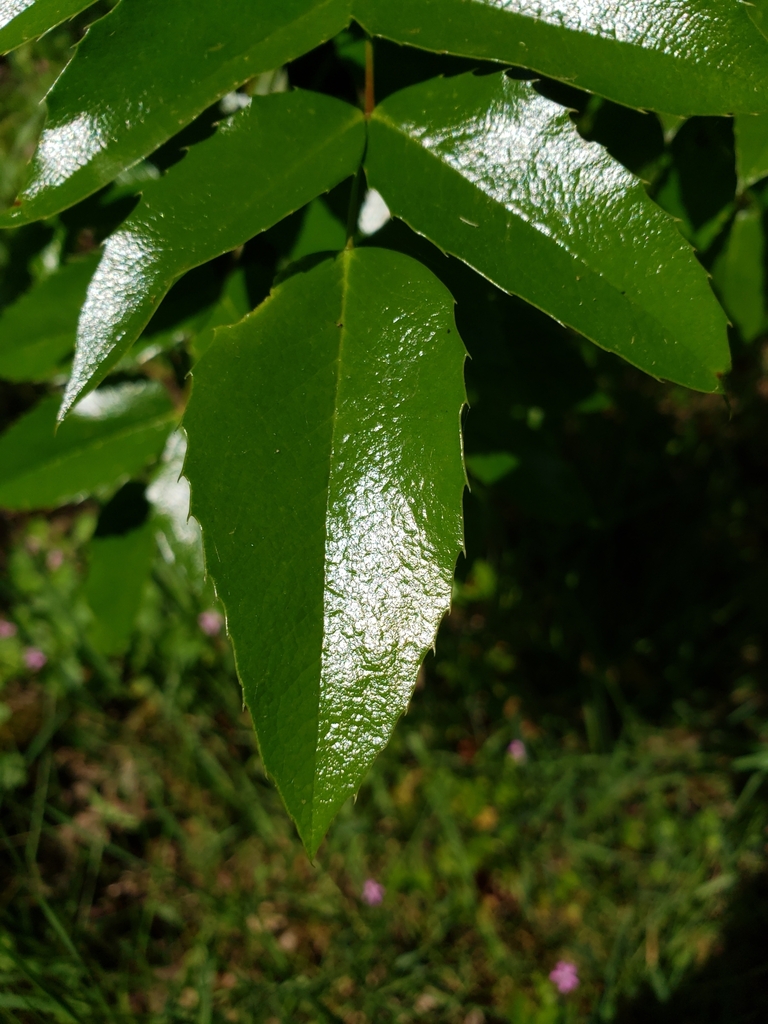
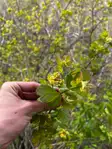
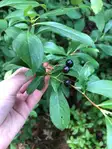
Glossy green foliage appearring to be a holly except with compound leaves. Bright yellow terminal floqwer clusters in early spring with bright blue fruit in summer.