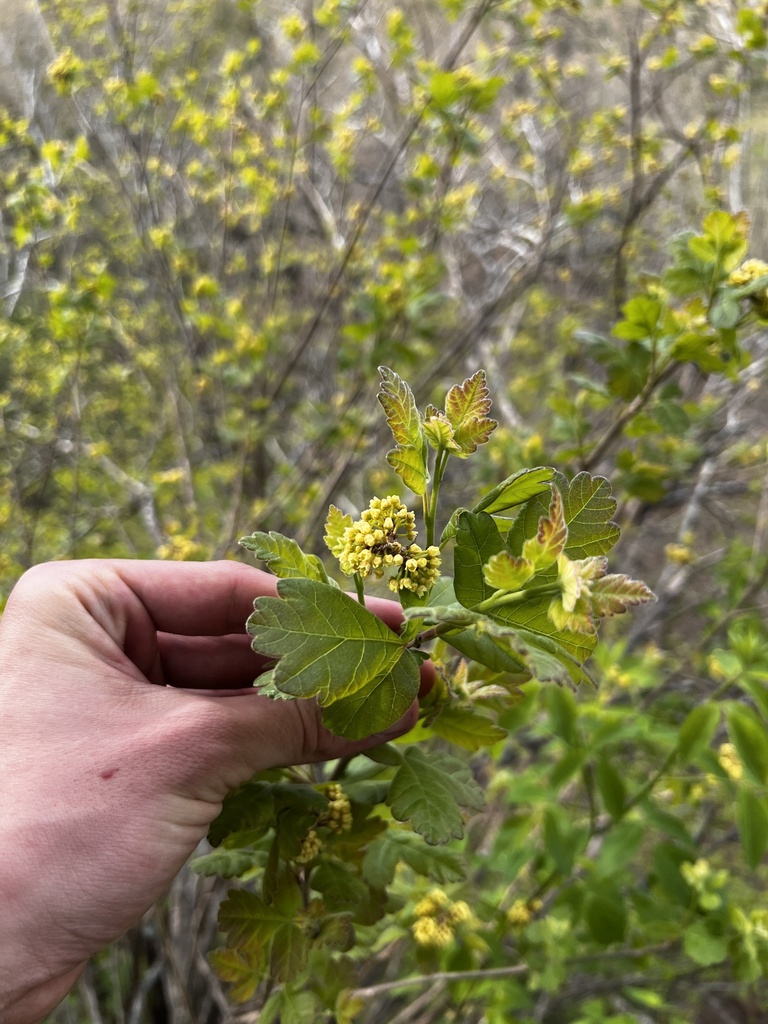
fragrant sumac
Rhus aromatica
A genus split is not a placement verdict.
Is this one for your yard?
Enter your ZIP to see whether this is legal to plant in your state, and whether it survives your winter.
Yes, fragrant sumac is rated fire resistant across several regional guides.
Six assessments recommend it, though their labels and rating systems differ. Pacific Northwest extension services list it as fire resistant, while the Forest Service and state Firewise programs place it in Firewise category 1, the safest of their four categories.
Ohio State’s extension service rates fragrant sumac “L” for both deciduous shrubs and ground covers, a recommended grade one step above the bottom of its five-band flammability scale. Virginia Tech also gives it an “L,” meaning low flammability on that program’s three-point scale. Fragrant sumac appears in both FireSmart BC’s approved fire-resistant plant chart and University of Tennessee Extension’s Firewise plant tables. The labels are not identical, but every source reaches the same practical side of the choice.
Fragrant sumac is a shrub in the Anacardiaceae family, native across much of the United States and suited to USDA zones 4a through 9b. Some guides also describe it as tolerant of drought or poor conditions and useful for erosion control, but those traits are separate from their fire ratings. Taken together, the regional guidance supports choosing fragrant sumac as a fire-resistant landscape plant, while “fire resistant” should not be read as unable to burn.
- Form
- shrub
- Rated in
- Austin, Texas; British Columbia; Maryland, New Jersey, and West Virginia; OR/WA/ID +5