Enter your ZIP to see whether this is legal to plant in your state, and whether it survives your winter.
Gum is not fire resistant overall; the findings support keeping Eucalyptus away from structures despite one conditional recommendation.
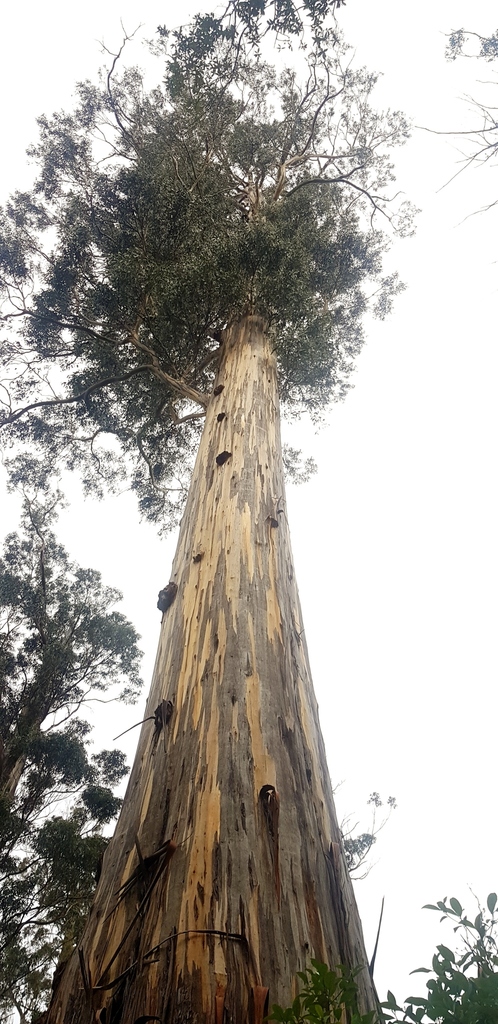
Five of six assessments warn against it, though they do not all use the same classification. UC Master Gardeners of Butte County and the City of Grants Pass list gum as highly flammable. Fire Safe Marin calls it fire-prone, while the USDA Forest Service and state Firewise programs rate it as not Firewise, their least favorable category. Oregon State University Extension describes Eucalyptus trees as flammable landscape material that contributed to wildfire intensity in the 1991 Oakland Hills Fire.
The exception comes from the University of California Agricultural Extension Service, which includes Eucalyptus among examples for fire-protection landscaping on irrigated hillsides. That recommendation requires minimizing fuel volume, watering plants according to their needs, and removing accumulated litter. It therefore describes carefully maintained landscaping, not an unconditional finding that gum resists fire.
The USDA selector also describes one hardy species with showy silver foliage as very heat resistant while still rating Eucalyptus Not Firewise. Taken together, the explicit highly flammable listings, other warnings, and the narrow conditions attached to the lone favorable recommendation support treating gum as highly flammable and keeping it away from structures.
Questions
Are eucalyptus trees flammable?
By the published evidence, yes. Nine of the ten directional sources on this record list gum as highly flammable, fire-prone or not Firewise, among them UC Master Gardeners, the City of Grants Pass, Fire Safe Marin, the South Carolina Forestry Commission and the Eastern US Fire Performance Plant Selector; one 1962 landscaping bulletin recommends it. The computed class is highly flammable, keep away.
Is it safe to plant eucalyptus near a house?
Nine of the ten directional sources on this record say to keep it away from structures, and the one recommendation is a 1962 bulletin. The first five feet are hardscape regardless of species; the plant directory lists fire-resistant trees for the outer zones.
Why do fire-resistant plant lists exclude eucalyptus?
Each list's own wording and edition is in the evidence table below: highly flammable, fire-prone, not Firewise, not recommended by six references. The one list that recommends it is shown beside them, as the disagreement it is, not averaged away.
Butte County and California's North State; California; Marin County, California; OR; Oregon; South Carolina; South Florida; Yavapai County, Arizona; eastern US
Maintenance
Typed publication scope: 6 scopes across 6 cited fire sources
South Florida (FL footprint); partial normalized coverage · 2013-04-09
Florida Forest Service labels this publication the South Florida Edition. FireApproved publishes eight exact owners from its explicit narrative hazard callouts as South Florida context. It is not a statewide ranked list and its source-wide guidance is not projected onto unnamed plants.
Marin County (CA footprint); partial normalized coverage · 2019-01-01
The publication is explicitly limited to plants common to Marin County. FireApproved publishes 104 exact owners as Marin regional context while retaining its placement, spacing, irrigation, and maintenance boundary. It is not statewide California guidance or parcel suitability.
The UC Forest Products Laboratory says the guide covers properties of common California landscaping plants and was prepared for California fire agencies. FireApproved publishes 130 exact owners at historical California publication scope. The report is a 1997 compilation, not a current endorsement, site rating, or independent test of every row.
South Carolina Forestry Commission publishes this explicitly as its Fire Smart Plant List for South Carolina. FireApproved publishes 63 exact genus owners from 72 unique common-name labels; unsafe common-name mappings and duplicates are not broadened. The brochure calls the list non-inclusive and does not establish species-level or site-specific suitability.
Butte County and California's North State (CA footprint); partial normalized coverage · 2023-06-02
UC Master Gardeners of Butte County frame the article for North State residents. FireApproved publishes only the two taxonomically exact owners from its prose examples and keeps them as northern California regional context. Generic maples, broom, Echinacea, creeping thyme, and Oregon grape remain held rather than being projected to species. The article is not a statewide list or site clearance.
Yavapai County (AZ footprint); partial normalized coverage · 2025-03-14
University of Arizona Cooperative Extension authors Bulletin 34 for Yavapai County. FireApproved publishes 198 exact source owners from its resistant and prone tables and keeps the county boundary visible. County publication scope is regional Arizona context, never statewide scope.
2. Why this plant is relevant here
State distribution
Documented in CA.
Native range
Introduced / established
USDA hardiness
Only uncertain or inapplicable hardiness rows are cited; no primary zone is projected.
3. Legal, ecological, and broader status
Legal-list status
Seed-list status
Reported invasive here
Broader regional context
Federal context
How to read this page
The status above is computed from the cited rows below: independent recommendations can support a fire-resistant result, an avoid row can produce keep-away, and disagreement stays visible as conflict. Placement notes preserve each source’s own scheme rather than translating unlike rules into one scale. This is evidence about a plant, not permission to plant it in every part of the defensible space; Zone 0 remains noncombustible.
Plant hardiness evidence
These values describe the plant source. Your ZIP zone comes from the separate 2023 USDA
Plant Hardiness Zone Map. Whole-zone values stay whole-zone, and a single unresolved value
is not treated as a tolerance range. Different source boundaries stay separate: overlapping
statements are compared independently, while only ranges with no shared zone are called a conflict.
Source prints 7 · single-value meaning unresolved · whole zone precision · source stated
Source taxon: Eucalyptus spp. · exact match.
Source location: Cold Hardiness Zone field in the recovered selector record.
Not used for comparison: The recovered selector prints one Cold Hardiness Zone value but does not define it as a minimum threshold or a one-zone range.
Conditions in the fire evidence
These describe tested or rated plant material. They are not horticultural maintenance instructions.
Placement rules below use each source's own distances or named zones, tied to its rating.
They are not interchangeable with the directory's current Zone 0 guidance.
Eastern United States Fire Performance Plant Selector: Landscape Zone 3 — 10–30 ft from the structure; thin vegetation, remove debris, and minimize plant massing [Fire Performance Plant Selector landscape zone] (with its avoid rating)
Landscape for Fire Protection: irrigated hillsides [maire-1968-fire-protection-landscape] (with its recommendation)
Defensible Space Landscaping in the Urban/Wildland Interf…: Chapter 4, Landscape Vegetation Database [ucfpl-1997] (with its avoid rating)
Landscaping Can Be Attractive & FIREWISE: TREES [SCFC Fire Smart plant-form sections] (with its avoid rating)
Landscaping to Reduce Wildfire Risk: South Florida Edition: eucalyptus [South Florida guide narrative callouts] (with its avoid rating)
The evidence
Grouped by what each source concluded. Primary evidence rated the plant itself
(a lab, field program, or original curation); corroboration compiled or
republished another source's rating and resolves to its root lineage.
Eucalyptus (Eucalyptus) appears in the source's conditioned examples for landscaping irrigated hillsides. Fuel volume is to be minimized, plants watered to their needs, and accumulated litter removed.
Listed as Eucaltyptus — Eucalyptus sp.. The bulletin says fire-resistant plants tend to resist ignition when irrigated and maintained, while fire-prone plants may ignite readily and burn intensely.