United States / Grow / Tasmanian bluegum

Tasmanian bluegum (Eucalyptus globulus)
Photo: (c) Yoav Daniel Bar-Ness, some rights reserved (CC BY) (CC BY), via iNaturalist. Species-typical, not necessarily this cultivar.

Tasmanian bluegum

Eucalyptus globulus · Myrtaceae · all Eucalyptus records · also called Blue Gum · Wikipedia

View Saved

Is this one for your yard?

Enter your ZIP to see whether this is legal to plant in your state, and whether it survives your winter.

No.

Tasmanian bluegum is highly flammable, and the available assessments support keeping it away from structures.

Four assessments reach an unfavorable verdict. The Tasmania Fire Service assigns it to its high-flammability group, whose guidance says not to plant or keep it within the Building Protection Zone. California’s Diablo Firesafe Council also places bluegum among plants with unfavorable fire performance in at least three references, although it cautions that the ranking terms in many underlying references were undefined.

Laboratory findings reinforce that warning. A 2021 IJERPH study rated the species extremely flammable, the highest band on its live-leaf index. All 50 live-leaf samples ignited, with a mean ignition time of 3.98 seconds. A 2020 International Journal of Wildland Fire study placed it in higher-heating-value class 4, which its five-class scale treats as high risk. It also reported a mean leaf flash point of 245 °C, while expressly warning that the flash-point measurement had low precision.

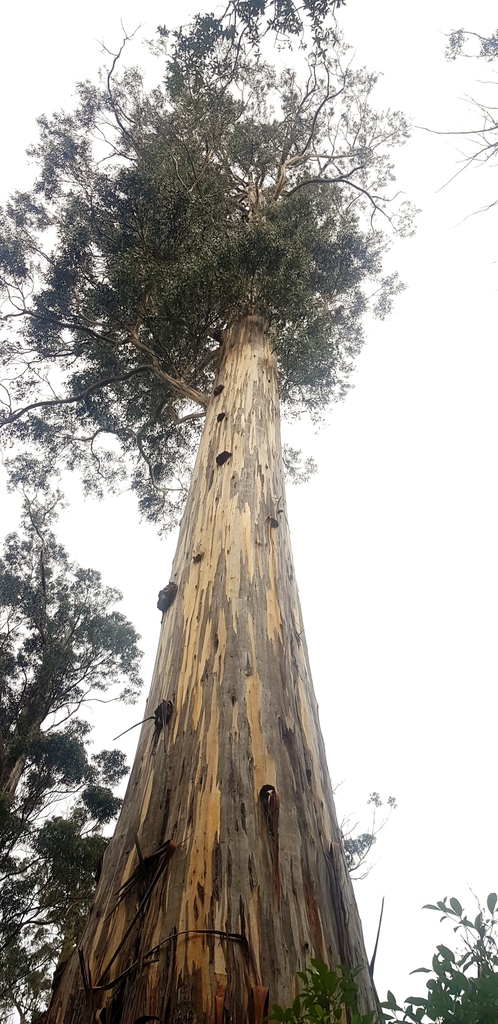
A separate calorimeter measurement found a calorific value of 5,218.21 kilocalories per kilogram for predried leaves sampled in winter. That number describes the leaves’ energy content under the stated test conditions; it is not a stand-alone landscape rating. Still, it sits beside several direct flammability assessments pointing the same way. For a tree that can reach about 160 feet, the practical conclusion is clear: Tasmanian bluegum should not be treated as a fire-resistant choice near structures.

Fire-resistant trees instead

Form
tree
Mature height
~160 ft
Water need
high
Rated in
California; Global; Peñuelas Lake National Reserve, Valparaíso, Chile; Tasmania, Australia
On this lot

1. Fire evidence and conditions

Fire evidence
Highly flammable — location does not change the cited classification.
Fire-performance conditions
1 condition stated in cited fire-evidence rows.
Placement evidence
2 source placement records; source schemes remain separate.
Evidence regions
California; Global; Peñuelas Lake National Reserve, Valparaíso, Chile; Tasmania, Australia
Typed publication scope: 1 scope across 1 cited fire source
  • Fire Performance of Common Plants (Guide to Plants) · Official scoped edition
    • CA; partial normalized coverage · 2026-08-29

      The guide presents itself as fire performance ratings for common landscape plants in a fire-prone California setting. FireApproved publishes 104 exact owners as republished California context. It is not an independent rating, a current endorsement, or parcel suitability.

2. Why this plant is relevant here

State distribution
Documented in CA, HI.
Introduced / established
2 sourced range or established records. This is not an invasive warning.
USDA hardiness
Documented minimum 8b; no upper limit is documented.

3. Legal, ecological, and broader status

Reported invasive here
2 ecological invasive reports.
How to read this page

The status above is computed from the cited rows below: independent recommendations can support a fire-resistant result, an avoid row can produce keep-away, and disagreement stays visible as conflict. Placement notes preserve each source’s own scheme rather than translating unlike rules into one scale. This is evidence about a plant, not permission to plant it in every part of the defensible space; Zone 0 remains noncombustible.

Native and introduced range evidence

These are exact U.S. botanical-area records from the cited range source. Native and introduced describe biogeographic relationship, not fire performance or planting approval. Doubtful and extinct rows stay visible but do not count as current presence.

Current native

0

exact source areas

Current introduced

2

exact source areas

Qualified

0

doubtful or extinct source rows

2 introduced source areas · World Checklist of Vascular Plants, version 16 v16, as of 2026-06-04
  • California (CA)
  • Hawaii (HI)

The lossless worldwide derivative is retained once in the research corpus; object pages repeat only exact U.S. areas needed by the local lens. The JSON twin carries the same page assertions.

Plant hardiness evidence

These values describe the plant source. Your ZIP zone comes from the separate 2023 USDA Plant Hardiness Zone Map. Whole-zone values stay whole-zone, and a single unresolved value is not treated as a tolerance range. Different source boundaries stay separate: overlapping statements are compared independently, while only ranges with no shared zone are called a conflict.

Conditions in the fire evidence

These describe tested or rated plant material. They are not horticultural maintenance instructions.

Where its sources say to plant it

Placement rules below use each source's own distances or named zones, tied to its rating. They are not interchangeable with the directory's current Zone 0 guidance.

The evidence

Grouped by what each source concluded. Primary evidence rated the plant itself (a lab, field program, or original curation); corroboration compiled or republished another source's rating and resolves to its root lineage.

Avoids (4)

Corroboration (1 rows from 1 source)
  • Fire Performance of Common Plants (Guide to Plants) — Diablo Firesafe Council · live page captured 2026-08-29 · original source Corroboration Mirror lineage: ucfpl-berkeley resolves to Defensible Space Landscaping in the Urban/Wildland Interface: A Compilation of Fire Performance Ratings of Residential Landscape Plants

    “Table 2: unfavorable fire performance rating in 3 or more references (refs 4,9,8)”

    The Diablo Firesafe Council Guide to Plants lists Eucalyptus globulus (Eucalyptus globulus, Blue gum) as tree, evergreen, in Table 2: plants with a unfavorable fire performance rating in 3 or more references. The guide cites 3 of its 57 numbered references for this row (4,9,8). The guide states the ranking terms in its underlying references were mostly undefined and makes no attempt to rank within the list, and that fire performance is compromised without maintenance.

Listed without a rating (46)
Corroboration (46 rows from 1 source)
  • FLAMITS: FLAMmability plant traiTS database — Dryad / Global Ecology and Biogeography · Dryad version 9 · original source Corroboration Trait database lineage: meta-aggregator

    46 cited rows from this source; its identity, lineage and tier are stated once.

    • Primary study Dickinson1985: Dickinson, K. J. M., & Kirkpatrick, J. B. (1985). The flammability and energy content of some important plant-species and fuel components in the forests of Southeastern Tasmania. Journal of Biogeography, 12, 121-134.

      Shared row context: plant part leaves; fuel live; predrying yes; device calorimeter; site Dickinson1985-1; sampling winter.

      • “calorific value (kcal/kg): 5218.21”

        FLAMITS record 2925; Combustibility measurement.

      • Shared measurement context: Sustainability measurement.

        • “rate of burning spread (cm/s): 0.15”

          FLAMITS record 2951.

        • “rate of burning spread (cm/s): 0.19”

          FLAMITS record 2952.

    • Primary study Guerrero2021: Guerrero, F., Hernández, C., Toledo, M., Espinoza, L., Carrasco, Y., Arriagada, A., ... Carmona, C. (2021). Leaf thermal and chemical properties as natural drivers of plant flammability of native and exotic tree species of the valparaíso region, Chile. International journal of environmental research and public health, 18, 7191.

      Shared row context: plant part leaves; fuel live; predrying no; device epiradiator; site Guerrero2021-1; sampling summer.

      • Shared measurement context: Ignitability measurement.

        • “time to flaming (s): 3.97”

          FLAMITS record 4619.

        • “ignition frequency (%): 50”

          FLAMITS record 4634.

        • “flammability value: 5”

          FLAMITS record 4639.

      • Shared measurement context: Sustainability measurement.

        • “flaming duration (s): 9.46”

          FLAMITS record 4624.

        • “burning duration (s): 49.38”

          FLAMITS record 4629.

      • “calorific value (kcal/kg): 5316.7”

        FLAMITS record 4644; Combustibility measurement.

    • Primary study Guijarro2002: Guijarro, M., Hernando, C., Díez, C., Martínez, E., Madrigal, J., Lampin-Cabaret, C., ... Vega, J. (2002). Flammability of some fuel beds common in the South-European ecosystems. IV International Conference Forest Fire Research. Coimbra, Portugal.

      Shared row context: plant part litter; fuel all; predrying no; device burning bench; site Guijarro2002-1; sampling ND.

      • Shared measurement context: Ignitability measurement.

        • “time to flaming (s): 9.09”

          FLAMITS record 4647.

        • “ignition frequency (%): 45”

          FLAMITS record 4670.

        • “time to flaming (s): 9.09”

          FLAMITS record 4678.

      • “flame height (cm): 65”

        FLAMITS record 4654; Combustibility measurement.

      • Shared measurement context: Sustainability measurement.

        • “rate of burning spread (cm/s): 0.17”

          FLAMITS record 4660.

        • “rate of burning spread (cm/s): 0.17”

          FLAMITS record 4686.

      • “burnt biomass (%): 79”

        FLAMITS record 4693; Consumability measurement.

    • Primary study Madrigal2011a: Madrigal, J., Guijarro, M., Hernando, C., Díez, C., & Marino, E. (2011a). Effective Heat of Combustion for Flaming Combustion of Mediterranean Forest Fuels. Fire Technology, 47, 461-474.

      Shared row context: plant part twigs; fuel live; predrying no; device calorimeter; site Madrigal2011a-1; sampling ND.

      • “flaming duration (s): 48”

        FLAMITS record 7328; Sustainability measurement.

      • Shared measurement context: Combustibility measurement.

        • “maximum energy flux (kW/m²): 397”

          FLAMITS record 7348.

        • “mass loss rate (g/s): 0.06”

          FLAMITS record 7388.

        • “total heat release (MJ/m²): 20.33”

          FLAMITS record 7408.

      • “time to flaming (s): 4”

        FLAMITS record 7368; Ignitability measurement.

    • Primary study Nunez1996: Nunez-Regueira, L., Anon, J. A. R., & Castineiras, J. P. (1996). Calorific values and flammability of forest species in Galicia. Coastal and hillside zones. Bioresource Technology, 57, 283-289.

      Shared row context: plant part litter; fuel all; predrying no; site Nunez1996-1.

      • Shared measurement context: Combustibility measurement; device calorimeter; sampling spring.

        • “calorific value (kcal/kg): 4437.01”

          FLAMITS record 9774.

        • “calorific value (kcal/kg): 4572.16”

          FLAMITS record 9778.

      • Shared measurement context: Combustibility measurement; device calorimeter; sampling summer.

        • “calorific value (kcal/kg): 1480.18”

          FLAMITS record 9775.

        • “calorific value (kcal/kg): 1961.18”

          FLAMITS record 9779.

      • Shared measurement context: Combustibility measurement; device calorimeter; sampling autumn.

        • “calorific value (kcal/kg): 4958.63”

          FLAMITS record 9776.

        • “calorific value (kcal/kg): 4189.13”

          FLAMITS record 9780.

      • Shared measurement context: Combustibility measurement; device calorimeter; sampling winter.

        • “calorific value (kcal/kg): 1610.61”

          FLAMITS record 9777.

        • “calorific value (kcal/kg): 1316.23”

          FLAMITS record 9781.

      • “flammability value: 4”

        FLAMITS record 9846; Ignitability measurement; device epiradiator; sampling spring.

      • “flammability value: 4”

        FLAMITS record 9855; Ignitability measurement; device epiradiator; sampling summer.

      • “flammability value: 4”

        FLAMITS record 9864; Ignitability measurement; device epiradiator; sampling autumn.

      • “flammability value: 3”

        FLAMITS record 9873; Ignitability measurement; device epiradiator; sampling winter.

    • Primary study Rossa2016: Rossa, C. G., Veloso, R., & Fernandes, P. M. (2016). A laboratory-based quantification of the effect of live fuel moisture content on fire spread rate. International Journal of Wildland Fire, 25, 569-573.

      Shared row context: plant part stems; fuel live; predrying no; device burning bench; site Rossa2016-1.

      • “rate of burning spread (cm/s): 1.268888888”

        FLAMITS record 16618; Sustainability measurement; sampling march and june 2014.

      • “flame height (cm): 152.5”

        FLAMITS record 16619; Combustibility measurement; sampling march and june 2015.

    • Primary study Sahila2023: Sahila, A., Boutchiche, H., Viegas, D. X., Reis, L., & Zekri, N. (2023). A comparative study of the combustion dynamics and flame properties of dead Mediterranean plants. International Journal of Wildland Fire, 32, 979-988.

      Shared row context: plant part leaves; fuel dead; predrying no; device burning bench; site Sahila2023-1; sampling ND.

      • Shared measurement context: Combustibility measurement.

        • “flame height (cm): 190”

          FLAMITS record 18023.

        • “mass loss rate (g/s): 10”

          FLAMITS record 18024.

        • “maximum flame temperature (°C): 292”

          FLAMITS record 18025.

        • “calorific value (kcal/kg): 3224.41”

          FLAMITS record 18041.

      • Shared measurement context: Sustainability measurement.

        • “flaming duration (s): 845”

          FLAMITS record 18026.

        • “flaming duration (s): 300”

          FLAMITS record 18040.

      • “time to flaming (s): 7”

        FLAMITS record 18027; Ignitability measurement.

    • Primary study Ganteaume2009: Ganteaume, A., Lampin-Maillet, C., Guijarro, M., Hernando, C., Jappiot, M., Fonturbel, T., ... Vega, J.A. (2009). Spot fires: fuel bed flammability and capability of firebrands to ignite fuel beds. International Journal of Wildland Fire, 18, 951-969.

      Shared row context: plant part litter; fuel all; predrying yes; device burning bench; site Ganteaume2009-2; sampling ND.

      • Shared measurement context: Ignitability measurement.

        • “ignition frequency (%): 94”

          FLAMITS record 19827.

        • “time to flaming (s): 9.09”

          FLAMITS record 19828.

      • “rate of burning spread (cm/s): 0.17”

        FLAMITS record 19829; Sustainability measurement.

      • “flame height (cm): 74.1”

        FLAMITS record 19830; Combustibility measurement.
Fire-resistant trees instead

Fire-resistant trees listed above

Last verified 2026-08-23. JSON (CC BY 4.0)

Profiles: USDA PLANTS · GBIF · iNaturalist · Wikidata · Wikipedia · ITIS

Eucalyptus globulus (Blue Gum). FireApproved. https://fireapproved.com/plants/eucalyptus-globulus/. Last verified 2026-08-23.