Enter your ZIP to see whether this is legal to plant in your state, and whether it survives your winter.
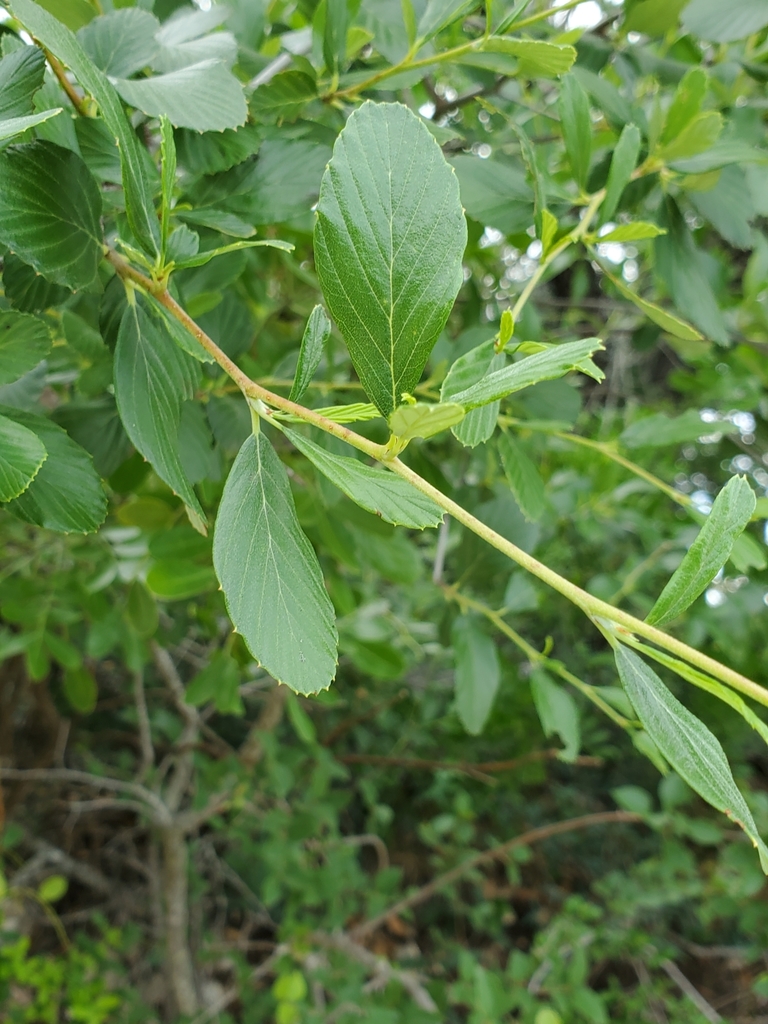
Alderleaf mountain mahogany should be treated as highly flammable near a home, despite appearing on three regional Firewise lists.
The strongest adverse finding comes from Idaho Firewise’s field trial. It gave the shrub a fire-resistance score of 3 out of 10, which falls in the avoid range on that source’s scale. In contrast, the University of Arizona Cooperative Extension recommends it above 3,000 feet, Fremont County Firewise includes it among plants generally described as low-growing, low-debris, and relatively moist, and New Mexico’s Forestry Division recommends it from 4,000 through 7,000 feet while marking suitability at 8,000 feet and above as unknown or doubtful.
These findings reflect different methods and regional settings. The favorable sources are compiled planting lists for Arizona, Wyoming, and New Mexico, while Idaho’s result comes from a field trial in the Intermountain region. A University of California Forest Products Laboratory compilation explicitly found conflicting information about this shrub’s fire performance and warned that many underlying plant lists used undefined terms or lacked a scientific basis.
USDA Forest Service testing adds measurements without placing the shrub in either its high- or low-flammability group: foliage moisture was 41 percent, green-sample peak heat release was 141 kW/m², and dry-sample effective heat of combustion was 15.8 MJ/kg. Those laboratory values describe moisture and burning behavior under test conditions, but they do not erase the adverse field score. For defensible-space decisions, the conflict should be resolved cautiously by keeping this roughly 12-foot shrub away from structures.
Fremont County (WY footprint); partial normalized coverage · 2011-02-25
The source identifies itself as the Fremont County Firewise Plant List. FireApproved publishes its 92 exact source owners as Fremont County regional context. No methodology, current county endorsement, statewide Wyoming scope, or site-specific suitability is inferred.
Southern Idaho (ID footprint); partial normalized coverage · 2013-11-08
The official database labels itself "For Southern Idaho" and describes Idaho residents at the urban-rangeland interface. FireApproved publishes 419 existing plant owners that cite its scored rows. This bounded Southern Idaho scope is regional context, not statewide coverage or a conclusion that the score transfers unchanged to every Idaho site.
The UC Forest Products Laboratory says the guide covers properties of common California landscaping plants and was prepared for California fire agencies. FireApproved publishes 130 exact owners at historical California publication scope. The report is a 1997 compilation, not a current endorsement, site rating, or independent test of every row.
New Mexico Forestry Division publishes this as its FireWise Plant List for New Mexico. FireApproved accounts for all 140 printed rows and publishes 95 exact same-rank owners already represented in the directory; 29 exact taxa without an existing record, 14 unresolved spellings or higher-rank matches, one compound taxon cell, and one species row whose only apparent owner has an infraspecific printed identity remain held. Every published row retains the source's Y, N, ?, or blank elevation cells. Publication scope does not erase those elevation limits or establish suitability for every New Mexico site.
Arizona at or above 3,000 feet (AZ footprint); partial normalized coverage · 2011-12-01
AZ1289 is explicitly limited to Arizona elevations of 3,000 feet and higher. FireApproved publishes 69 exact owners as regional Arizona context, retaining every water and elevation condition. It is never promoted to statewide low-desert guidance or an independent Tier 1 vote.
2. Why this plant is relevant here
State distribution
Documented in AZ, CA, CO, ID, KS, MT, NE, NM, NV, OK, OR, SD, TX, UT, WY.
Native range
Current cited native range in AZ, CO, ID, NE, NM, NV, OK, SD, TX, UT, WY.
Introduced / established
USDA hardiness
Documented minimum 3a; no upper limit is documented.
3. Legal, ecological, and broader status
Legal-list status
Seed-list status
Reported invasive here
Broader regional context
Federal context
How to read this page
The status above is computed from the cited rows below: independent recommendations can support a fire-resistant result, an avoid row can produce keep-away, and disagreement stays visible as conflict. Placement notes preserve each source’s own scheme rather than translating unlike rules into one scale. This is evidence about a plant, not permission to plant it in every part of the defensible space; Zone 0 remains noncombustible.
Native and introduced range evidence
These are exact U.S. botanical-area records from the cited range source. Native and
introduced describe biogeographic relationship, not fire performance or planting approval.
Doubtful and extinct rows stay visible but do not count as current presence.
The lossless worldwide derivative is retained once in the research corpus; object pages repeat only exact U.S. areas needed by the local lens. The JSON twin carries the same page assertions.
Plant hardiness evidence
These values describe the plant source. Your ZIP zone comes from the separate 2023 USDA
Plant Hardiness Zone Map. Whole-zone values stay whole-zone, and a single unresolved value
is not treated as a tolerance range. Different source boundaries stay separate: overlapping
statements are compared independently, while only ranges with no shared zone are called a conflict.
Placement rules below use each source's own distances or named zones, tied to its rating.
They are not interchangeable with the directory's current Zone 0 guidance.
Fire Resistance of Plants Master Database: plantable at 80' from home [Idaho minimum planting distance] (with its avoid rating)
Defensible Space Landscaping in the Urban/Wildland Interf…: Chapter 4, Landscape Vegetation Database [ucfpl-1997] (mid-scale rating)
FireWise Plant List for New Mexico: PDF page 4, Shrubs, p4-r07 [nm-emnrd-firewise-table-row] (with its recommendation)
The evidence
Grouped by what each source concluded. Primary evidence rated the plant itself
(a lab, field program, or original curation); corroboration compiled or
republished another source's rating and resolves to its root lineage.
“Fremont County Firewise Plant List — Cercocarpus montanus — True Mountain Mahogany”
Listed in the source's Shrubs section; the page describes its listed Firewise plants as generally low-growing, low-debris, and relatively moist.
FireWise Plant List for New Mexico — New Mexico Energy, Minerals and Natural Resources Department, Forestry Division · 2003 Forestry Division PDF · original sourceCorroborationCompilationlineage: csu-nmsu-firewise
3 cited rows from this source; its identity, lineage and tier are stated once.
Primary study White2002: White, R. H., Weise, D. R., Mackes, K., & Dibble, A. C. (2002). Cone calorimeter testing of vegetation--an update. Ninth International Conference on Electrical and Electronic Products. Columbus, Ohio, USA.
Shared row context: Combustibility measurement; plant part leaves; fuel live; device calorimeter; site White2002-2; sampling ND.