Enter your ZIP to see whether this is legal to plant in your state, and whether it survives your winter.
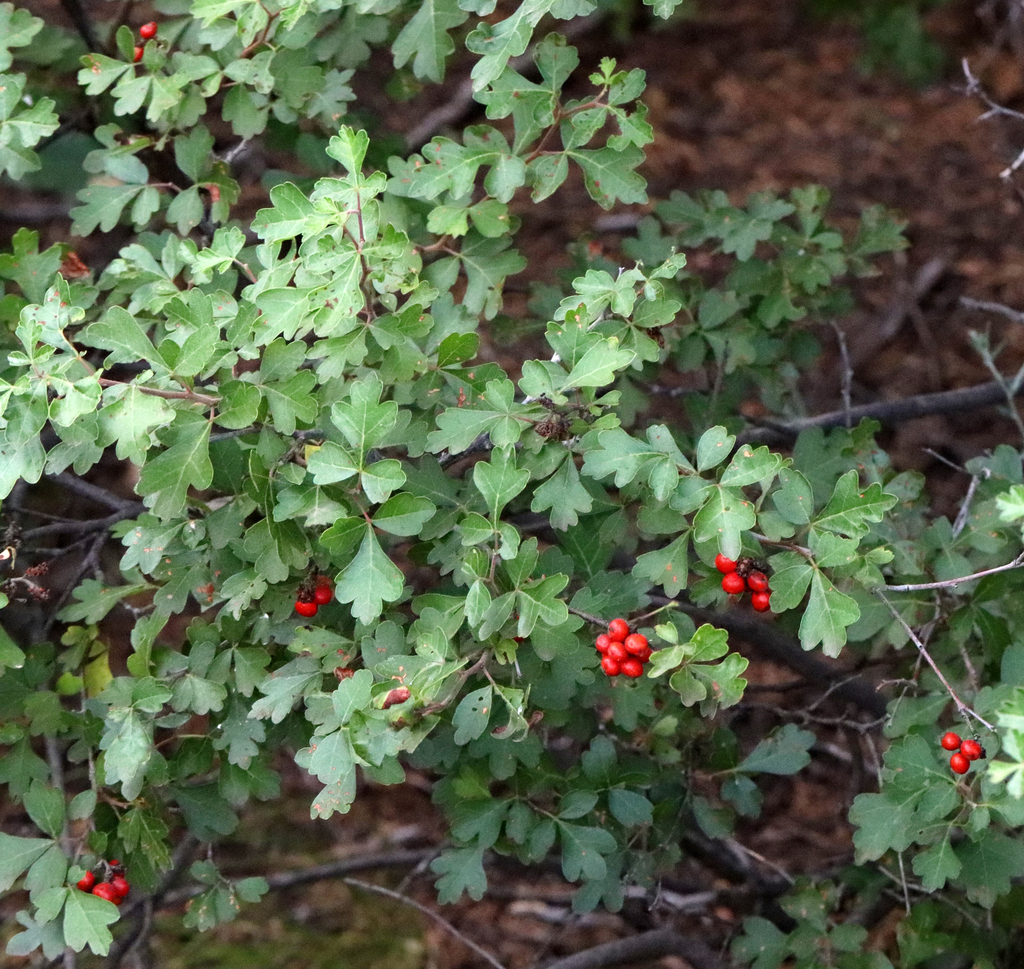
Skunkbush sumac is rated fire resistant, but its published scores should remain distinct.
Idaho Firewise records an eight for Autumn Amber and a seven for oak-leaf sumac under Rhus trilobata. Colorado State University Extension and the Colorado State Forest Service likewise print an eight specifically for Autumn Amber. That score meets their recommendation for defensible-space Zones 1 and 2; it should not be extended to the lower-scoring form.
Regional plant guides also favor the shrub. Montana State lists it among fire-resistant plants adapted to Montana, while Utah State's Firewise recommendation depends on proper use and maintenance. New Mexico marks its printed elevations from 4,000 through 8,000 feet yes and leaves 9,000-plus unknown or doubtful.
The favorable overall assessment thus includes meaningful distinctions for plant selection. A gardener choosing a form has an eight-point finding attached to Autumn Amber, a separate seven for oak-leaf sumac, and regional recommendations with their own maintenance or elevation qualifications.
Form
shrub
Mature height
~4 ft
Water need
low
Rated in
British Columbia; Colorado / Rocky Mountain Front Range; Montana / Northern Rockies; New Mexico +2
On this lot
1. Fire evidence and conditions
Fire evidence
Fire-resistant — location does not change the cited classification.
Colorado State University Extension and the Colorado State Forest Service publish Fact Sheet 6.305 for Colorado's WUI and varied ecosystems. FireApproved exposes all 114 exact source owners at Colorado publication scope while retaining score, elevation, water, and Idaho-carrier lineage. Publication scope is not suitability for every Colorado site or zone.
Southern Idaho (ID footprint); partial normalized coverage · 2013-11-08
The official database labels itself "For Southern Idaho" and describes Idaho residents at the urban-rangeland interface. FireApproved publishes 419 existing plant owners that cite its scored rows. This bounded Southern Idaho scope is regional context, not statewide coverage or a conclusion that the score transfers unchanged to every Idaho site.
The April 2022 MontGuide explicitly presents fire-resistant species adapted to Montana. FireApproved publishes 92 exact plant records from the source while retaining excluded genus, family, and unresolved rows; the guide itself says not every listed species grows in every part of the state.
New Mexico Forestry Division publishes this as its FireWise Plant List for New Mexico. FireApproved accounts for all 140 printed rows and publishes 95 exact same-rank owners already represented in the directory; 29 exact taxa without an existing record, 14 unresolved spellings or higher-rank matches, one compound taxon cell, and one species row whose only apparent owner has an infraspecific printed identity remain held. Every published row retains the source's Y, N, ?, or blank elevation cells. Publication scope does not erase those elevation limits or establish suitability for every New Mexico site.
Utah State University Extension states that this fact sheet selects examples for Utah landscapes and that they require proper placement and maintenance. FireApproved publishes 83 exact source owners at Utah publication scope. The table is not a site-specific planting clearance.
2. Why this plant is relevant here
State distribution
Documented in AR, AZ, CA, CO, IA, ID, KS, MD, MT, ND, NE, NM, NV, OK, OR, SD, TX, UT, WA, WY.
Native range
Introduced / established
USDA hardiness
Documented minimum 2a; no upper limit is documented.
3. Legal, ecological, and broader status
Legal-list status
Seed-list status
Reported invasive here
Broader regional context
Federal context
How to read this page
The status above is computed from the cited rows below: independent recommendations can support a fire-resistant result, an avoid row can produce keep-away, and disagreement stays visible as conflict. Placement notes preserve each source’s own scheme rather than translating unlike rules into one scale. This is evidence about a plant, not permission to plant it in every part of the defensible space; Zone 0 remains noncombustible.
Plant hardiness evidence
These values describe the plant source. Your ZIP zone comes from the separate 2023 USDA
Plant Hardiness Zone Map. Whole-zone values stay whole-zone, and a single unresolved value
is not treated as a tolerance range. Different source boundaries stay separate: overlapping
statements are compared independently, while only ranges with no shared zone are called a conflict.
Source location: PlantCharacteristics record 92983, Temperature, Minimum (°F).
Where its sources say to plant it
Placement rules below use each source's own distances or named zones, tied to its rating.
They are not interchangeable with the directory's current Zone 0 guidance.
Fire Resistance of Plants Master Database: plantable at 30' from home [Idaho minimum planting distance] (with its recommendation)
FireSmart BC Plant Program: suitable for HIZ extended zone (30-100 m) [FireSmart BC Home Ignition Zone] (with its recommendation)
Ignition-Resistant Landscape Plants: suitable for defensible-space zones 1-2 (score 8+) [CSU defensible-space zone] (with its recommendation)
FireWise Plant List for New Mexico: PDF page 4, Shrubs, p4-r26 [nm-emnrd-firewise-table-row] (with its recommendation)
The evidence
Grouped by what each source concluded. Primary evidence rated the plant itself
(a lab, field program, or original curation); corroboration compiled or
republished another source's rating and resolves to its root lineage.
Listed among fire-resistant plant species adapted to Montana.
Ignition-Resistant Landscape Plants (Fact Sheet 6.305) — Colorado State University Extension / Colorado State Forest Service (Wildfire Mitigation Series) · 2025 · original sourcePrimary evidenceField programlineage: idaho-tree resolves to Fire Resistance of Plants Master Database
“ignitability score 8 of 10”
· score 8 (idaho-0-10)
CSU 6.305 table lists Rhus trilobata 'Autumn Amber' (Autumn Amber sumac) with the preserved ignitability score.
FireWise Plant List for New Mexico — New Mexico Energy, Minerals and Natural Resources Department, Forestry Division · 2003 Forestry Division PDF · original sourceCorroborationCompilationlineage: csu-nmsu-firewise