Home / Guides / How to read a record / Piñon-juniper woodland is the yard
Piñon-juniper woodland is the yard
The woodland is the planting. NMSU Los Alamos Extension: no vegetation within 5 feet of the building. No conifer trees within 30 feet of the structure. Hardscape in the 5-foot perimeter. NM EMNRD / NMSU: there are no truly fireproof plant species. Where and how you plant can be more important than what species you use. Conifers tend to be flammable due to oil and pitch, regardless of water status. The opened FireWise plant list does not name piñon or juniper. Pinus edulis currently computes as a candidate and includes NM.
You are in a Los Alamos casita keeping every piñon for the view. The demonstration sheet’s first note is empty ground for five feet, then no conifer for thirty.
This is not a New Mexico doorway.
Why it matters
“Native woodland” is easy to hear as the landscape plan. The opened NMSU sheet is hardscape at the wall. The opened EMNRD pamphlet is spacing over species, borrowed from Colorado’s Chuck Dennis. When the lab disagrees with the lists is the cone-calorimeter row for Juniperus monosperma. This page is the yard is the fuel type. Zone 0 is still not a planting list.
This site’s New Mexico plant evidence currently holds 429 USDA-distribution records. That is occurrence, not a PJ palette.
How it works
The casita (NMSU Los Alamos):
- Immediate 0–5 feet: hardscape occupies the perimeter. No vegetation within 5 feet. Gutters and roof clear. Canopy >10 feet from the roof, >15 feet from the chimney.
- No conifer trees within 30 feet of the structure.
- 5–30 feet: fuel breaks of paths and patios; grass to 4 inches; trees in small clusters; prune 6–10 feet; crowns >18 feet apart (more on slope).
- 30–100 feet, up to 200: interrupt spread; keep fire on the ground; conifer canopies >12 feet apart.
- Demonstration garden is one-fifth actual size. Do not treat the photo as a 5-foot scale.
The pamphlet (EMNRD / NMSU):
- No fireproof plants. Where and how > what.
- Conifers: oil and pitch, even when well-watered.
- Deciduous: higher moisture, less canopy fuel when dormant.
- Salt cedar: salt-tolerant and volatile oils, burns very hot. Exception, not a rule.
- Clusters and islands, not masses. Rock and gravel as fuel breaks.
- Mulch: wood chips or gravel. Avoid pine bark and thick pine needles.
- Maintenance: fire-resistant plants lose those characteristics over time.
- Heavily borrowed from CSU / Chuck Dennis. Lineage is disclosed on the pamphlet.
The list:
- Elevation bands in thousands of feet (4 through 9+).
- The source has 140 printed rows. 95 exact same-rank owners publish; 45 rows remain held rather than widened or used to mint thin records.
- Each published plant retains its exact Y / N / ? / blank elevation cells. A state match does not erase a row’s elevation condition.
- Trees named include Rocky Mountain maple, serviceberry, desert willow, New Mexico locust in the characteristics text.
- Piñon and juniper are not on the extracted tree table.
This directory:
- New Mexico: 429 records. 199 on-list, 37 avoid, 7 conflict, 186 candidate.
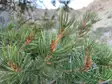
- Pinus edulis candidate, mid-scale, NM.
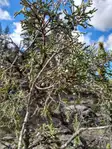
- Juniperus scopulorum avoid, consensus, NM.
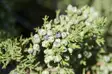
- Juniperus monosperma avoid, limited-evidence. USDA states on this record do not include NM.
- Populus tremuloides on-list, NM. EMNRD names aspen as a resprouter.
- Cercocarpus montanus avoid, NM. EMNRD names mountain mahogany as low-volume vegetation. Avoid is the computed banner. Read the row.
The paths
| Claim | Opened source | What it is not |
|---|---|---|
| No plants in 5 feet | NMSU Los Alamos | A piñon foundation |
| No conifer in 30 feet | Same sheet | A pruned-juniper exemption |
| Spacing over species | EMNRD / NMSU | A PJ cultivar that is fireproof |
| Conifers burn wet | Oil and pitch sentence | A well-watered piñon permit |
| Fire Wise list | Maples, serviceberry, desert willow | Piñon and juniper |
| Piñon candidate | Computed, NM | On-list because native |
| Oneseed juniper avoid | Lab lineage | A New Mexico USDA flag on this record |
| 429 New Mexico records | USDA distribution | The 140-row FireWise table |
What people mix up
- Living in the woodland with planting the woodland against the wall.
- Native with on-list.
- EMNRD’s mountain mahogany example with this site’s avoid banner on Cercocarpus montanus.
- Lab vs lists with this spacing sheet.
- Montana MontGuide thick-bark forest survivors with New Mexico’s no conifer in 30 feet.
- The one-fifth demonstration garden with full-scale 5 and 30 feet.
- CSU’s original with a New Mexico-only invention. The pamphlet says it borrowed.
How to check
- Open the NMSU Los Alamos sheet. Read “no vegetation within 5’” and “no conifer trees within 30’.”
- Open Fire Wise Plant Materials. Read “where and how.”
- Search the plant list PDF for Pinus edulis and Juniperus.
- Open Pinus edulis and Juniperus monosperma.
- Open New Mexico plant evidence. Distribution is not the woodland.
- Do not plant in Zone 0.
Limits
This page quotes the opened NMSU Los Alamos PDF, the opened EMNRD/NMSU Fire Wise Plant Materials PDF, and the opened WUI plant-list PDF. Piñon and juniper absence is from the complete extracted table, not a claim about a later edition. Juniperus monosperma is not on the New Mexico USDA list in this directory; this page does not invent the flag. 429 is a count of stored USDA-distribution rows as of this writing, not an EMNRD statistic. The Los Alamos demonstration is scaled to one-fifth. The Fire Wise pamphlet discloses a CSU source. Zone 0 is not a planting list.
Related records
- Pinus edulis
- Juniperus scopulorum
- Juniperus monosperma
- New Mexico plant evidence
- When the lab disagrees with the lists
- Glossary: Zone 0
Plant records this page rests on
Questions
The yard is piñon-juniper. Now what?
Spacing first. NMSU Los Alamos Extension’s Fire Defensible Space sheet: no vegetation within 5 feet of the building; gravel paths around the perimeter; no conifer trees within 30 feet of the structure. NM Energy, Minerals and Natural Resources Department and NMSU Cooperative Extension Fire Wise Plant Materials: there are no truly fireproof plant species. Where and how you plant can be more important than what species you use. Conifers tend to be flammable due to their oil and pitch content, regardless of water status. The opened FireWise plant list for New Mexico names maples, serviceberry, and desert willow — not piñon or juniper. Pinus edulis currently computes as a candidate and includes NM.
Can I keep the woodland if I pick the right species?
The opened EMNRD pamphlet’s first move is arrangement, not a PJ cultivar. Defensible space is the area between a structure and an oncoming wildfire where nearby vegetation has been modified. Native plants can be highly flammable in some seasons. Plant in small, irregular clusters and islands, not large masses. Break continuity with rock, gravel, and stepping stones.
Does this site have oneseed juniper on the New Mexico plant evidence page?
Juniperus monosperma currently computes as avoid, limited-evidence (the 2002 cone-calorimeter lineage). This record’s USDA states do not currently include NM, so it is not on the New Mexico plant evidence page. Do not invent the flag. Juniperus scopulorum currently computes as avoid and includes NM. See when the lab disagrees with the lists.
Is this a New Mexico doorway page?
No. The object is living in PJ versus the 5-foot and 30-foot conifer rules and a plant list that does not name the woodland. Place claims sit on whereThisDiffers. The New Mexico plant evidence list is USDA distribution, not this article.