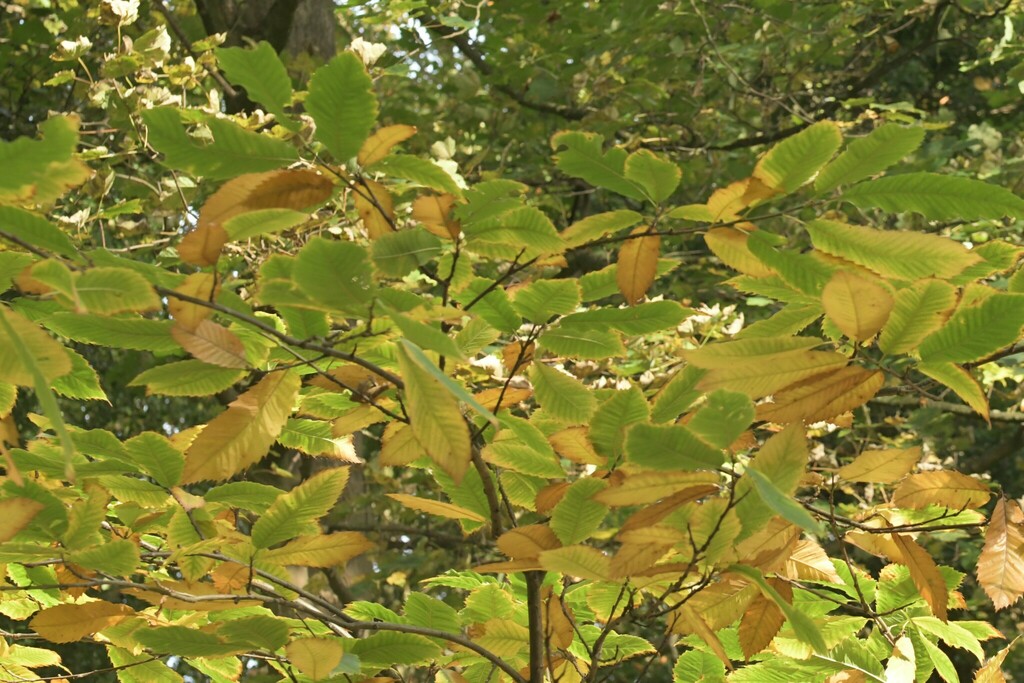
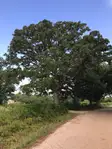
Enter your ZIP to see whether this is legal to plant in your state, and whether it survives your winter.
European chestnut cannot be called plainly fire resistant because fire authorities and laboratory findings point in different directions.
European chestnut scored 5 from July through April in INRA’s Avignon epiradiator tests; May scored 0 and June 3. Its scale defines 5 as extremely inflammable and bases the note on ignition frequency and mean ignition delay. Fire and Emergency New Zealand likewise classifies the species as having moderate-high flammability on its seven-level scale.
European chestnut is “very recommended” for gardens by the Diputació de Girona and Catalonia’s fire service, assuming species-specific care. That judgment addresses garden suitability rather than ignition alone. Fuel structure, maintenance, origin, and invasiveness enter that judgment alongside fire-resistance research and fire-service experience.
Further measurements describe burning behavior without settling the choice. University of Cape Town trials measured fresh and dry leaves, including ignition time, sustainability, and combustibility, but reported no observation for European chestnut in the 2021 fire. FLAMITS records an energy flux of 370.5 kW/m² for dead wood tested in a calorimeter without prior drying, yet applies no shared threshold for turning such measurements into a resistant-or-not verdict. The practical conclusion is caution: one expert garden guide strongly favors European chestnut, while two flammability classifications give homeowners sound reasons not to assume the tree itself resists fire.
Cape Town, Western Cape, South Africa; Catalonia, Spain; Global; Mediterranean France / Provence; New Zealand
Maintenance
2. Why this plant is relevant here
State distribution
Documented in AL, DC, KY, MA, NY, PA.
Native range
Introduced / established
1 sourced range or established record. This is not an invasive warning.
USDA hardiness
3. Legal, ecological, and broader status
Legal-list status
Seed-list status
Reported invasive here
1 ecological invasive report.
Broader regional context
Federal context
How to read this page
The status above is computed from the cited rows below: independent recommendations can support a fire-resistant result, an avoid row can produce keep-away, and disagreement stays visible as conflict. Placement notes preserve each source’s own scheme rather than translating unlike rules into one scale. This is evidence about a plant, not permission to plant it in every part of the defensible space; Zone 0 remains noncombustible.
Native and introduced range evidence
These are exact U.S. botanical-area records from the cited range source. Native and
introduced describe biogeographic relationship, not fire performance or planting approval.
Doubtful and extinct rows stay visible but do not count as current presence.
The lossless worldwide derivative is retained once in the research corpus; object pages repeat only exact U.S. areas needed by the local lens. The JSON twin carries the same page assertions.
Where its sources say to plant it
Placement rules below use each source's own distances or named zones, tied to its rating.
They are not interchangeable with the directory's current Zone 0 guidance.
Guía de pirojardinería: suitable inside or outside the 25-metre maximum-risk zone [girona-2020-iuf-25m-suitability] (with its recommendation)
Time to extinguish the exotic flame: Lessons from the 202…: Natural; Table 1 and deposited raw workbook [macalister-2025-leaf-flammability] (mid-scale rating)
The evidence
Grouped by what each source concluded. Primary evidence rated the plant itself
(a lab, field program, or original curation); corroboration compiled or
republished another source's rating and resolves to its root lineage.
Castanea sativa is rated “MUY RECOMENDADA” by the guide's qualitative IUF garden-suitability method. The method assumes species-specific care and integrates fire evidence with fuel structure, maintenance, origin, invasiveness, and expert fire-service experience.
Low Flammability Plants directory — Fire and Emergency New Zealand (plant flammability testing at Lincoln University) · 2026 · original sourcePrimary evidenceLab-testedlineage: lincoln-nz-tree
23 cited rows from this source; its identity, lineage and tier are stated once.
Primary study Chung2010: Chung, Y. J. (2010). Comparison of combustion properties of native wood species used for fire pots in Korea. Journal of Industrial and Engineering Chemistry, 16, 15-19.
Shared row context: plant part wood; fuel dead; predrying no; device calorimeter; site Chung2010-1; sampling ND.
FLAMITS record 3918; Combustibility measurement; plant part leaves; fuel live; predrying yes; device calorimeter; site Gillon1997-1; sampling june to september. Primary study Gillon1997: Gillon, D., Hernando, C., Valette, J.-C., & Joffre, R. (1997). Fast estimation of the calorific values of forest fuels by near infrared-reflectance spectroscopy. Canadian Journal of Forest Research, 27, 760-765.
Primary study Nunez1996: Nunez-Regueira, L., Anon, J. A. R., & Castineiras, J. P. (1996). Calorific values and flammability of forest species in Galicia. Coastal and hillside zones. Bioresource Technology, 57, 283-289.
Shared row context: plant part litter; fuel all; predrying no; site Nunez1996-1.
FLAMITS record 9853; Ignitability measurement; device epiradiator; sampling spring.
“flammability value: 5”
FLAMITS record 9862; Ignitability measurement; device epiradiator; sampling summer.
“flammability value: 5”
FLAMITS record 9871; Ignitability measurement; device epiradiator; sampling autumn.
“flammability value: 4”
FLAMITS record 9880; Ignitability measurement; device epiradiator; sampling winter.
Primary study Valette1990: Valette, J.-C. (1990). Flammabilities of Mediterranean forest species. Effects on the combustibility of the forest communities inflammabilités des espèces forestières méditerranéennes. Conséquences sur la combustibilité des formations forestières. Revue forestière française, 42, 76-92.
Shared row context: Ignitability measurement; plant part leaves; fuel live; predrying no; device epiradiator; site Valette1990-1; sampling june to september.
“flammability value: 0”
FLAMITS record 13338.
“flammability value: 5”
FLAMITS record 13339.
Primary study Chung2008: Chung, Y. J., & Spearpoint, M. (2008). Combustion properties of native Korean wood species. International Journal on Engineering Performance-Based Fire Codes, 9, 11825.
Shared row context: plant part wood; fuel dead; predrying yes; device calorimeter; site Chung2008-1; sampling ND.