Enter your ZIP to see whether this is legal to plant in your state, and whether it survives your winter.
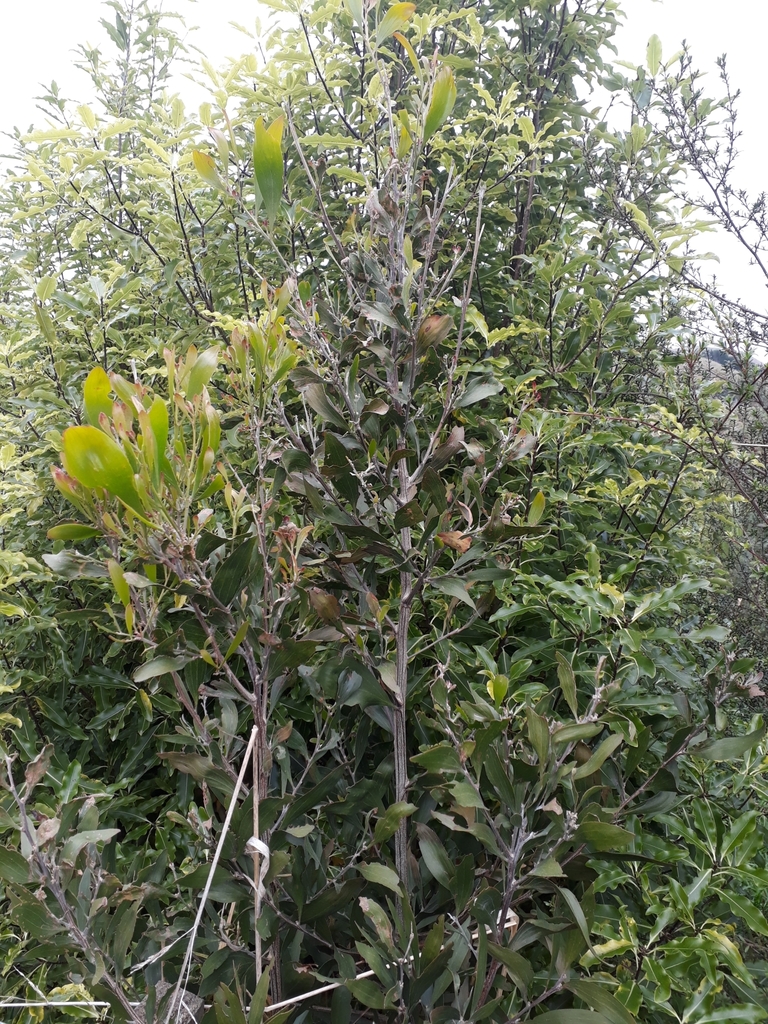
Keep blackwood away from structures: its monthly INRA scores reach the scale’s extreme flammability category.
The sources use different methods and scales. Fire and Emergency New Zealand classifies blackwood as moderate-high on its seven-level scale, based on shoot-flammability testing, and includes it among high-flammability environmental weeds. INRA’s epiradiator tests produced monthly scores ranging from 0 to 5, with several months scoring 5, which its scale defines as extremely flammable.
Australian Plants Society Victoria reached a more favorable conclusion through field trials. It calls blackwood fire-retardant, meaning it resists the first flame wave but may burn after drying. The ACT Government’s compiled plant selector also marks the species as fire-retardant. These findings do not mean that blackwood will not burn. Tasmania Fire Service places it in its moderate group and advises against such plants within a Building Protection Zone.
Cape Town researchers measured fresh and dry leaves for ignition time, burning duration and combustibility. They also reported that blackwood did not burn during the 2021 fire. That observation adds useful context, but it does not resolve the conflicting laboratory and field findings. For a tree reaching about 40 feet at maturity, the results showing moderate-high to extreme flammability support the cautious conclusion: blackwood is not dependable fire-resistant landscaping near a structure.
Australian Capital Territory, Australia; Cape Town, Western Cape, South Africa; Global; Mediterranean France / Provence; New Zealand; Tasmania, Australia; Victoria, Australia
Maintenance
2. Why this plant is relevant here
State distribution
Documented in CA, HI.
Native range
Introduced / established
3 sourced range or established records. This is not an invasive warning.
USDA hardiness
Documented minimum 8a; no upper limit is documented.
3. Legal, ecological, and broader status
Legal-list status
Seed-list status
Reported invasive here
2 ecological invasive reports.
Broader regional context
Federal context
How to read this page
The status above is computed from the cited rows below: independent recommendations can support a fire-resistant result, an avoid row can produce keep-away, and disagreement stays visible as conflict. Placement notes preserve each source’s own scheme rather than translating unlike rules into one scale. This is evidence about a plant, not permission to plant it in every part of the defensible space; Zone 0 remains noncombustible.
Native and introduced range evidence
These are exact U.S. botanical-area records from the cited range source. Native and
introduced describe biogeographic relationship, not fire performance or planting approval.
Doubtful and extinct rows stay visible but do not count as current presence.
The lossless worldwide derivative is retained once in the research corpus; object pages repeat only exact U.S. areas needed by the local lens. The JSON twin carries the same page assertions.
Plant hardiness evidence
These values describe the plant source. Your ZIP zone comes from the separate 2023 USDA
Plant Hardiness Zone Map. Whole-zone values stay whole-zone, and a single unresolved value
is not treated as a tolerance range. Different source boundaries stay separate: overlapping
statements are compared independently, while only ranges with no shared zone are called a conflict.
Source location: PlantCharacteristics record 76690, Temperature, Minimum (°F).
Where its sources say to plant it
Placement rules below use each source's own distances or named zones, tied to its rating.
They are not interchangeable with the directory's current Zone 0 guidance.
Fire Resisting Garden Plants for the Urban Fringe and Rur…: should be avoided in the Building Protection Zone [Texas Building Protection Zone] (mid-scale rating)
Time to extinguish the exotic flame: Lessons from the 202…: Urban zone; Table 1 and deposited raw workbook [macalister-2025-leaf-flammability] (mid-scale rating)
Canberra Plant Selector: filtered result page 2 [canberra-selector] (with its recommendation)
The evidence
Grouped by what each source concluded. Primary evidence rated the plant itself
(a lab, field program, or original curation); corroboration compiled or
republished another source's rating and resolves to its root lineage.
The live Canberra Plant Selector marks “Acacia melanoxylon” as “Fire Retardant: Yes.”
Avoids (2)
Low Flammability Plants directory — Fire and Emergency New Zealand (plant flammability testing at Lincoln University) · 2026 · original sourcePrimary evidenceLab-testedlineage: lincoln-nz-tree
“Moderate/high flammability”
Moderate/high flammability classification. On FENZ's high-flammability environmental weeds list (2024 DOC list).
17 cited rows from this source; its identity, lineage and tier are stated once.
Primary study Clarke2014: Clarke, P. J., Prior, L. D., French, B. J., Vincent, B., Knox, K. J., & Bowman, D. M. (2014). Using a rainforest-flame forest mosaic to test the hypothesis that leaf and litter fuel flammability is under natural selection. Oecologia, 176, 1123-33.
Shared row context: plant part leaves; device burning bench; site Clarke2014-1; sampling october.
“time to flaming (s): 8.6”
FLAMITS record 1203; Ignitability measurement; fuel dead; predrying yes.
“flaming duration (s): 10.9”
FLAMITS record 1227; Sustainability measurement; fuel dead; predrying yes.
“time to flaming (s): 21.7”
FLAMITS record 1251; Ignitability measurement; fuel live; predrying no.
“flaming duration (s): 11.1”
FLAMITS record 1275; Sustainability measurement; fuel live; predrying no.
Primary study Gill1996: Gill, M., & Moore, P. (1996). Ignitibility of leaves of Australian plants. Centre for Plant Biodiversity Research, CSIRO Plant Industry.
Shared row context: Ignitability measurement; plant part leaves; fuel live; device muffle furnace; site Gill1996-1; sampling march to april.
“time to flaming (s): 22.5”
FLAMITS record 3810; predrying no.
“time to flaming (s): 5.07”
FLAMITS record 3858; predrying yes.
Primary study Msweli2020: Msweli, S. T., Potts, A. J., Fritz, H., & Kraaij, T. (2020). Fire weather effects on flammability of indigenous and invasive alien plants in coastal fynbos and thicket shrublands (Cape Floristic Region). PeerJ, 8, e10161.
Shared row context: plant part branches; fuel all; predrying yes; device grill; site Msweli2020-1; sampling february to november.
Primary study Valette1990: Valette, J.-C. (1990). Flammabilities of Mediterranean forest species. Effects on the combustibility of the forest communities inflammabilités des espèces forestières méditerranéennes. Conséquences sur la combustibilité des formations forestières. Revue forestière française, 42, 76-92.
Shared row context: Ignitability measurement; plant part leaves; fuel live; predrying no; device epiradiator; site Valette1990-1; sampling june to september.
“flammability value: 4”
FLAMITS record 13357.
“flammability value: 5”
FLAMITS record 13358.
Primary study Potts2022: Potts, E., Tng, D., Apgaua, D., Curran, T. J., Engert, J., & Laurance, S. G. (2022). Growth form and functional traits influence the shoot flammability of tropical rainforest species. Forest Ecology and Management, 522, 120485.
Shared row context: plant part branches; fuel all; predrying yes; device grill; site Potts2022-1; sampling ND.