Current native
43
exact source areas
Home / Plants / Grow / Chokecherry
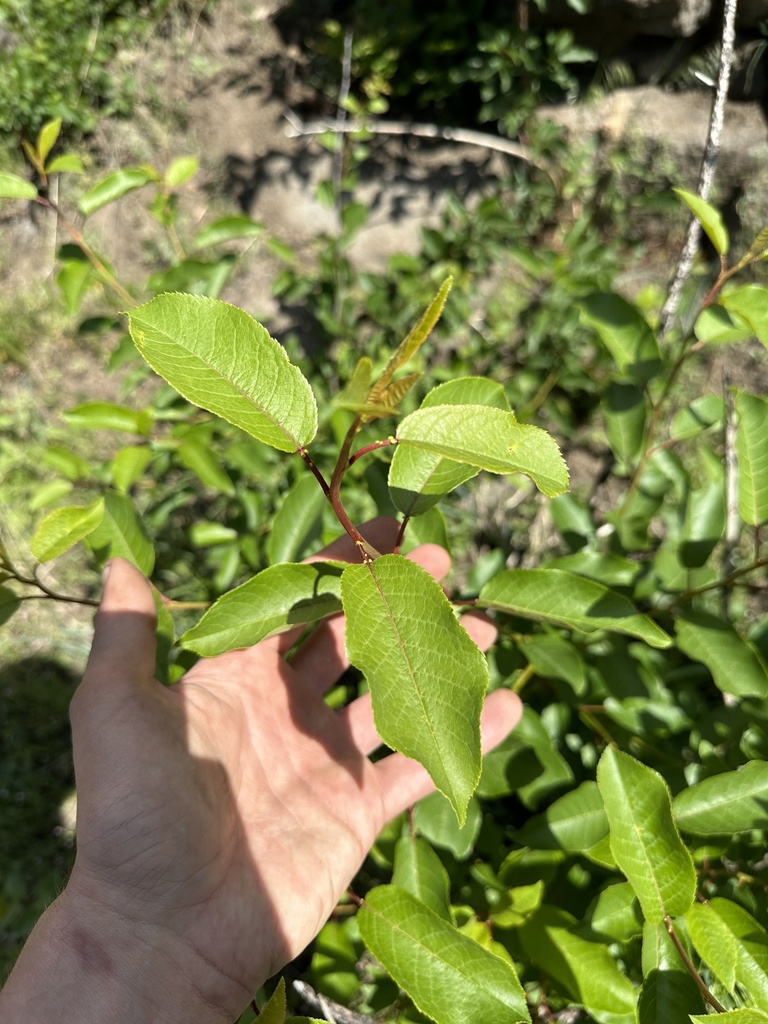
Prunus virginiana
Your local evidence lens
A genus split is not a placement verdict. Set a ZIP to read the local documented split.
The status above is computed from the cited rows below: independent recommendations can support a fire-resistant result, an avoid row can produce keep-away, and disagreement stays visible as conflict. Placement notes preserve each source’s own scheme rather than translating unlike rules into one scale. This is evidence about a plant, not permission to plant it in every part of the defensible space; Zone 0 remains noncombustible.
These are exact U.S. botanical-area records from the cited range source. Native and introduced describe biogeographic relationship, not fire performance or planting approval. Doubtful and extinct rows stay visible but do not count as current presence.
Current native
exact source areas
Current introduced
exact source areas
Qualified
doubtful or extinct source rows
Eastern United States Fire Performance Plant Selector
Source prints 5 · single-value meaning unresolved
Wildfire-resistant Landscape Plants for Michigan (Extension Bulletin E2948)
2–6 explicit range
Fire-Resistant Plants for Home Landscapes (PNW 590)
2–6 explicit range
USDA PLANTS Database — Plant Characteristics
Minimum 2b · no upper limit documented
FireSmart BC Plant Program — fire-resistant plant chart
“FireSmart-approved fire-resistant plant”
A Compilation of Good Plant Choices for Nevada's High Fire Hazard Areas (SP-05-16)
“listed by at least two cited sources”
Compilation marks: AZ1289, CSU 6.305, OSU FRN 6.
FIREWISE Plant Materials for 3,000 ft. and Higher Elevations (AZ1289)
“listed FIREWISE plant material”
Listed among fire-resistant plant materials for Arizona above 3,000 feet.
Fire-Resistant Plants for Montana Landscapes (MontGuide MT200101AG)
“listed fire-resistant”
Listed among fire-resistant plant species adapted to Montana. Source table name: P. virginiana.
Cone calorimeter testing of vegetation — an update
“Author-named low relative flammability”
Table 4 reports 172% foliage moisture, green-sample PHRR 55 kW/m2, and dry-sample EHOC 13.8 MJ/kg.
Wildfire-resistant Landscape Plants for Michigan (Extension Bulletin E2948)
“considered wildfire-resistant and are recommended for Michigan’s climate”
Table 1 row: Prunus virginiana (Chokecherry).
Fire-Resistant Plants for Oregon Home Landscapes
“Fire-Resistant Plant Materials for Oregon”
Prunus virginiana (Chokecherry) is listed under “Trees—deciduous”. The guide says most listed plants require some irrigation during Oregon's dry summer months and must be maintained in a healthy condition.
Fire-resistant plant profile galleries
“Choose the right trees for your fire-resistant landscape”
The Chokecherry profile prints Prunus virginiana. The gallery points to PNW 590 for complete details.
Fremont County Firewise Plant List
“Fremont County Firewise Plant List — Prunus virviniana melanocarpa — Western Chokecherry”
Listed in the source's Large Shrubs and Trees section; the page describes its listed Firewise plants as generally low-growing, low-debris, and relatively moist.
“FIRE-RESISTANT PLANTS — Examples: Chokecherry”
The article prints this taxon as an example beneath its fire-resistant or Firewise-landscape guidance.
Fire-Resistant and Fire-Prone Plants Common to Yavapai County (Bulletin 34)
“Fire-Resistant Plants”
Listed as Choke cherry — Prunus virginiana. The bulletin says fire-resistant plants tend to resist ignition when irrigated and maintained, while fire-prone plants may ignite readily and burn intensely.
Protect Your Home from Wildfire — Fire Resistant Vegetation and Landscaping
“Following are a few of the plants that may be used in firewise landscapes in Alaska if placed and maintained appropriately.”
Listed as Chokecherry — Prunus virginiana; the source conditions these examples on appropriate placement and maintenance.
FireWise Plant List for New Mexico
“FireWise Plant List for New Mexico”
Listed as Prunus virginiana (Western chokecherry) in Trees and Large Shrubs. Printed elevation cells: 4,000 ft=?, 5,000 ft=Y, 6,000 ft=Y, 7,000 ft=Y, 8,000 ft=Y, 9,000+ ft=Y. Water need: H; sun/shade: S/PS; mature height: 10-30; approximate bloom: Apr.
Maine fire-resistant plant list
“listed as fire-resistant for landscaping 30-100 feet from a structure”
Maine Forest Service includes Chokecherry (Prunus virginiana) on its partial fire-resistant plant list for landscaping 30-100 feet from a structure. The printed scientific name is a unique current-name match to this record.
Fire Resistance of Plants Master Database
“fire-resistance score 6/5 (cultivars vary) of 10”
Combustion characteristics of north-eastern USA vegetation tested in the cone calorimeter
“Measured; not in an author-named high or low effective-heat-of-combustion group”
Conditioned foliage and twigs were tested at 25 kW/m2 in a cone calorimeter.
Eastern United States Fire Performance Plant Selector
“”
Red fruit in clusters.
FLAMITS: FLAMmability plant traiTS database
“calorific value (kcal/kg): 3152.77”
FLAMITS record 2884; Combustibility measurement; plant part leaves; fuel live; predrying yes; device calorimeter; site Dibble2007-1; sampling ND. Primary study Dibble2007: Dibble, A. C., White, R. H., & Lebow, P. K. (2007). Combustion characteristics of north-eastern USA vegetation tested in the cone calorimeter: invasive versus non-invasive plants. International journal of wildland fire, 16, 426-443.
“maximum energy flux (kW/m²): 55”
FLAMITS record 14145; Combustibility measurement; plant part leaves; fuel live; predrying no; device calorimeter; site White2002-2; sampling ND. Primary study White2002: White, R. H., Weise, D. R., Mackes, K., & Dibble, A. C. (2002). Cone calorimeter testing of vegetation--an update. Ninth International Conference on Electrical and Electronic Products. Columbus, Ohio, USA.
“calorific value (kcal/kg): 3296.07”
FLAMITS record 14198; Combustibility measurement; plant part leaves; fuel live; predrying yes; device calorimeter; site White2002-2; sampling ND. Primary study White2002: White, R. H., Weise, D. R., Mackes, K., & Dibble, A. C. (2002). Cone calorimeter testing of vegetation--an update. Ninth International Conference on Electrical and Electronic Products. Columbus, Ohio, USA.
“calorific value (kcal/kg): 3726”
FLAMITS record 14287; Combustibility measurement; plant part leaves; fuel live; predrying yes; device calorimeter; site White2002-2; sampling ND. Primary study White2002: White, R. H., Weise, D. R., Mackes, K., & Dibble, A. C. (2002). Cone calorimeter testing of vegetation--an update. Ninth International Conference on Electrical and Electronic Products. Columbus, Ohio, USA.