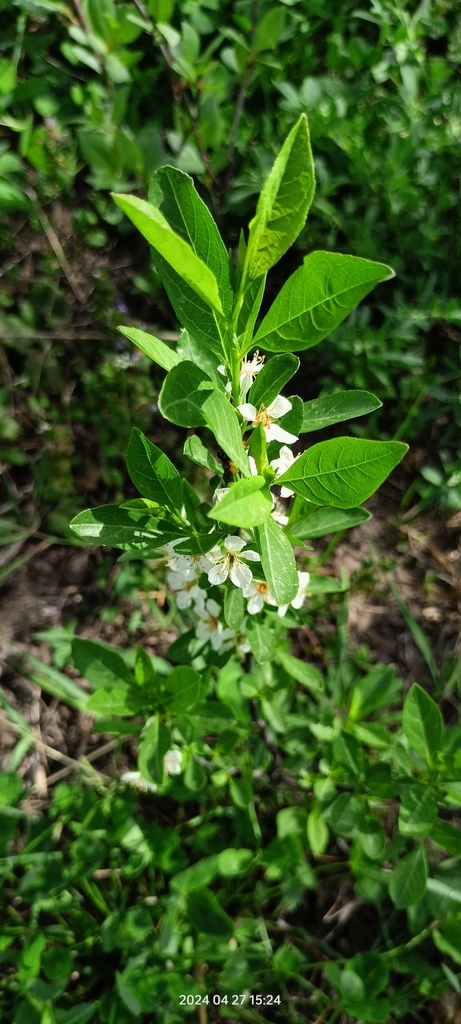
Enter your ZIP to see whether this is legal to plant in your state, and whether it survives your winter.
Yes, sandcherry is consistently listed as a fire-resistant landscape shrub by six extension and FireSmart assessments.
The agreement spans the Pacific Northwest, British Columbia, Utah, Michigan, and Oregon’s Willamette Valley. These are expert-curated or compiled recommendations, not results from a shared laboratory test.
The regional guidance reaches the same conclusion under different local terms. Utah State University Extension says sandcherry can be firewise when properly used and maintained. Michigan State University Extension considers it wildfire resistant for Michigan’s climate, while Oregon State University Extension profiles it among plants that thrive in Willamette Valley growing conditions and recommends it in a fire-resistant shrub gallery. FireSmart BC approves it as fire resistant but flags it as needing more research, leaving a caution attached to that particular assessment.
Sandcherry is a low-water shrub in the rose family and reaches about six feet at maturity. Its published hardiness range is USDA zones 3a to 7b, while Oregon State’s Willamette Valley profile gives zones 3 through 6. Taken together, the recommendations strongly support treating sandcherry as fire resistant, with FireSmart BC’s research flag kept in view.
Form
shrub
Mature height
~6 ft
Water need
low
Rated in
Black Hills, South Dakota; British Columbia; Fremont County, Wyoming; Michigan / Great Lakes +5
On this lot
1. Fire evidence and conditions
Fire evidence
Fire-resistant — location does not change the cited classification.
Black Hills, South Dakota; British Columbia; Fremont County, Wyoming; Michigan / Great Lakes; OR/WA/ID; Oregon (Willamette Valley); Pacific Northwest (Oregon / Washington / Idaho); Utah / Intermountain West; southern Idaho / Intermountain
Maintenance
Typed publication scope: 7 scopes across 7 cited fire sources
Black Hills (SD footprint); partial normalized coverage
The page explicitly limits itself to the Black Hills, and NFPA Firewise's archived 2006 plant-list index files it under South Dakota. FireApproved publishes 47 exact genus or species owners from 48 printed rows. This is bounded Black Hills context, not statewide South Dakota coverage or a finding that a plant suits a particular site.
Fremont County (WY footprint); partial normalized coverage · 2011-02-25
The source identifies itself as the Fremont County Firewise Plant List. FireApproved publishes its 92 exact source owners as Fremont County regional context. No methodology, current county endorsement, statewide Wyoming scope, or site-specific suitability is inferred.
Southern Idaho (ID footprint); partial normalized coverage · 2013-11-08
The official database labels itself "For Southern Idaho" and describes Idaho residents at the urban-rangeland interface. FireApproved publishes 419 existing plant owners that cite its scored rows. This bounded Southern Idaho scope is regional context, not statewide coverage or a conclusion that the score transfers unchanged to every Idaho site.
Michigan State University Extension Bulletin E2948 is explicitly a list of wildfire-resistant landscape plants for Michigan and includes a Michigan-native field. FireApproved publishes 221 exact GBIF owners from 226 represented source rows and holds 15 complex or non-exact rows. This dated publication scope is not a current site-suitability determination.
Willamette Valley (OR footprint); partial normalized coverage · 2015-02-01
OSU Extension says EM 9103 highlights fire-resistant plants that thrive under Willamette Valley growing conditions. FireApproved publishes 172 exact owners only as valley context. The guide shares the PNW 590 lineage and is not a second independent vote or statewide site clearance.
The October 2023 joint Pacific Northwest Extension publication explicitly names Oregon, Washington, and Idaho and publishes more than 150 plant profiles. FireApproved has normalized 155 exact plant records from the source; publication scope does not assert that every listed plant suits every site within the three states.
Utah State University Extension states that this fact sheet selects examples for Utah landscapes and that they require proper placement and maintenance. FireApproved publishes 83 exact source owners at Utah publication scope. The table is not a site-specific planting clearance.
4 applicable cited hardiness statements overlap but have different boundaries; compare each complete source row.
3. Legal, ecological, and broader status
Legal-list status
Seed-list status
Reported invasive here
Broader regional context
Federal context
How to read this page
The status above is computed from the cited rows below: independent recommendations can support a fire-resistant result, an avoid row can produce keep-away, and disagreement stays visible as conflict. Placement notes preserve each source’s own scheme rather than translating unlike rules into one scale. This is evidence about a plant, not permission to plant it in every part of the defensible space; Zone 0 remains noncombustible.
Plant hardiness evidence
These values describe the plant source. Your ZIP zone comes from the separate 2023 USDA
Plant Hardiness Zone Map. Whole-zone values stay whole-zone, and a single unresolved value
is not treated as a tolerance range. Different source boundaries stay separate: overlapping
statements are compared independently, while only ranges with no shared zone are called a conflict.
Source location: PlantCharacteristics record 90634, Temperature, Minimum (°F).
Where its sources say to plant it
Placement rules below use each source's own distances or named zones, tied to its rating.
They are not interchangeable with the directory's current Zone 0 guidance.
Fire Resistance of Plants Master Database: plantable at 50' from home [Idaho minimum planting distance] (mid-scale rating)
Fire-resistant Landscape Plants for the Willamette Valley: Sand Cherry profile (PDF page 152) [osu-em-9103-profile] (with its recommendation)
Fire-resistant plant profile galleries: Western sandcherry — Prunus besseyi [osu-2023-shrubs-gallery] (with its recommendation)
Firewise Plant Material for the Black Hills: Shrubs [black-hills-plant-form-table] (with its recommendation)
The evidence
Grouped by what each source concluded. Primary evidence rated the plant itself
(a lab, field program, or original curation); corroboration compiled or
republished another source's rating and resolves to its root lineage.
The introduction describes all table entries as fire-resistive plants that can be used in landscaping. Printed-name correction used for exact matching: Prunus bessevi -> Prunus besseyi.