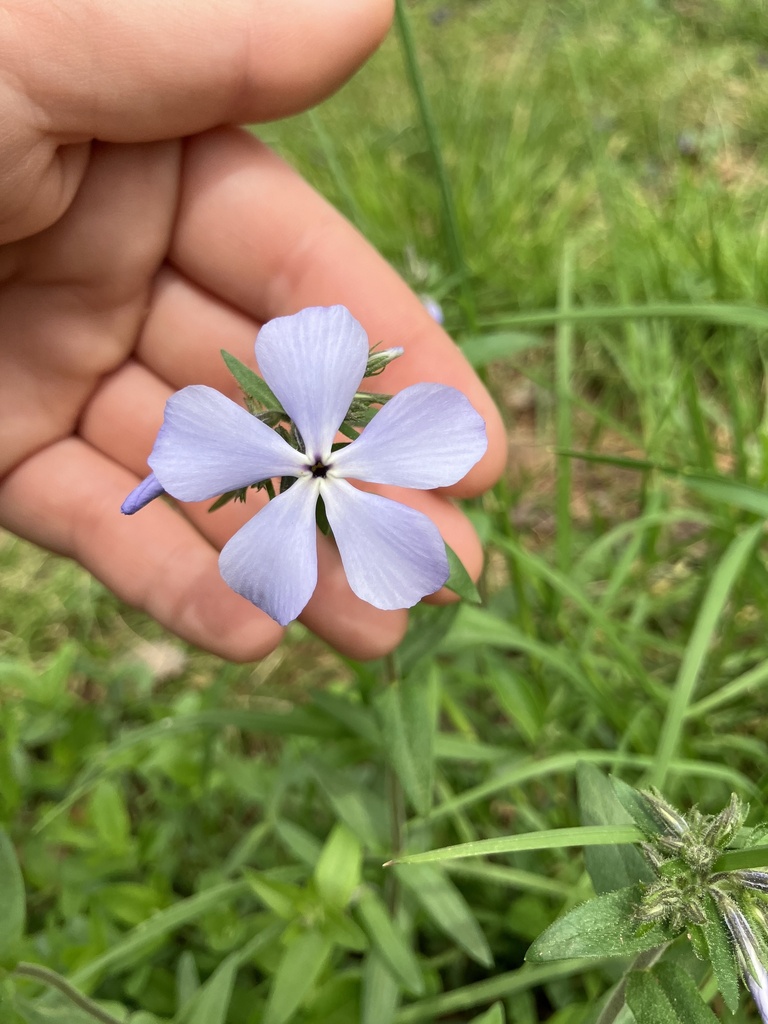
wild blue phlox
Phlox divaricata
A genus split is not a placement verdict.
Is this one for your yard?
Enter your ZIP to see whether this is legal to plant in your state, and whether it survives your winter.
Wild blue phlox is rated fire resistant, with repeated low-flammability listings but limited primary evidence.
NC State’s extension service, working with the USFWS in 2005, placed it in the lowest of four flammability bands. NC State’s 2025 successor list again calls it low flammability, and its live Plant Toolbox uses the same tag.
The Nevada Division of Forestry and University of Nevada Cooperative Extension also rate wild blue phlox low in their Lake Tahoe landscaping guidance. That agreement broadens the geographic context, but the Nevada guide describes its ratings as rough estimates drawn from various sources, not scientific trials. The Plant Toolbox does not identify who assigned its values, so its matching tag supports the pattern without adding a clearly described testing method.
The sound conclusion is favorable but bounded: expert guidance consistently places wild blue phlox on the fire-resistant side, while the Nevada support is explicitly not trial-based and the North Carolina findings are expert-curated guidance. The Nevada guide also warns generally that plants turning brown often become high fire hazards. Wild blue phlox is a roughly three-foot perennial with moderate water needs, so its low rating is useful for plant selection, but it is not a promise that dry vegetation cannot burn.
- Form
- perennial
- Mature height
- ~3 ft
- Water need
- moderate
- Rated in
- Lake Tahoe Basin, Nevada and California; NC; North Carolina; North Carolina / southeastern US