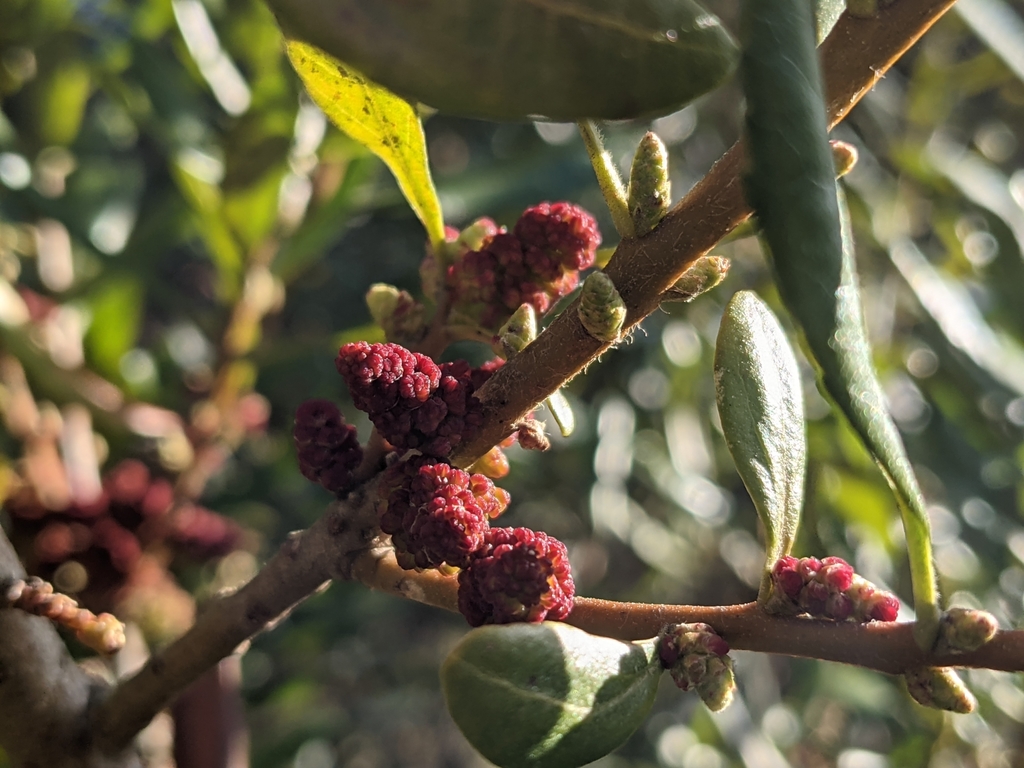
Northern bayberry
Myrica pensylvanica
A genus split is not a placement verdict.
Is this one for your yard?
Enter your ZIP to see whether this is legal to plant in your state, and whether it survives your winter.
Northern bayberry has mixed fire evidence: a low whole-plant laboratory grouping sits alongside adverse combustion findings and planting advice.
Long and colleagues placed northern bayberry in their Low group after controlled whole-plant burns. The study’s classification combined several measurements, including ignition, heat release, flame height and plant consumption. That grouping describes the tested shrubs across those measures.
Dibble, White and Lebow examined unground foliage and twigs in a cone calorimeter. Their material was dried and conditioned before testing, and they named northern bayberry among species with high average effective heat of combustion. This concerns prepared fine fuels. It does not demonstrate that an intact living bayberry ignites more readily than the shrubs in Long’s separate experiment. The studies differ in material burned and result classified.
Regional planting advice also varies. Virginia Firescapes assigns northern bayberry H, or High; Ohio’s bulletin assigns M, or Medium; Michigan includes it in a wildfire-resistant plant list. The publications’ placement systems need their own attribution, too. Virginia prints Zone 3 as 30–100 feet from the house, while Ohio uses 10–30 feet. Treating those zone names as interchangeable would change the instructions.
Michigan’s recommendation carries specific spacing and care conditions. Its bulletin requires a minimum 3 feet between structures and landscape plants, with no organic mulch, peat or wood chips in that barrier. It calls for at least 30 feet between structures and solid stands of wildland vegetation, and 10–16 feet between ornamental plant crowns. At a hill crest, the minimum defensible space on the downhill side is 60 feet. Firewood, propane tanks and other fuels belong outside the applicable perimeter. Plan for mature growth, maintain lawns and remove dead litter; the crown gaps can shrink as plants grow. Its tree-limbing instructions apply to trees, rather than to this shrub.
The historical Eastern U.S. selector rates Myrica pensylvanica Moderately Firewise and marks ladder potential without pruning Yes. It describes a 10-foot multistemmed shrub with high tolerance of poorly drained soils and salt tolerance. Those site attributes leave the ladder concern intact. Its maintenance advice calls for dead and diseased branch removal, clearing dead leaves and twigs, vertical and horizontal separation, and watering and pruning to prevent deadwood accumulation.
A choice needs both parts of the evidence: what each assessment measured or recommended, and the planting conditions attached to that recommendation. The favorable whole-plant grouping cannot supply a universal placement distance for northern bayberry.
- Form
- shrub
- Mature height
- ~10 ft
- Light
- Part sun
- Rated in
- Global; Michigan / Great Lakes; Ohio / Midwest; Virginia / Mid-Atlantic +3