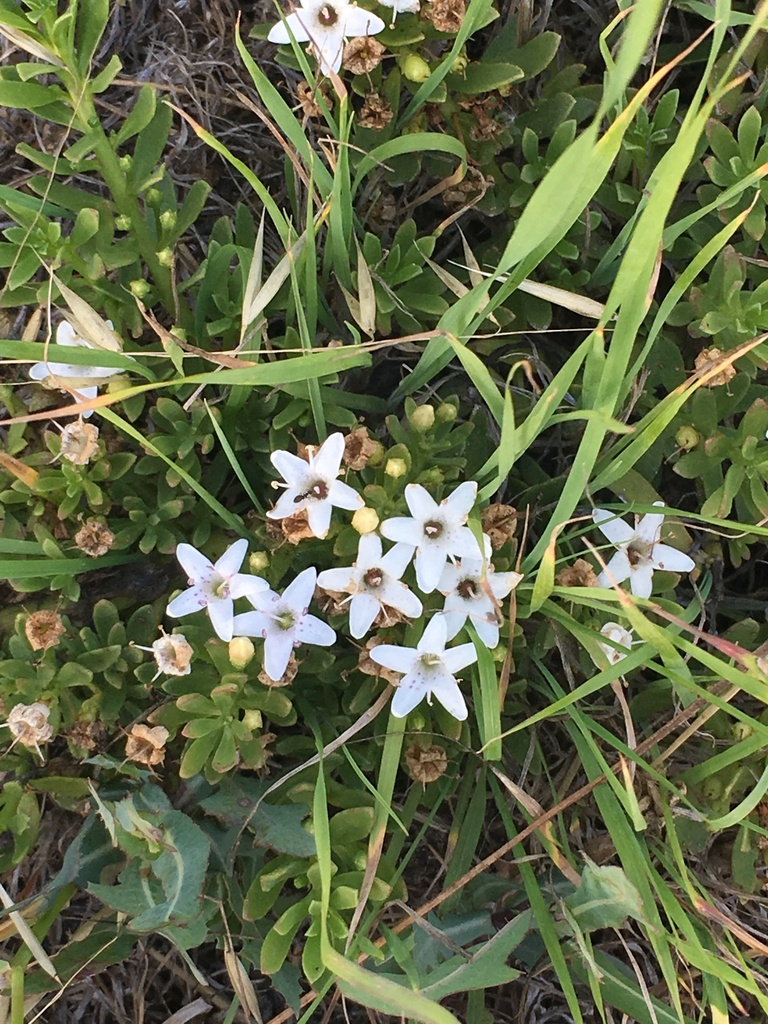
Enter your ZIP to see whether this is legal to plant in your state, and whether it survives your winter.
Slender myoporum is rated fire resistant, and sources from California and Australia agree on that verdict.
The strongest language comes from the Australian Plants Society Victoria, whose field trial classifies slender myoporum as fire resistant, meaning it will not burn under continued flame. Under normal garden conditions at the Los Angeles State & County Arboretum, its leaves fell in the medium-high moisture category of 70 to 80 percent, within the Arboretum’s recommended set. The USDA Forest Service also rated prostrate myoporum “generally high” after considering fuel volume, the plant’s inherent flammability, and how easily fire spreads through it.
Broader plant guides reinforce those findings. The ACT Government’s live plant selector marks Myoporum parvifolium as fire retardant. Ozbreed places a named cultivar on its list for plants whose genus and species recur on multiple fire-retardant lists. The Diablo Firesafe Council likewise includes the prostrate form among plants receiving favorable fire-performance ratings across several references, although its guide cautions that terminology used by those references was mostly undefined.
Slender myoporum is a shrub in the Scrophulariaceae family and has been introduced in California. Its favorable rating rests on several kinds of support, from flame exposure and leaf moisture observations to landscape assessments and compiled guidance. Those sources use different methods, but they point in the same direction: slender myoporum is a fire-resistant landscaping choice.
Form
shrub
Region
EE. UU.; Victoria, Australia
Rated in
Australia; Australian Capital Territory, Australia; California; Global +2
On this lot
1. Fire evidence and conditions
Fire evidence
Fire-resistant — location does not change the cited classification.
The guide presents itself as fire performance ratings for common landscape plants in a fire-prone California setting. FireApproved publishes 104 exact owners as republished California context. It is not an independent rating, a current endorsement, or parcel suitability.
2. Why this plant is relevant here
State distribution
Native range
Introduced / established
1 sourced range or established record. This is not an invasive warning.
USDA hardiness
3. Legal, ecological, and broader status
Legal-list status
Seed-list status
Reported invasive here
Broader regional context
Federal context
How to read this page
The status above is computed from the cited rows below: independent recommendations can support a fire-resistant result, an avoid row can produce keep-away, and disagreement stays visible as conflict. Placement notes preserve each source’s own scheme rather than translating unlike rules into one scale. This is evidence about a plant, not permission to plant it in every part of the defensible space; Zone 0 remains noncombustible.
Native and introduced range evidence
These are exact U.S. botanical-area records from the cited range source. Native and
introduced describe biogeographic relationship, not fire performance or planting approval.
Doubtful and extinct rows stay visible but do not count as current presence.
The lossless worldwide derivative is retained once in the research corpus; object pages repeat only exact U.S. areas needed by the local lens. The JSON twin carries the same page assertions.
Conditions in the fire evidence
These describe tested or rated plant material. They are not horticultural maintenance instructions.
Placement rules below use each source's own distances or named zones, tied to its rating.
They are not interchangeable with the directory's current Zone 0 guidance.
Low-volume and slow-burning vegetation for planting on cl…: Table 3: Fair performance [nord-green-brushland-clearing-performance] (mid-scale rating)
Fire-Retardant Plants for Brush Fire Prevention in Hillsi…: Category 3 [la-arboretum-1970-leaf-moisture-fire-retardance] (with its recommendation)
Canberra Plant Selector: filtered result page 4 [canberra-selector] (with its recommendation)
Fire Performance of Common Plants: Table 1 (favorable in 3 or more references) [diablo-guide-to-plants-three-reference-vote] (with its recommendation)
The evidence
Grouped by what each source concluded. Primary evidence rated the plant itself
(a lab, field program, or original curation); corroboration compiled or
republished another source's rating and resolves to its root lineage.
“CATEGORY 3 — Plants with medium-high leaf moisture content capacity (70-80%)”
· condition: green
Myoporum parvifolium is one of 30 low-growing plants in the source's recommended Table 1. The category reflects leaf moisture capacity under normal garden conditions at the Arboretum.
The live Canberra Plant Selector marks “Myoporum parvifolium” as “Fire Retardant: Yes.”
Fire Performance of Common Plants (Guide to Plants) — Diablo Firesafe Council · live page captured 2026-08-29 · original sourceCorroborationMirrorlineage: ucfpl-berkeley resolves to Defensible Space Landscaping in the Urban/Wildland Interface: A Compilation of Fire Performance Ratings of Residential Landscape Plants
“Table 1: favorable fire performance rating in 3 or more references (refs 8, 9,10,11,12,21,23,24,25,28,35,36, 38,39,40,41,42,53)”
The Diablo Firesafe Council Guide to Plants lists Myoporum parvifolium prostrata (Creeping boobyalla, Myoporum) as groundcover, evergreen, in Table 1: plants with a favorable fire performance rating in 3 or more references. The guide cites 18 of its 57 numbered references for this row (8, 9,10,11,12,21,23,24,25,28,35,36, 38,39,40,41,42,53). The guide states the ranking terms in its underlying references were mostly undefined and makes no attempt to rank within the list, and that fire performance is compromised without maintenance.
39 cited rows from this source; its identity, lineage and tier are stated once.
Primary study Weise2005: Weise, D. R., White, R. H., Beall, F. C., & Etlinger, M. (2005). Use of the cone calorimeter to detect seasonal differences in selected combustion characteristics of ornamental vegetation. International Journal of Wildland Fire, 14, 321-338.
Shared row context: plant part leaves; fuel live; device calorimeter; site Weise2005-1.
“time to flaming (s): 292”
FLAMITS record 13767; Ignitability measurement; predrying no; sampling august.
“time to flaming (s): 336”
FLAMITS record 13768; Ignitability measurement; predrying no; sampling december.
“time to flaming (s): 544”
FLAMITS record 13769; Ignitability measurement; predrying no; sampling march.
Primary study White1996: White, R. H., Weise, D. R., & Frommer, S. (1996). Preliminary evaluation of the flammability of native and ornamental plants with the cone calorimeter. 21st International Conference on Fire Safety. Coimbra, Portugal.
Shared row context: Combustibility measurement; plant part leaves; fuel live; device calorimeter; site White1996-1; sampling ND.
Shared measurement context: predrying no.
“energy flux (kW/m²): 20”
FLAMITS record 13990.
“maximum energy flux (kW/m²): 34”
FLAMITS record 14027.
“maximum energy flux (kW/m²): 33”
FLAMITS record 14029.
“calorific value (kcal/kg): 429.92”
FLAMITS record 14030.
“calorific value (kcal/kg): 644.88”
FLAMITS record 14060.
Shared measurement context: predrying yes.
“energy flux (kW/m²): 97”
FLAMITS record 13999.
“maximum energy flux (kW/m²): 161”
FLAMITS record 14028.
“calorific value (kcal/kg): 4275.34”
FLAMITS record 14050.
Primary study White2002: White, R. H., Weise, D. R., Mackes, K., & Dibble, A. C. (2002). Cone calorimeter testing of vegetation--an update. Ninth International Conference on Electrical and Electronic Products. Columbus, Ohio, USA.
Shared row context: Combustibility measurement; plant part leaves; fuel live; device calorimeter; site White2002-1.