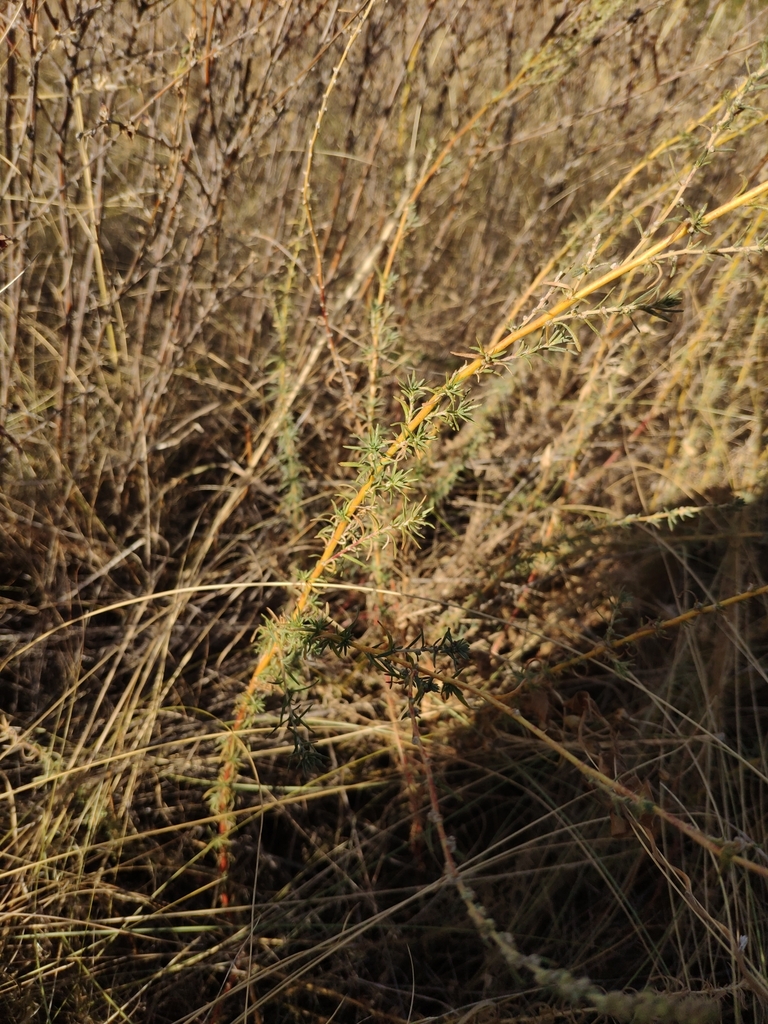
Enter your ZIP to see whether this is legal to plant in your state, and whether it survives your winter.
Forage kochia is rated fire resistant overall, but its strongest support is for greenstrips, and one California study warns about dry fuel.
Four of six assessments favor its use in firewise landscaping or greenstrips. Utah State University Extension lists it as firewise when properly used and maintained. The USDA Natural Resources Conservation Service includes it among common greenstrip plants in the Great Basin, and the University of Nevada Cooperative Extension identifies it as a perennial used in northern Nevada greenstrips. The Society for Range Management calls it very effective for greenstrips in fire-prone landscapes.
The practical case rests partly on summer moisture. The Society for Range Management reports that forage kochia held four times as much August moisture as crested wheatgrass and ten times as much as cheatgrass. Idaho Firewise gives it a fire-resistance score of 7 out of 10, within the mixed range of that source’s planting-distance scale rather than its recommended range.
The caution is specific but serious. A USDA Forest Service field trial in California judged Kochia prostrata unsuitable for reducing fire hazards because its fine foliage and numerous erect stems could become flash-fire fuel when dry. Forage kochia therefore has credible support as a greenstrip plant in semiarid western settings, especially under the placement and maintenance conditions stated by those sources, but it should not be treated as resistant under every condition.
Form
shrub
Mature height
~2.5 ft
Water need
low
Rated in
California; Great Basin; Great Basin / Intermountain West; Northern Nevada / Great Basin +2
On this lot
1. Fire evidence and conditions
Fire evidence
Fire-resistant — location does not change the cited classification.
Southern Idaho (ID footprint); partial normalized coverage · 2013-11-08
The official database labels itself "For Southern Idaho" and describes Idaho residents at the urban-rangeland interface. FireApproved publishes 419 existing plant owners that cite its scored rows. This bounded Southern Idaho scope is regional context, not statewide coverage or a conclusion that the score transfers unchanged to every Idaho site.
Utah State University Extension states that this fact sheet selects examples for Utah landscapes and that they require proper placement and maintenance. FireApproved publishes 83 exact source owners at Utah publication scope. The table is not a site-specific planting clearance.
2. Why this plant is relevant here
State distribution
Documented in AZ, CO, ID, MT, NM, NV, OR, UT, WY.
Native range
Introduced / established
1 sourced range or established record. This is not an invasive warning.
USDA hardiness
Documented minimum 4a; no upper limit is documented.
3. Legal, ecological, and broader status
Legal-list status
Seed-list status
1 state noxious-weed seed record; the Place chip matches exact scope.
Reported invasive here
Broader regional context
Federal context
How to read this page
The status above is computed from the cited rows below: independent recommendations can support a fire-resistant result, an avoid row can produce keep-away, and disagreement stays visible as conflict. Placement notes preserve each source’s own scheme rather than translating unlike rules into one scale. This is evidence about a plant, not permission to plant it in every part of the defensible space; Zone 0 remains noncombustible.
Plant hardiness evidence
These values describe the plant source. Your ZIP zone comes from the separate 2023 USDA
Plant Hardiness Zone Map. Whole-zone values stay whole-zone, and a single unresolved value
is not treated as a tolerance range. Different source boundaries stay separate: overlapping
statements are compared independently, while only ranges with no shared zone are called a conflict.
Source location: PlantCharacteristics record 58837, Temperature, Minimum (°F).
Where its sources say to plant it
Placement rules below use each source's own distances or named zones, tied to its rating.
They are not interchangeable with the directory's current Zone 0 guidance.
Fire Resistance of Plants Master Database: plantable at 40' from home [Idaho minimum planting distance] (mid-scale rating)
Fuel Breaks to Reduce Large Wildfire Impacts in Sagebrush…: common plant material option for a managed greenstrip in sagebrush ecosystems [nrcs-tn66-greenstrip] (with its recommendation)
Greenstrips: Another Tool to Manage Wildfire: common perennial plant used in a maintained northern Nevada greenstrip [unr-fs-97-36-greenstrip] (with its recommendation)
Forage Kochia Helps Fight Range Fires: species used in a semiarid western rangeland greenstrip [harrison-2002-greenstrip] (with its recommendation)
Low-volume and slow-burning vegetation for planting on cl…: Table 5: Plants not considered suitable for use to reduce fire hazards [nord-green-brushland-clearing-performance] (mid-scale rating)
The evidence
Grouped by what each source concluded. Primary evidence rated the plant itself
(a lab, field program, or original curation); corroboration compiled or
republished another source's rating and resolves to its root lineage.
“forage kochia is a very effective greenstrip species for fire-prone landscapes”
The article identifies the table row as Kochia prostrata (L.) Schrad. It reports August moisture at four times crested wheatgrass and ten times cheatgrass; a 1998 wildfire flame-length drop from about 10 feet to under one foot; a 1993 controlled burn in which 50-foot forage-kochia plantings did not burn; and a simulated-strip fire that went out after two feet at 16.3 mph wind. It also says forage kochia can burn with ignitable fuels, that litter altered burn behavior, and that more quantitative research is needed.