Enter your ZIP to see whether this is legal to plant in your state, and whether it survives your winter.
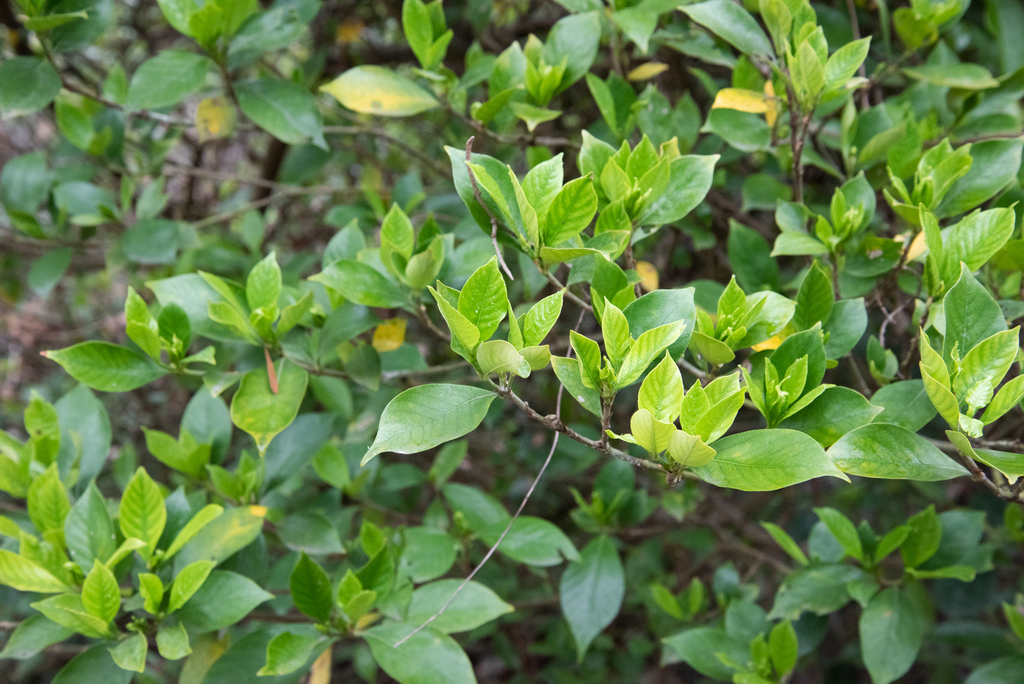
Cape jasmine cannot be treated as consistently fire resistant because credible sources reach opposing conclusions.
USDA Forest Service and NIST researchers placed Cape jasmine in a low-flammability cluster after whole-plant burns with large-scale calorimetry. The ACT Government also marks the specific cultivar Gardenia augusta ‘Florida’ as fire retardant. Those favorable findings conflict with Virginia Cooperative Extension’s H flammability rating, the avoid result on its three-point scale.
Two other sources stop between those positions. An eastern Firewise selector rates Cape jasmine “At Risk” at level 3 on a four-level scale, while a Japanese classification assigns it medium fire-protection power. These are neither endorsements nor the same finding as Virginia’s H rating. The Canberra result also belongs specifically to the ‘Florida’ cultivar and should not be stretched to every Cape jasmine.
Cape jasmine is hardy to USDA zone 8a and grows in full sun; this Rubiaceae shrub reaches about 12 feet at maturity. Its conflicting assessments support a cautious answer: whole-plant testing provides meaningful favorable evidence, but expert guidance also places the shrub at high flammability or at risk. It is therefore not a dependable choice if the decision requires agreement that a plant is fire resistant.
Virginia Cooperative Extension's publication opens with Virginia wildfire conditions, identifies its Virginia Firewise Landscaping Task Force, and labels plants native to Virginia. FireApproved publishes 306 exact source owners. Publication scope does not establish parcel suitability or current endorsement of this archived 2009 list.
2. Why this plant is relevant here
State distribution
Documented in DC, DE, MD, NJ, OH, PA, PR, WV.
Native range
Introduced / established
USDA hardiness
Only uncertain or inapplicable hardiness rows are cited; no primary zone is projected.
3. Legal, ecological, and broader status
Legal-list status
Seed-list status
Reported invasive here
Broader regional context
Federal context
How to read this page
The status above is computed from the cited rows below: independent recommendations can support a fire-resistant result, an avoid row can produce keep-away, and disagreement stays visible as conflict. Placement notes preserve each source’s own scheme rather than translating unlike rules into one scale. This is evidence about a plant, not permission to plant it in every part of the defensible space; Zone 0 remains noncombustible.
Plant hardiness evidence
These values describe the plant source. Your ZIP zone comes from the separate 2023 USDA
Plant Hardiness Zone Map. Whole-zone values stay whole-zone, and a single unresolved value
is not treated as a tolerance range. Different source boundaries stay separate: overlapping
statements are compared independently, while only ranges with no shared zone are called a conflict.
Source prints 8 · single-value meaning unresolved · whole zone precision · source stated
Source taxon: Gardenia jasminoides · exact match.
Source location: Cold Hardiness Zone field in the recovered selector record.
Not used for comparison: The recovered selector prints one Cold Hardiness Zone value but does not define it as a minimum threshold or a one-zone range.
Where its sources say to plant it
Placement rules below use each source's own distances or named zones, tied to its rating.
They are not interchangeable with the directory's current Zone 0 guidance.
Eastern United States Fire Performance Plant Selector: Landscape Zone 2 — 5–10 ft from the structure; maintained lawn or fuel breaks, with easily ignited evergreens avoided [Fire Performance Plant Selector landscape zone] (mid-scale rating)
Tree fire-protection classification in Hito to Shinrin: クチナシ — Table 10-2 [tadaki-kira-1982-fire-protection-power] (mid-scale rating)
Canberra Plant Selector: filtered result page 7 [canberra-selector] (with its recommendation)
The evidence
Grouped by what each source concluded. Primary evidence rated the plant itself
(a lab, field program, or original curation); corroboration compiled or
republished another source's rating and resolves to its root lineage.
Tree fire-protection classification in Hito to Shinrin (人と森林) — Kyoritsu Shuppan; table reproduced by Kagoshima Prefecture · Hito to Shinrin (1982), Table 10-2; Kagoshima web reproduction · original sourcePrimary evidenceExpert-curatedlineage: independent (root of Japanese municipal fire-protection tree lists)
Table 10-2 prints クチナシ in the medium fire-protection-power class. The Kagoshima reproduction says highly fire-protective trees can slow spread, promote upward dispersal of heat and smoke, and intercept flying embers.