Enter your ZIP to see whether this is legal to plant in your state, and whether it survives your winter.
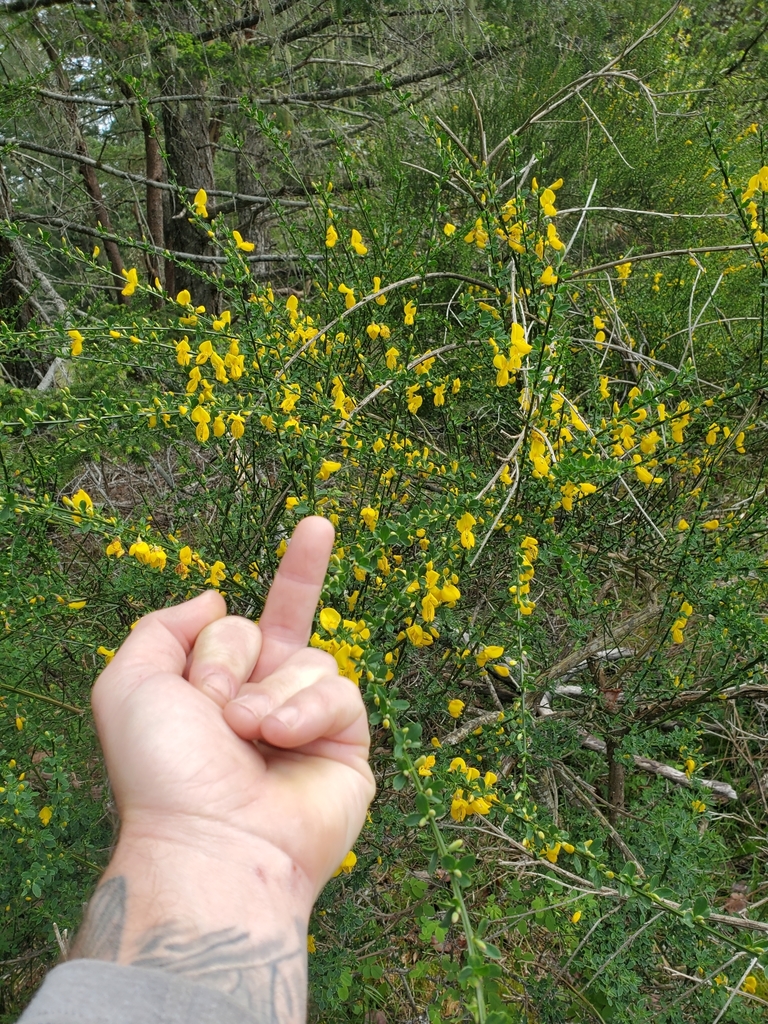
Scotch broom is not reliably fire resistant: some sources rate it low or moderate, while others call it highly flammable or fire-prone.
Virginia Cooperative Extension gives Scotch broom its lowest flammability rating on a three-point scale. The USDA Forest Service and state Firewise programs place it one step above their best category, noting its green winter stems and large clumps. A New Zealand laboratory study also puts air-dried shoots in a moderate flammability cluster. Together, these findings explain why the shrub sometimes appears in fire-conscious planting guidance.
The opposing findings are harder to dismiss. The City of Ashland lists Scotch broom as highly flammable in regulatory guidance with legal force, while Fire Safe Marin names it among common fire-prone plants and stresses spacing, irrigation, and dead-material removal. A separate laboratory study found high effective heat of combustion when conditioned foliage and twigs were tested at 25 kilowatts per square metre. That measurement concerns heat released during burning, not simply how readily the plant ignites.
The disagreement reflects different questions, regions, preparation methods, and rating scales. Scotch broom may score favorably in one broad plant list yet release substantial heat under a particular laboratory test or be treated as a local fire hazard. For a homeowner choosing vegetation near buildings, the evidence does not support treating this seven-foot shrub as reliably fire resistant, especially where local rules identify it as hazardous.
Northeastern and mid-Atlantic study sites (ME, MD, MA, NY, VA footprint); partial normalized coverage · 2007-08-20
The authors collected foliage and twigs across study sites in Maine, Maryland, Massachusetts, New York, and Virginia, then conditioned and tested the samples in a cone calorimeter. FireApproved publishes 37 exact source owners only as multi-state laboratory context. The source does not establish that every taxon was sampled in every named state, whole-plant behavior, landscape suitability, or state planting guidance.
Marin County (CA footprint); partial normalized coverage · 2019-01-01
The publication is explicitly limited to plants common to Marin County. FireApproved publishes 104 exact owners as Marin regional context while retaining its placement, spacing, irrigation, and maintenance boundary. It is not statewide California guidance or parcel suitability.
Virginia Cooperative Extension's publication opens with Virginia wildfire conditions, identifies its Virginia Firewise Landscaping Task Force, and labels plants native to Virginia. FireApproved publishes 306 exact source owners. Publication scope does not establish parcel suitability or current endorsement of this archived 2009 list.
2. Why this plant is relevant here
State distribution
Documented in AK, AL, CA, CT, DC, DE, GA, HI, ID, KY, MA, MD, ME, MI, MT, NC, NH, NJ, NY, OH, OR, PA, SC, TN, UT, VA, WA, WV.
Native range
Introduced / established
12 sourced range or established records. This is not an invasive warning.
USDA hardiness
Documented minimum 5b; no upper limit is documented.
3. Legal, ecological, and broader status
Legal-list status
2 legal-list records; the Place chip matches exact scope.
Seed-list status
4 state noxious-weed seed records; the Place chip matches exact scope.
Reported invasive here
3 ecological invasive reports.
Broader regional context
Federal context
How to read this page
The status above is computed from the cited rows below: independent recommendations can support a fire-resistant result, an avoid row can produce keep-away, and disagreement stays visible as conflict. Placement notes preserve each source’s own scheme rather than translating unlike rules into one scale. This is evidence about a plant, not permission to plant it in every part of the defensible space; Zone 0 remains noncombustible.
Native and introduced range evidence
These are exact U.S. botanical-area records from the cited range source. Native and
introduced describe biogeographic relationship, not fire performance or planting approval.
Doubtful and extinct rows stay visible but do not count as current presence.
The lossless worldwide derivative is retained once in the research corpus; object pages repeat only exact U.S. areas needed by the local lens. The JSON twin carries the same page assertions.
Plant hardiness evidence
These values describe the plant source. Your ZIP zone comes from the separate 2023 USDA
Plant Hardiness Zone Map. Whole-zone values stay whole-zone, and a single unresolved value
is not treated as a tolerance range. Different source boundaries stay separate: overlapping
statements are compared independently, while only ranges with no shared zone are called a conflict.
Source prints 6 · single-value meaning unresolved · whole zone precision · source stated
Source taxon: Cytisus scoparius · exact match.
Source location: Cold Hardiness Zone field in the recovered selector record.
Not used for comparison: The recovered selector prints one Cold Hardiness Zone value but does not define it as a minimum threshold or a one-zone range.
Placement rules below use each source's own distances or named zones, tied to its rating.
They are not interchangeable with the directory's current Zone 0 guidance.
Eastern United States Fire Performance Plant Selector: Landscape Zone 2 — 5–10 ft from the structure; maintained lawn or fuel breaks, with easily ignited evergreens avoided [Fire Performance Plant Selector landscape zone] (mid-scale rating)
The evidence
Grouped by what each source concluded. Primary evidence rated the plant itself
(a lab, field program, or original curation); corroboration compiled or
republished another source's rating and resolves to its root lineage.
76 cited rows from this source; its identity, lineage and tier are stated once.
Primary study Anon1995: Añón, J.R., López, F.F., Castiñeiras, J.P., Ledo, J.P. & Regueira, L.N. (1995). Calorific values and flammability for forest wastes during the seasons of the year. Bioresource technology, 52, 269-274.
Shared row context: plant part litter; fuel all; predrying no; device calorimeter; site Anon1995-1.
“calorific value (kcal/kg): 4907.72”
FLAMITS record 339; Combustibility measurement; sampling spring.
“calorific value (kcal/kg): 4545.66”
FLAMITS record 340; Combustibility measurement; sampling summer.
“calorific value (kcal/kg): 4904.62”
FLAMITS record 341; Combustibility measurement; sampling autumn.
“calorific value (kcal/kg): 4942.15”
FLAMITS record 342; Combustibility measurement; sampling winter.
“flammability value: 1”
FLAMITS record 355; Ignitability measurement; sampling spring.
“flammability value: 1”
FLAMITS record 356; Ignitability measurement; sampling summer.
“flammability value: 2”
FLAMITS record 357; Ignitability measurement; sampling autumn.
“flammability value: 2”
FLAMITS record 358; Ignitability measurement; sampling winter.
Primary study Blackhall2019: Blackhall, M., & Raffaele, E. (2019). Flammability of Patagonian invaders and natives: When exotic plant species affect live fine fuel ignitability in wildland-urban interfaces. Landscape and Urban Planning, 189, 1-10.
Shared row context: plant part twigs; fuel live; predrying no; device epiradiator; site Blackhall2019-1; sampling february.
Primary study Cui2020a: Cui, X., Paterson, A. M., Wyse, S. V., Alam, M. A., Maurin, K. J. L., Pieper, R., ... Curran, T. J. (2020a). Shoot flammability of vascular plants is phylogenetically conserved and related to habitat fire-proneness and growth form. Nature Plants, 6, 355-359.
Shared row context: plant part branches; fuel all; predrying yes; device grill; site Cui2020a-1; sampling ND.
“ignition frequency (%): 87.5”
FLAMITS record 1375; Ignitability measurement.
“maximum sample temperature (°C): 342.3”
FLAMITS record 1569; Combustibility measurement.
“burning duration (s): 13.3”
FLAMITS record 1763; Sustainability measurement.
“estimated burnt biomass (%): 31.3”
FLAMITS record 1957; Consumability measurement.
“calorific value (kcal/kg): 4036.5”
FLAMITS record 2868; Combustibility measurement; plant part leaves; fuel live; predrying yes; device calorimeter; site Dibble2007-1; sampling ND. Primary study Dibble2007: Dibble, A. C., White, R. H., & Lebow, P. K. (2007). Combustion characteristics of north-eastern USA vegetation tested in the cone calorimeter: invasive versus non-invasive plants. International journal of wildland fire, 16, 426-443.
Primary study Madrigal2011a: Madrigal, J., Guijarro, M., Hernando, C., Díez, C., & Marino, E. (2011a). Effective Heat of Combustion for Flaming Combustion of Mediterranean Forest Fuels. Fire Technology, 47, 461-474.
Shared row context: plant part twigs; fuel live; predrying no; device calorimeter; site Madrigal2011a-1; sampling ND.
FLAMITS record 7892; Combustibility measurement; sampling ND.
“flammability value: 2”
FLAMITS record 7939; Ignitability measurement; sampling ND.
Primary study Nunez1996: Nunez-Regueira, L., Anon, J. A. R., & Castineiras, J. P. (1996). Calorific values and flammability of forest species in Galicia. Coastal and hillside zones. Bioresource Technology, 57, 283-289.
Shared row context: plant part litter; fuel all; predrying no; site Nunez1996-1.
FLAMITS record 9850; Ignitability measurement; device epiradiator; sampling spring.
“flammability value: 1”
FLAMITS record 9859; Ignitability measurement; device epiradiator; sampling summer.
“flammability value: 2”
FLAMITS record 9868; Ignitability measurement; device epiradiator; sampling autumn.
“flammability value: 2”
FLAMITS record 9877; Ignitability measurement; device epiradiator; sampling winter.
Primary study Salvo2015: Salvo-Aires, F. (2015). Effects of woody weeds on fuels and fire behaviour in Eastern Australian forests and woodlands. PhD. Dissertation. University of Sydney.
Shared row context: plant part leaves; fuel live; predrying yes; device calorimeter; site Salvo2015-1; sampling ND.
Primary study Wyse2016: Wyse, S. V., Perry, G. L. W., O'Connell, D. M., Holland, P. S., Wright, M. J., Hosted, C. L., ... Curran, T. J. (2016). A quantitative assessment of shoot flammability for 60 tree and shrub species supports rankings based on expert opinion. International Journal of Wildland Fire, 25, 466-477.
Shared row context: plant part branches; fuel all; predrying yes; device grill; site Wyse2016-3; sampling ND.
“ignition frequency (%): 87.5”
FLAMITS record 14334; Ignitability measurement.
“maximum sample temperature (°C): 323.5”
FLAMITS record 14394; Combustibility measurement.
“burning duration (s): 13.3”
FLAMITS record 14454; Sustainability measurement.
“estimated burnt biomass (%): 31.3”
FLAMITS record 14514; Consumability measurement.
Primary study Sultana2022: Sultana, N. (2022). Traits underpinning the eco-physiological processes linking drought and flammability. PhD. Dissertation. Lincoln University.
Shared row context: plant part branches; fuel all; predrying yes; device grill; site Sultana2022-1.
“time to flaming (s): 4.91”
FLAMITS record 16089; Ignitability measurement; sampling autum 2019.
“time to flaming (s): 8.41”
FLAMITS record 16090; Ignitability measurement; sampling winter 2019.
“time to flaming (s): 5.42”
FLAMITS record 16091; Ignitability measurement; sampling spring 2019.
“time to flaming (s): 1.98”
FLAMITS record 16092; Ignitability measurement; sampling summer 2019.
“maximum flame temperature (°C): 363.98”
FLAMITS record 16129; Combustibility measurement; sampling autum 2019.
“maximum flame temperature (°C): 372.11”
FLAMITS record 16130; Combustibility measurement; sampling winter 2019.
“maximum flame temperature (°C): 471.62”
FLAMITS record 16131; Combustibility measurement; sampling spring 2019.
“maximum flame temperature (°C): 525.44”
FLAMITS record 16132; Combustibility measurement; sampling summer 2019.
“estimated burnt biomass (%): 10.04”
FLAMITS record 16169; Consumability measurement; sampling autum 2019.
“estimated burnt biomass (%): 7.7”
FLAMITS record 16170; Consumability measurement; sampling winter 2019.
“estimated burnt biomass (%): 12.02”
FLAMITS record 16171; Consumability measurement; sampling spring 2019.
“estimated burnt biomass (%): 34.36”
FLAMITS record 16172; Consumability measurement; sampling summer 2019.
“burning duration (s): 10.56”
FLAMITS record 16209; Sustainability measurement; sampling autum 2019.
“burning duration (s): 21.46”
FLAMITS record 16210; Sustainability measurement; sampling winter 2019.
“burning duration (s): 19.94”
FLAMITS record 16211; Sustainability measurement; sampling spring 2019.
“burning duration (s): 31.46”
FLAMITS record 16212; Sustainability measurement; sampling summer 2019.