City of Ashland (OR footprint); partial normalized coverage · 2026-08-26
This is a City of Ashland adoption fact, not statewide Oregon guidance or an experimental flammability result. FireApproved publishes 24 taxonomy-safe owners as city-level regulatory context. It applies to new planting and propagation within 30 feet of structures, including structures on adjacent lots; it is not projected as a blanket removal order for every established listed plant.
The guide presents itself as fire performance ratings for common landscape plants in a fire-prone California setting. FireApproved publishes 104 exact owners as republished California context. It is not an independent rating, a current endorsement, or parcel suitability.
Marin County (CA footprint); partial normalized coverage · 2019-01-01
The publication is explicitly limited to plants common to Marin County. FireApproved publishes 104 exact owners as Marin regional context while retaining its placement, spacing, irrigation, and maintenance boundary. It is not statewide California guidance or parcel suitability.
The UC Forest Products Laboratory says the guide covers properties of common California landscaping plants and was prepared for California fire agencies. FireApproved publishes 130 exact owners at historical California publication scope. The report is a 1997 compilation, not a current endorsement, site rating, or independent test of every row.
Sun City Texas, Georgetown (TX footprint); partial normalized coverage · 2015-01-14
The guide is authored for the Sun City Texas community in Georgetown. FireApproved publishes 142 exact owners only as community-level context. It is an archived HOA exhibit with unknown rating lineage, not a current statewide Texas source or an independent Tier 1 determination.
Yavapai County (AZ footprint); partial normalized coverage · 2025-03-14
University of Arizona Cooperative Extension authors Bulletin 34 for Yavapai County. FireApproved publishes 198 exact source owners from its resistant and prone tables and keeps the county boundary visible. County publication scope is regional Arizona context, never statewide scope.
2. Why this plant is relevant here
State distribution
Documented in AL, CA, GA, LA, NJ, OR, SC, TN, TX, UT, VA, WA.
Native range
Introduced / established
13 sourced range or established records. This is not an invasive warning.
USDA hardiness
Documented minimum 6b; no upper limit is documented.
3. Legal, ecological, and broader status
Legal-list status
1 legal-list record; the Place chip matches exact scope.
Seed-list status
Reported invasive here
2 ecological invasive reports.
Broader regional context
Federal context
How to read this page
The status above is computed from the cited rows below: independent recommendations can support a fire-resistant result, an avoid row can produce keep-away, and disagreement stays visible as conflict. Placement notes preserve each source’s own scheme rather than translating unlike rules into one scale. This is evidence about a plant, not permission to plant it in every part of the defensible space; Zone 0 remains noncombustible.
Native and introduced range evidence
These are exact U.S. botanical-area records from the cited range source. Native and
introduced describe biogeographic relationship, not fire performance or planting approval.
Doubtful and extinct rows stay visible but do not count as current presence.
The lossless worldwide derivative is retained once in the research corpus; object pages repeat only exact U.S. areas needed by the local lens. The JSON twin carries the same page assertions.
Plant hardiness evidence
These values describe the plant source. Your ZIP zone comes from the separate 2023 USDA
Plant Hardiness Zone Map. Whole-zone values stay whole-zone, and a single unresolved value
is not treated as a tolerance range. Different source boundaries stay separate: overlapping
statements are compared independently, while only ranges with no shared zone are called a conflict.
Source prints 8 · single-value meaning unresolved · whole zone precision · source stated
Source taxon: Cortaderia selloana · exact match.
Source location: Cold Hardiness Zone field in the recovered selector record.
Not used for comparison: The recovered selector prints one Cold Hardiness Zone value but does not define it as a minimum threshold or a one-zone range.
Source location: PlantCharacteristics record 21404, Temperature, Minimum (°F).
Where its sources say to plant it
Placement rules below use each source's own distances or named zones, tied to its rating.
They are not interchangeable with the directory's current Zone 0 guidance.
Eastern United States Fire Performance Plant Selector: Landscape Zone 4 — beyond 30 ft; outside the selector's recommendation area [Fire Performance Plant Selector landscape zone] (with its avoid rating)
Fire Resisting Garden Plants for the Urban Fringe and Rur…: remove from the Building Protection Zone; avoid in the Fuel Modified Zone [Texas Building Protection Zone] (with its avoid rating)
Prohibited Flammable Plants: new planting or propagation restricted within 30 ft of any structure [Ashland Municipal Code setback] (with its avoid rating)
Guía de pirojardinería: prohibited as a regulated invasive plant; not a fire-suitability verdict [girona-2020-iuf-25m-suitability] (mid-scale rating)
Defensible Space Landscaping in the Urban/Wildland Interf…: Chapter 4, Landscape Vegetation Database [ucfpl-1997] (with its avoid rating)
Firewise Plant Guide: Avoid if Possible [Sun City plant-table sections] (with its avoid rating)
Fire Performance of Common Plants: Table 2 (unfavorable in 3 or more references) [diablo-guide-to-plants-three-reference-vote] (with its avoid rating)
The evidence
Grouped by what each source concluded. Primary evidence rated the plant itself
(a lab, field program, or original curation); corroboration compiled or
republished another source's rating and resolves to its root lineage.
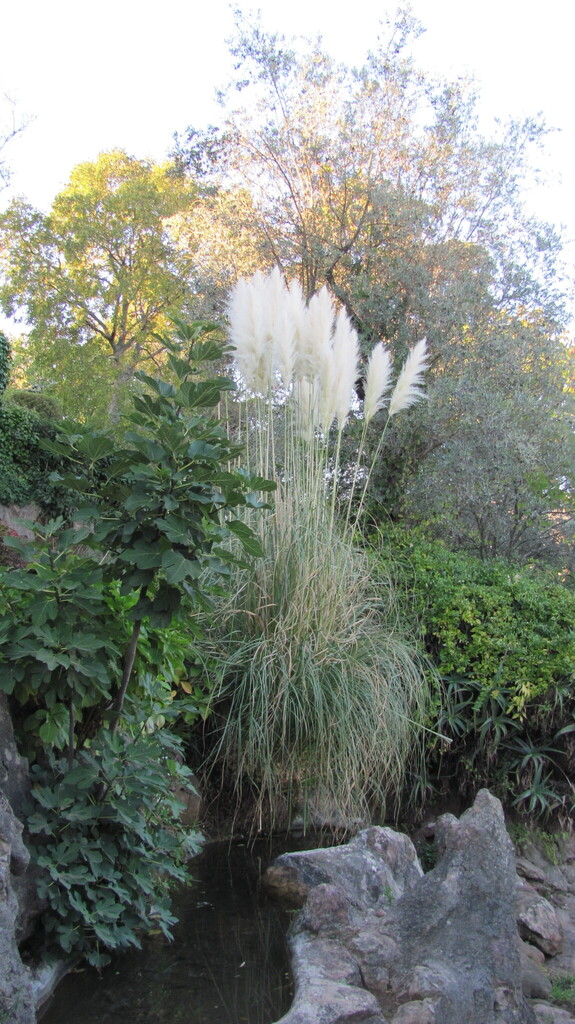
Listed as Pampus grass — Cortaderia selloana. The bulletin says fire-resistant plants tend to resist ignition when irrigated and maintained, while fire-prone plants may ignite readily and burn intensely.
The table rates Pampas Grass — Cortaderia selloana very high for flammability hazard, defined as the ease a plant can burn at high temperatures for a prolonged time.
Fire Performance of Common Plants (Guide to Plants) — Diablo Firesafe Council · live page captured 2026-08-29 · original sourceCorroborationMirrorlineage: ucfpl-berkeley resolves to Defensible Space Landscaping in the Urban/Wildland Interface: A Compilation of Fire Performance Ratings of Residential Landscape Plants
“Table 2: unfavorable fire performance rating in 3 or more references (refs 4,8,9,40)”
The Diablo Firesafe Council Guide to Plants lists Cortaderia selloana (Pampas grass) as grass, evergreen, in Table 2: plants with a unfavorable fire performance rating in 3 or more references. The guide cites 4 of its 57 numbered references for this row (4,8,9,40). The guide states the ranking terms in its underlying references were mostly undefined and makes no attempt to rank within the list, and that fire performance is compromised without maintenance.
Cortaderia selloana is rated “PROHIBIDA” by the guide's qualitative IUF garden-suitability method. The method assumes species-specific care and integrates fire evidence with fuel structure, maintenance, origin, invasiveness, and expert fire-service experience.