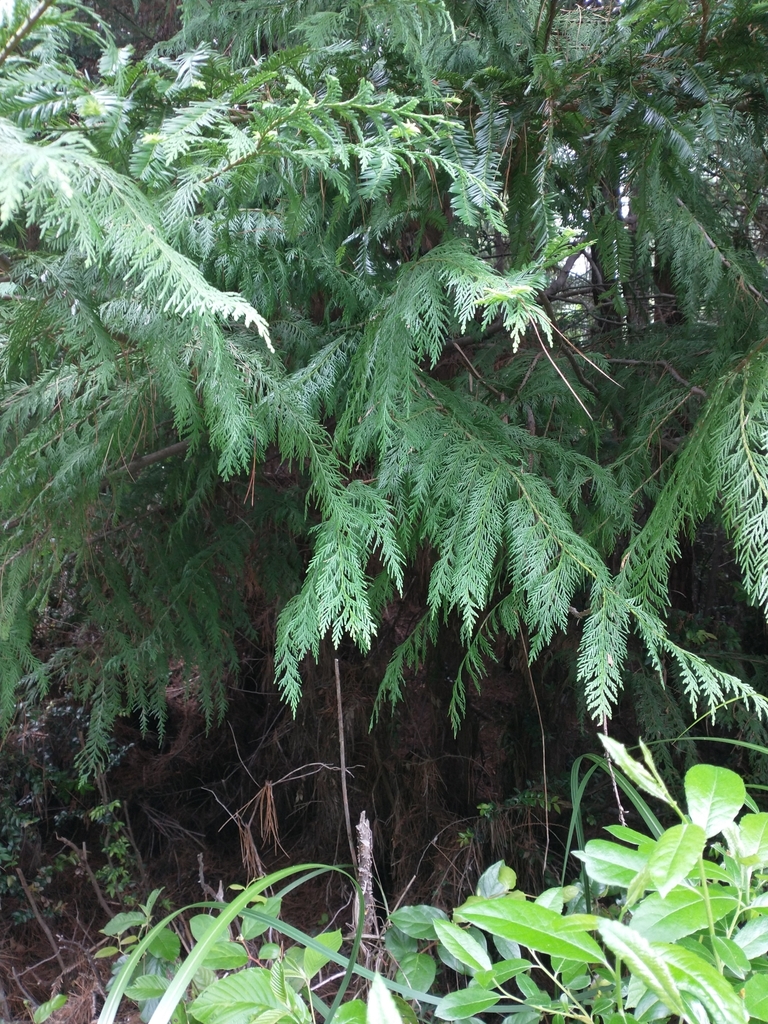
Enter your ZIP to see whether this is legal to plant in your state, and whether it survives your winter.
Port Orford cedar is not fire resistant: four of five assessments place it on the avoid side, and Tasmania Fire Service calls it highly flammable.
Across five assessments, four support avoiding it and one gives a moderate rating. The USDA Forest Service and state Firewise programs rate it “Not Firewise,” the least favorable point on their four-part scale. The Tasmania Fire Service calls it highly flammable, meaning it should not be planted or kept within the Building Protection Zone and should be avoided in the Fuel Modified Zone.
The Dorset Heaths Partnership, Firewise UK, and the University of Exeter wildFIRE Lab place Lawson’s cypress in the red class. Their leaflet says its dead, dry parts can produce flames over 2.5 metres and advises against planting it directly beside a home or shed. Girona’s provincial government and Catalonia’s fire service rate the species “very discouraged” using a method that considers fire research, fuel structure, maintenance, origin, invasiveness, and fire-service experience.
Fire and Emergency New Zealand supplies the only softer result, rating the tree moderately flammable on a seven-level scale. Even so, that finding does not make it fire resistant. Port Orford cedar grows to about 50 feet at maturity, and although the Forest Service description notes bark up to three inches thick, it still assigns the tree its worst Firewise rating. The practical choice is to avoid relying on this species for fire-resistant landscaping near buildings.
Catalonia, Spain; Dorset, United Kingdom; New Zealand; Tasmania, Australia; eastern US
Maintenance
2. Why this plant is relevant here
State distribution
Documented in CA, DC, DE, MD, NJ, OH, OR, PA, WV.
Native range
Current cited native range in CA, OR.
Introduced / established
USDA hardiness
Documented minimum 5b; no upper limit is documented.
3. Legal, ecological, and broader status
Legal-list status
Seed-list status
Reported invasive here
Broader regional context
Federal context
How to read this page
The status above is computed from the cited rows below: independent recommendations can support a fire-resistant result, an avoid row can produce keep-away, and disagreement stays visible as conflict. Placement notes preserve each source’s own scheme rather than translating unlike rules into one scale. This is evidence about a plant, not permission to plant it in every part of the defensible space; Zone 0 remains noncombustible.
Native and introduced range evidence
These are exact U.S. botanical-area records from the cited range source. Native and
introduced describe biogeographic relationship, not fire performance or planting approval.
Doubtful and extinct rows stay visible but do not count as current presence.
The lossless worldwide derivative is retained once in the research corpus; object pages repeat only exact U.S. areas needed by the local lens. The JSON twin carries the same page assertions.
Plant hardiness evidence
These values describe the plant source. Your ZIP zone comes from the separate 2023 USDA
Plant Hardiness Zone Map. Whole-zone values stay whole-zone, and a single unresolved value
is not treated as a tolerance range. Different source boundaries stay separate: overlapping
statements are compared independently, while only ranges with no shared zone are called a conflict.
Source location: Cold Hardiness Zone field in the recovered selector record.
Not used for comparison: The recovered selector prints one Cold Hardiness Zone value but does not define it as a minimum threshold or a one-zone range.
Source location: PlantCharacteristics record 15030, Temperature, Minimum (°F).
Where its sources say to plant it
Placement rules below use each source's own distances or named zones, tied to its rating.
They are not interchangeable with the directory's current Zone 0 guidance.
Eastern United States Fire Performance Plant Selector: Landscape Zone 3 — 10–30 ft from the structure; thin vegetation, remove debris, and minimize plant massing [Fire Performance Plant Selector landscape zone] (with its avoid rating)
Fire Resisting Garden Plants for the Urban Fringe and Rur…: remove from the Building Protection Zone; avoid in the Fuel Modified Zone [Texas Building Protection Zone] (with its avoid rating)
Guía de pirojardinería: not suitable inside or outside the 25-metre maximum-risk zone [girona-2020-iuf-25m-suitability] (with its avoid rating)
The evidence
Grouped by what each source concluded. Primary evidence rated the plant itself
(a lab, field program, or original curation); corroboration compiled or
republished another source's rating and resolves to its root lineage.
Chamaecyparis lawsoniana is rated “MUY DESACONSEJADA” by the guide's qualitative IUF garden-suitability method. The method assumes species-specific care and integrates fire evidence with fuel structure, maintenance, origin, invasiveness, and expert fire-service experience.
Mid-scale / conditional (1)
Low Flammability Plants directory — Fire and Emergency New Zealand (plant flammability testing at Lincoln University) · 2026 · original sourcePrimary evidenceLab-testedlineage: lincoln-nz-tree