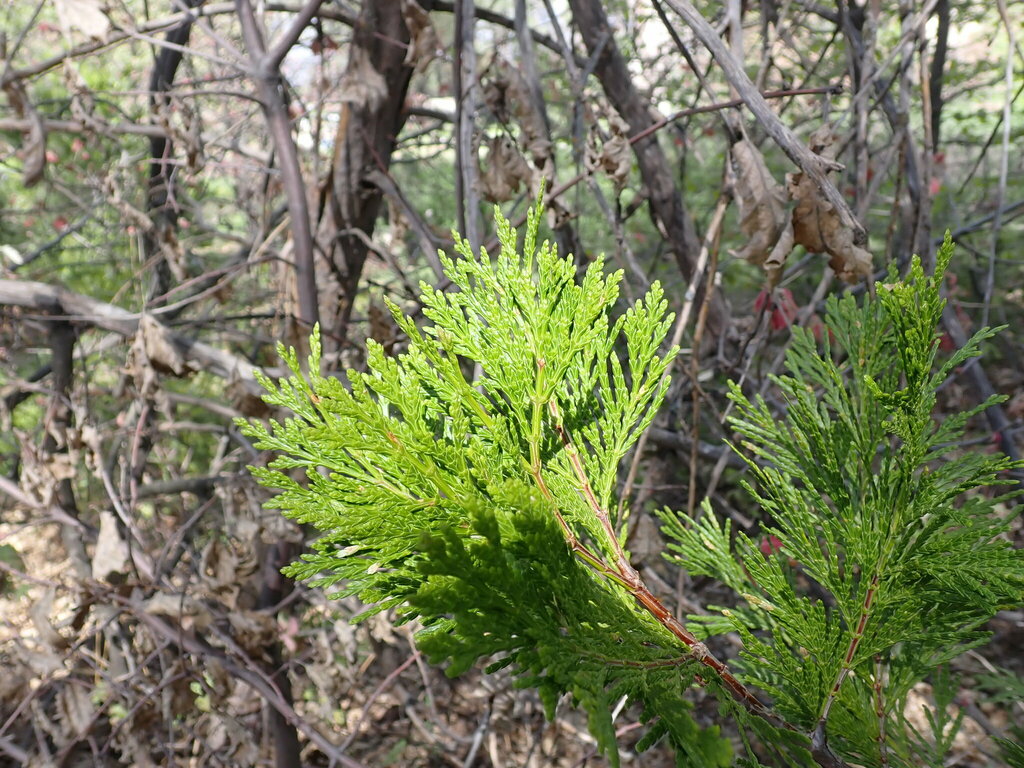
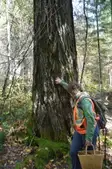
Enter your ZIP to see whether this is legal to plant in your state, and whether it survives your winter.
Incense cedar has 2 hardiness assertions in hardiness evidence. The Calocedrus decurrens record also cites same-form alternatives under related plants.
Its computed direction is avoid in the evidence table. Range evidence supplies geographic context, while the alternatives and hardiness rows retain their separate roles. None of those sections replaces the evidence behind the direction; together they keep the accepted facts navigable within the decurrens species record rather than turning the genus into a record-level conclusion. The incense cedar card therefore keeps temperature, range, comparison, and recommendation in their respective evidence channels.
City of Ashland (OR footprint); partial normalized coverage · 2026-08-26
This is a City of Ashland adoption fact, not statewide Oregon guidance or an experimental flammability result. FireApproved publishes 24 taxonomy-safe owners as city-level regulatory context. It applies to new planting and propagation within 30 feet of structures, including structures on adjacent lots; it is not projected as a blanket removal order for every established listed plant.
Southern Idaho (ID footprint); partial normalized coverage · 2013-11-08
The official database labels itself "For Southern Idaho" and describes Idaho residents at the urban-rangeland interface. FireApproved publishes 419 existing plant owners that cite its scored rows. This bounded Southern Idaho scope is regional context, not statewide coverage or a conclusion that the score transfers unchanged to every Idaho site.
Michigan State University Extension Bulletin E2948 is explicitly a list of wildfire-resistant landscape plants for Michigan and includes a Michigan-native field. FireApproved publishes 221 exact GBIF owners from 226 represented source rows and holds 15 complex or non-exact rows. This dated publication scope is not a current site-suitability determination.
Nevada Division of Forestry and University of Nevada Cooperative Extension publish Bulletin 06-01 for the Lake Tahoe Basin and vicinity. FireApproved publishes 83 exact rated owners as basin context across Nevada and California. Rough estimates are not statewide or site ratings.
2. Why this plant is relevant here
State distribution
Documented in CA, MI, NV, OR.
Native range
Current cited native range in CA, OR.
Introduced / established
USDA hardiness
2 applicable cited hardiness statements overlap but have different boundaries; compare each complete source row.
3. Legal, ecological, and broader status
Legal-list status
Seed-list status
Reported invasive here
Broader regional context
Federal context
How to read this page
The status above is computed from the cited rows below: independent recommendations can support a fire-resistant result, an avoid row can produce keep-away, and disagreement stays visible as conflict. Placement notes preserve each source’s own scheme rather than translating unlike rules into one scale. This is evidence about a plant, not permission to plant it in every part of the defensible space; Zone 0 remains noncombustible.
Native and introduced range evidence
These are exact U.S. botanical-area records from the cited range source. Native and
introduced describe biogeographic relationship, not fire performance or planting approval.
Doubtful and extinct rows stay visible but do not count as current presence.
The lossless worldwide derivative is retained once in the research corpus; object pages repeat only exact U.S. areas needed by the local lens. The JSON twin carries the same page assertions.
Plant hardiness evidence
These values describe the plant source. Your ZIP zone comes from the separate 2023 USDA
Plant Hardiness Zone Map. Whole-zone values stay whole-zone, and a single unresolved value
is not treated as a tolerance range. Different source boundaries stay separate: overlapping
statements are compared independently, while only ranges with no shared zone are called a conflict.
Source location: PlantCharacteristics record 15026, Temperature, Minimum (°F).
Where its sources say to plant it
Placement rules below use each source's own distances or named zones, tied to its rating.
They are not interchangeable with the directory's current Zone 0 guidance.
Prohibited Flammable Plants: new planting or propagation restricted within 30 ft of any structure [Ashland Municipal Code setback] (with its avoid rating)
Guía de pirojardinería: not suitable inside or outside the 25-metre maximum-risk zone [girona-2020-iuf-25m-suitability] (with its avoid rating)
Fire Resistance of Plants Master Database: 100 ft minimum planting distance on flat terrain [Idaho minimum planting distance] (with its avoid rating)
Home Landscaping Guide for Lake Tahoe and Vicinity: Fire Hazard column: high [tahoe-guide-2006] (with its avoid rating)
The evidence
Grouped by what each source concluded. Primary evidence rated the plant itself
(a lab, field program, or original curation); corroboration compiled or
republished another source's rating and resolves to its root lineage.
Calocedrus decurrens is rated “MUY DESACONSEJADA” by the guide's qualitative IUF garden-suitability method. The method assumes species-specific care and integrates fire evidence with fuel structure, maintenance, origin, invasiveness, and expert fire-service experience.
Table 1's Fire Hazard column prints “high” for this taxon. The guide calls the rating a rough estimate of potential flammability, not a result of scientific trials. Its footnote says plants that turn brown often become high fire hazards and tells readers to mow grasses and forbs when they begin to turn brown.
Listed without a rating (30)Corroboration (30 rows from 1 source)
30 cited rows from this source; its identity, lineage and tier are stated once.
Primary study deMagalhaes2012: De Magalhães, R. M. Q., & Schwilk, D. W. (2012). Leaf traits and litter flammability: evidence for non-additive mixture effects in a temperate forest. Journal of Ecology, 100, 1153-1163.
Shared row context: plant part litter; fuel all; predrying no; device burning bench; site deMagalhaes2012-1; sampling summer.
Primary study vanWagtendonk1998: Van Wagdendonk, J., Sydoriak, W. M., & Benedict, J. M. (1998). Heat content variation of Sierra Nevada conifers. International Journal of Wildland Fire, 8, 147-158.
Primary study Zhang2022: Zhang, S., Cornwell, W. K., Zhao, W., van Logtestijn, R. S., Krab, E. J., Aerts, R., & Cornelissen, J. H. (2022). Experimental evidence that leaf litter decomposability and flammability are decoupled across gymnosperm species. Journal of Ecology, 111, 761-772.
Shared row context: plant part leaves; fuel all; predrying yes; device burning bench; site Zhang2022-1; sampling january and march 2011.
“maximum flame temperature (°C): 515.396”
FLAMITS record 15552; Combustibility measurement.
“flaming duration (s): 4.2”
FLAMITS record 15593; Sustainability measurement.
Primary study deMagalhaes2017: de Magalhães, R. (2017). The effect of leaf traits on litter flammability in mixed-conifer forest. PhD. Dissertation. Texas Tech University.
Shared row context: plant part litter; fuel all; predrying no; device burning bench; site deMagalhaes2017-1; sampling ND.