Enter your ZIP to see whether this is legal to plant in your state, and whether it survives your winter.
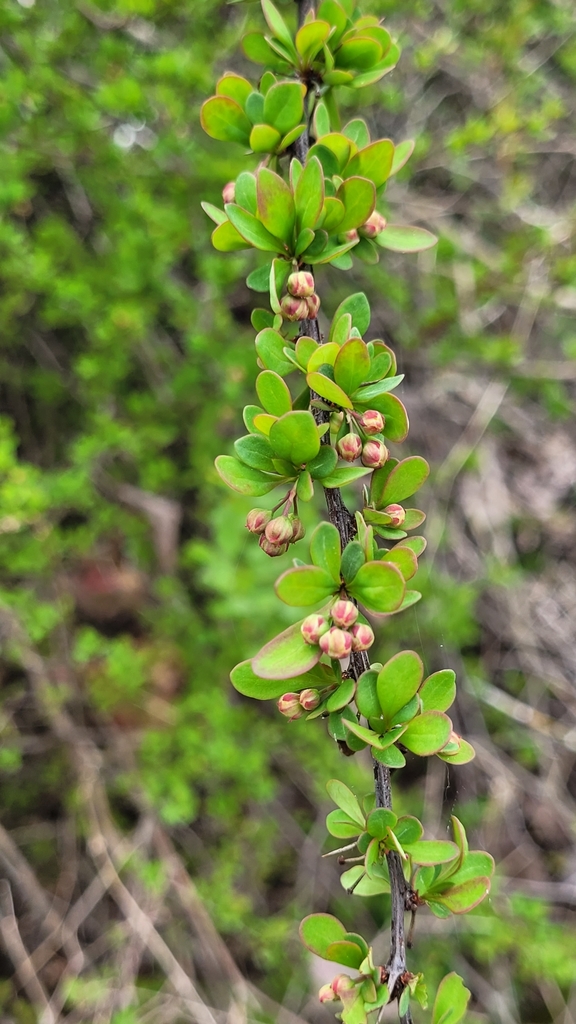
Japanese barberry is rated fire resistant overall, with broad agreement and one caution about its thorns holding blown-in trash.
Across six assessments, every institution reaches a favorable result. Idaho Firewise gives the shrub 8 of 10, within its recommended range based on field trials. Ohio State University Extension and Virginia Cooperative Extension each rate it low in flammability on their respective expert scales. FireSmart BC approves it as a fire-resistant plant, while Spain’s Generalitat Valenciana recommends it among low-flammability shrubs for gardens near wildland areas. These different approaches all support the fire-resistant classification.
The USDA Forest Service Northeastern Area and state Firewise programs also place Japanese barberry in the best category on their four-step Firewise scale. Their caution is specific: persistent single thorns at each node hold blown-in trash. That observation does not contradict the favorable fire rating, but it gives homeowners a concrete feature to watch when caring for the shrub.
Japanese barberry is a shrub in the Berberidaceae family that reaches about seven feet at maturity. Hardy to USDA zone 4a, Japanese barberry takes moderate water and grows in full sun. It has also been flagged invasive in one jurisdiction, which is a separate consideration from flammability. On the fire question itself, the sources consistently favor resistance.
Form
shrub
Mature height
~7 ft
Light
Full sun
Water need
moderate
Rated in
British Columbia; Catalonia, Spain; Colorado / Rocky Mountain Front Range; Georgetown, Texas +7
On this lot
1. Fire evidence and conditions
Fire evidence
Fire-resistant — location does not change the cited classification.
Colorado State University Extension and the Colorado State Forest Service publish Fact Sheet 6.305 for Colorado's WUI and varied ecosystems. FireApproved exposes all 114 exact source owners at Colorado publication scope while retaining score, elevation, water, and Idaho-carrier lineage. Publication scope is not suitability for every Colorado site or zone.
Northeastern and mid-Atlantic study sites (ME, MD, MA, NY, VA footprint); partial normalized coverage · 2007-08-20
The authors collected foliage and twigs across study sites in Maine, Maryland, Massachusetts, New York, and Virginia, then conditioned and tested the samples in a cone calorimeter. FireApproved publishes 37 exact source owners only as multi-state laboratory context. The source does not establish that every taxon was sampled in every named state, whole-plant behavior, landscape suitability, or state planting guidance.
Southern Idaho (ID footprint); partial normalized coverage · 2013-11-08
The official database labels itself "For Southern Idaho" and describes Idaho residents at the urban-rangeland interface. FireApproved publishes 419 existing plant owners that cite its scored rows. This bounded Southern Idaho scope is regional context, not statewide coverage or a conclusion that the score transfers unchanged to every Idaho site.
Ohio State University Extension Bulletin 921 is an Ohio publication that describes Ohio fire seasons and landscape conditions and labels nativity to Ohio. FireApproved publishes 352 exact source-owning plant records from its eight rated tables. This historical publication scope does not assert current extension endorsement or that a listed plant suits every Ohio site.
Sun City Texas, Georgetown (TX footprint); partial normalized coverage · 2015-01-14
The guide is authored for the Sun City Texas community in Georgetown. FireApproved publishes 142 exact owners only as community-level context. It is an archived HOA exhibit with unknown rating lineage, not a current statewide Texas source or an independent Tier 1 determination.
Virginia Cooperative Extension's publication opens with Virginia wildfire conditions, identifies its Virginia Firewise Landscaping Task Force, and labels plants native to Virginia. FireApproved publishes 306 exact source owners. Publication scope does not establish parcel suitability or current endorsement of this archived 2009 list.
2. Why this plant is relevant here
State distribution
Documented in CT, DC, DE, GA, IA, IL, IN, KS, KY, MA, MD, ME, MI, MN, MO, NC, ND, NE, NH, NJ, NY, OH, PA, RI, SC, SD, TN, VA, VT, WA, WI, WV, WY.
Native range
Introduced / established
USDA hardiness
Documented minimum 4a; no upper limit is documented.
3. Legal, ecological, and broader status
Legal-list status
5 legal-list records; the Place chip matches exact scope.
Seed-list status
1 state noxious-weed seed record; the Place chip matches exact scope.
Reported invasive here
1 ecological invasive report.
Broader regional context
Federal context
Plant-specific legal-list reviews (1)
These source-bound review receipts are separate from ecological invasive reports. A source or plant identity change invalidates a receipt.
NY · Prohibited here. Designated prohibited in the reviewed New York 6 NYCRR Part 575 Prohibited and Regulated Invasive Species as of 2026-08-26. Authority: New York State Department of Environmental Conservation; scope: state; as of 2026-08-26.Official reference.Normalized source record.
How to read this page
The status above is computed from the cited rows below: independent recommendations can support a fire-resistant result, an avoid row can produce keep-away, and disagreement stays visible as conflict. Placement notes preserve each source’s own scheme rather than translating unlike rules into one scale. This is evidence about a plant, not permission to plant it in every part of the defensible space; Zone 0 remains noncombustible.
Plant hardiness evidence
These values describe the plant source. Your ZIP zone comes from the separate 2023 USDA
Plant Hardiness Zone Map. Whole-zone values stay whole-zone, and a single unresolved value
is not treated as a tolerance range. Different source boundaries stay separate: overlapping
statements are compared independently, while only ranges with no shared zone are called a conflict.
Source prints 4 · single-value meaning unresolved · whole zone precision · source stated
Source taxon: Berberis thunbergi · exact match.
Source location: Cold Hardiness Zone field in the recovered selector record.
Not used for comparison: The recovered selector prints one Cold Hardiness Zone value but does not define it as a minimum threshold or a one-zone range.
Placement rules below use each source's own distances or named zones, tied to its rating.
They are not interchangeable with the directory's current Zone 0 guidance.
Eastern United States Fire Performance Plant Selector: Landscape Zone 2 — 5–10 ft from the structure; maintained lawn or fuel breaks, with easily ignited evergreens avoided [Fire Performance Plant Selector landscape zone] (with its recommendation)
Fire Resistance of Plants Master Database: plantable at 30' from home [Idaho minimum planting distance] (with its recommendation)
FireSmart BC Plant Program: suitable for HIZ extended zone (30-100 m) [FireSmart BC Home Ignition Zone] (with its recommendation)
Guía de pirojardinería: suitable inside or outside the 25-metre maximum-risk zone [girona-2020-iuf-25m-suitability] (with its recommendation)
Ignition-Resistant Landscape Plants: suitable for defensible-space zones 1-2 (score 8+) [CSU defensible-space zone] (with its recommendation)
Firewise Plant Guide: Shrubs [Sun City plant-table sections] (with its recommendation)
The evidence
Grouped by what each source concluded. Primary evidence rated the plant itself
(a lab, field program, or original curation); corroboration compiled or
republished another source's rating and resolves to its root lineage.
Berberis thunbergii is rated “RECOMENDADA” by the guide's qualitative IUF garden-suitability method. The method assumes species-specific care and integrates fire evidence with fuel structure, maintenance, origin, invasiveness, and expert fire-service experience.
Ignition-Resistant Landscape Plants (Fact Sheet 6.305) — Colorado State University Extension / Colorado State Forest Service (Wildfire Mitigation Series) · 2025 · original sourcePrimary evidenceField programlineage: idaho-tree resolves to Fire Resistance of Plants Master Database
“ignitability score 8 of 10”
· score 8 (idaho-0-10)
CSU 6.305 table lists Berberis thunbergii 'Atropurpurea Nana' (crimson pygmy Japanese barberry) with the preserved ignitability score.
The table rates Barberry, Japanese — Berberis thunbergii low for flammability hazard, defined as the ease a plant can burn at high temperatures for a prolonged time.
FLAMITS record 2863; Combustibility measurement; plant part leaves; fuel live; predrying yes; device calorimeter; site Dibble2007-1; sampling ND. Primary study Dibble2007: Dibble, A. C., White, R. H., & Lebow, P. K. (2007). Combustion characteristics of north-eastern USA vegetation tested in the cone calorimeter: invasive versus non-invasive plants. International journal of wildland fire, 16, 426-443.