Enter your ZIP to see whether this is legal to plant in your state, and whether it survives your winter.
Yes, western wheatgrass is rated fire resistant overall, though one field-trial score gives reason for caution.
Five of six assessments support its use in some form, while Idaho Firewise gives it 4 of 10, a score in the mixed rather than recommended band under Colorado State University’s published use of the scale.
The supportive findings cover several western settings. FireSmart BC calls western wheatgrass an approved fire-resistant plant, but also flags it for more research. The University of Nevada’s broader compilation includes it because at least two named western sources listed it favorably. Utah State says it can be firewise when properly placed and maintained, while the University of Arizona lists it for sites above 3,000 feet.
A second Nevada assessment concerns northern Nevada greenstrips rather than ordinary home landscaping. It identifies western wheatgrass as a perennial sod-forming plant suited to that use, with minimum yearly precipitation of 8 to 10 inches, and says greenstrips should be grazed or mown frequently. That finding should stay tied to those placement and maintenance conditions.
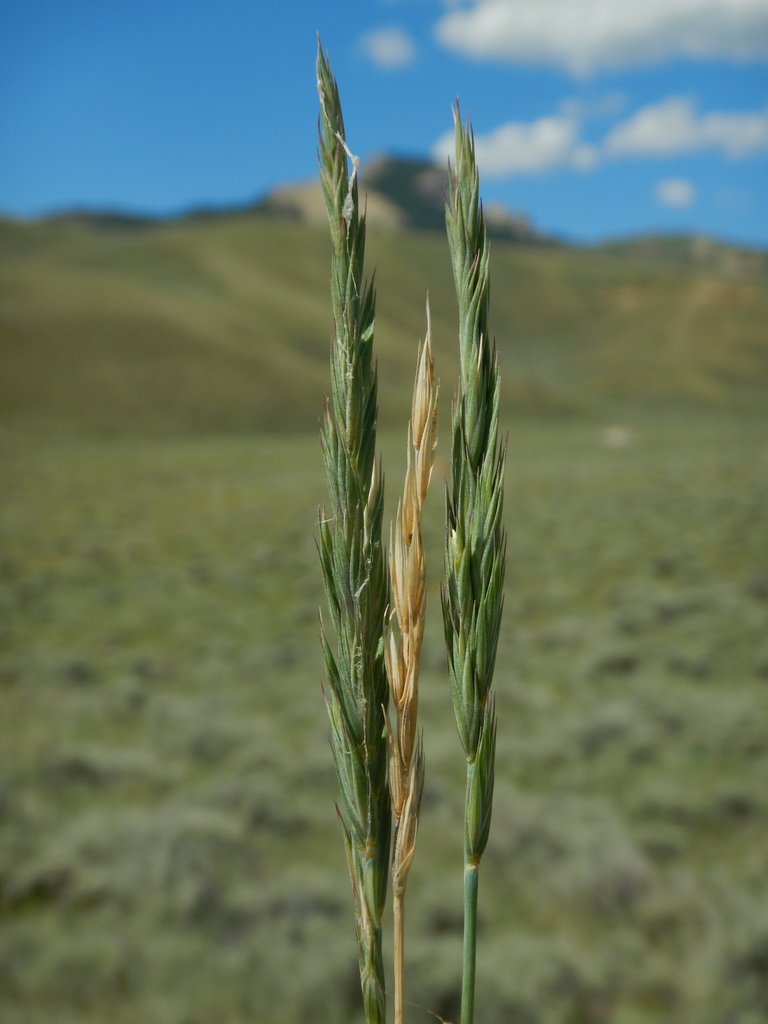
Western wheatgrass is a grass in the Poaceae family, reaches about two feet at maturity, needs moderate water, and is hardy to USDA zone 4a. The practical reading is a qualified yes: several extension sources treat it as fire-resistant or firewise, but the field-trial score and FireSmart BC’s research flag argue against treating that label as an unconditional guarantee.
Form
grass
Mature height
~2 ft
Water need
moderate
Rated in
Arizona above 3,000 feet / interior Southwest; British Columbia; Global; Nevada / Great Basin +3
On this lot
1. Fire evidence and conditions
Fire evidence
Fire-resistant — location does not change the cited classification.
Southern Idaho (ID footprint); partial normalized coverage · 2013-11-08
The official database labels itself "For Southern Idaho" and describes Idaho residents at the urban-rangeland interface. FireApproved publishes 419 existing plant owners that cite its scored rows. This bounded Southern Idaho scope is regional context, not statewide coverage or a conclusion that the score transfers unchanged to every Idaho site.
Arizona at or above 3,000 feet (AZ footprint); partial normalized coverage · 2011-12-01
AZ1289 is explicitly limited to Arizona elevations of 3,000 feet and higher. FireApproved publishes 69 exact owners as regional Arizona context, retaining every water and elevation condition. It is never promoted to statewide low-desert guidance or an independent Tier 1 vote.
University of Nevada Cooperative Extension compiled plants suited to Nevada climate zones and reported favorably by at least two upstream firewise lists. FireApproved publishes 126 exact source owners at Nevada publication scope. The source explicitly makes no independent flammability determination, so these rows remain corroborative.
Utah State University Extension states that this fact sheet selects examples for Utah landscapes and that they require proper placement and maintenance. FireApproved publishes 83 exact source owners at Utah publication scope. The table is not a site-specific planting clearance.
2. Why this plant is relevant here
State distribution
Documented in AK, AR, AZ, CA, CO, GA, IA, ID, IL, IN, KS, KY, MA, MI, MN, MO, MT, ND, NE, NH, NM, NV, NY, OH, OK, OR, SD, TN, TX, UT, WA, WI, WY.
Native range
Introduced / established
USDA hardiness
Documented minimum 4a; no upper limit is documented.
3. Legal, ecological, and broader status
Legal-list status
Seed-list status
Reported invasive here
Broader regional context
Federal context
How to read this page
The status above is computed from the cited rows below: independent recommendations can support a fire-resistant result, an avoid row can produce keep-away, and disagreement stays visible as conflict. Placement notes preserve each source’s own scheme rather than translating unlike rules into one scale. This is evidence about a plant, not permission to plant it in every part of the defensible space; Zone 0 remains noncombustible.
Plant hardiness evidence
These values describe the plant source. Your ZIP zone comes from the separate 2023 USDA
Plant Hardiness Zone Map. Whole-zone values stay whole-zone, and a single unresolved value
is not treated as a tolerance range. Different source boundaries stay separate: overlapping
statements are compared independently, while only ranges with no shared zone are called a conflict.
Source location: PlantCharacteristics record 24416, Temperature, Minimum (°F).
Where its sources say to plant it
Placement rules below use each source's own distances or named zones, tied to its rating.
They are not interchangeable with the directory's current Zone 0 guidance.
Fire Resistance of Plants Master Database: plantable at 70' from home [Idaho minimum planting distance] (mid-scale rating)
Greenstrips: Another Tool to Manage Wildfire: common perennial plant used in a maintained northern Nevada greenstrip [unr-fs-97-36-greenstrip] (with its recommendation)
The evidence
Grouped by what each source concluded. Primary evidence rated the plant itself
(a lab, field program, or original curation); corroboration compiled or
republished another source's rating and resolves to its root lineage.
“Common perennial plants used in greenstrips and selected characteristics important to their establishment and use”
Table 1 row: Western Wheatgrass (Pascopyrum Smithii). Minimum yearly precipitation: 8-10 inches; salt or alkali tolerance: High; status: N; growth form, flower color, or season: Sodformer; varieties: ‘Arriba’, ‘Barton’, ‘Rosanna’. The fact sheet says greenstrips should be grazed or mown frequently enough to reduce fuel buildup; otherwise their effectiveness is reduced dramatically.