Home / Guides / How to read a record / The list Ohio forgot it had
The list Ohio forgot it had
Ohio already rated the nursery list. Then the live catalog forgot the PDF. OSU Extension Bulletin 921 (T. Davis Sydnor, Larry Steward, Aaron Kloss; copyright 2006, imprint 3/06): there are no fireproof plants. Under extreme fire conditions, all plants will burn. Zone 1 is the house to 5 feet with nothing flammable, including bark mulch. Evergreen trees, if used, 30 feet out in Zone 3. The ratings are the authors’ experience. Live Ohioline for Bulletin 921 returned HTTP 404 this session. The copy opened here is the 14 July 2007 Wayback capture of firewise.org/usa/files/ohio_plantlist.pdf. This directory currently stores 352 plant records citing B921. Juniperus virginiana, Pinus strobus, and Kalmia latifolia currently compute as avoid and include OH.
You are in the Hocking Hills putting white pine and mountain laurel against the foundation because both are native and the live Extension catalog does not warn you. Bulletin 921 already did. It left the shop window. The tables did not.
This is not an Ohio doorway.
Why it matters
“Ohio has no Firewise plant list” is a live-web sentence. It is not a 2006 sentence. The Steward rule is how this site refuses to count B921 and the Fire Performance Plant Selector as two votes: Steward co-authored the bulletin and built the selector prototype. This page opens the bulletin. What MSU actually rated is a live MontGuide. B921 is the Midwest list that went dead-web.
Zone 0 is still not a planting list. B921’s Zone 1 is already 0 to 5 feet, nothing flammable. That is not permission to put an H-rated foundation shrub in the first five feet because Table 4 printed an F use code.
The Ohio plant evidence page now keeps two different local signals visible without blending them: 919 USDA-distribution records describe documented occurrence, while the 352 source-owned B921 records carry a dated Ohio fire-evidence scope. Neither is a parcel-specific planting answer, and the historical bulletin is not presented as current Extension approval.
How it works
What the bulletin actually says (opened PDF):
- Loss of homes from fire is not just California or Florida. Ohio has spring and fall fire seasons.
- Goal: break the chain of fuel between surrounding vegetation and the house.
- Spacing and density can be more crucial than species.
- Maintenance: deadwood, diseased wood, cross-branches. Debris makes plants more flammable.
- Typical Ohio summers are lush; typical winters are cool and damp. Weather can still load fuel in both seasons.
B921’s three zones (not IBHS 0–5 / 5–30 / 30–100):
| B921 zone | Distance | Opened rule |
|---|---|---|
| Zone 1 | House to 5 feet | Nothing flammable: trees, brush, tall grass, leaves, firewood, bark mulch |
| Zone 2 | 5 to 10 feet | Well-kept lawn; avoid evergreens; trees at least 10 feet from the house; 10 to 15 feet between crowns |
| Zone 3 | 10 to 30 feet | Thin to at least 30 feet; 100 feet downhill on a slope |
The rating method:
- Eight plant tables plus Table 9 mulches.
- Scale printed on every table: VH = Very High; H = High; M = Medium; L = Low; VL = Very Low.
- “The flammability ratings are the result of the authors’ experience and that of others.”
- Nativity column: N = native to Ohio; E = exotic.
- Use codes include F = Foundation. A foundation use code is not a Zone 1 permit.
Category siting, from the prose (not per-row zones):
- Evergreen trees: more flammable than deciduous because of oils and compounds. If used, always a safe distance; kept 30 feet from the home in Zone 3. They burn readily and with very high intensity. Rake needles.
- Evergreen shrubs: ignite readily; planting around the home is not recommended. If planted, widely spaced, not within 5 feet (Zone 1).
- Grasses: ornamental grasses burn very rapidly when dry; winds push them. No closer than Zones 2 or 3 or beyond. Individuals or smaller groups, not masses.
Named rows on this directory (opened table grades):
- Juniperus virginiana — Table 3 VH, native, screen/specimen. Table 4 also VH. Computed avoid, OH.
- Juniperus scopulorum — Table 3 VH. B921’s common name on that row is Western Redcedar. Computed avoid, OH.
- Pinus strobus — Table 3 H, native. Computed avoid, OH.
- Ilex opaca — Table 3 H, native American holly. Computed avoid, OH.
- Kalmia latifolia — Table 4 H, native mountain-laurel, use codes F, M, Sp. Computed avoid, OH.
- Panicum virgatum — Table 8 H, native switch grass. Computed avoid, OH.
- Schizachyrium scoparium — Table 8 H. B921’s common name on that row is Big Bluestem. Computed avoid, OH.
- Aesculus glabra — Table 1 L, native Ohio buckeye, specimen. Computed on-list, limited-evidence, OH.
Mulch (Table 9), opened grades:
- Brick chips: N (nonflammable). Bluegrass sod and cocoa shells: VL. Pine bark nuggets: L. Shredded hardwood bark: H. Pine straw and oat straw: VH. Decorative ground rubber: VH.
- Inorganic mulches (gravel, brick, marble, granite chips) “might be particularly useful when used close to structures in Zone 1.” Ground pallets are “particularly dangerous” in Zone 1. Ground rubber is “very flammable and particularly difficult to put out.” Turf is treated as mulch and called useful in Zones 1, 2, or 3.
This directory:
- B921 source record: 352 taxa. 326 of those also carry OH on USDA states.
- Stored B921 verdicts on those rows: 237 recommend, 81 avoid, 34 mixed.
- Lineage
ufifas-srs-tree. Not a second vote beside FPS. See the Steward rule.
The paths
| Claim | Opened source | What it is not |
|---|---|---|
| Ohio has no rated list | Live Ohioline 404 this session | Absence of the 2006 bulletin |
| No fireproof plants | B921 p. 8, all caps | A VL table as noncombustible |
| Zone 1 = 0–5 feet, nothing flammable | B921 zones | IBHS/NFPA 30-foot Zone 1 |
| Evergreen trees at 30 feet | Table 3 prose | White pine as a foundation native |
| Mountain laurel H and F | Table 4 | A Zone 1 planting |
| Ratings = authors’ experience | p. 9 | A lab burn |
| 352 scoped B921 rows | source coverage joined to us-oh | Current endorsement or site approval |
| B921 + FPS | Steward co-author | Two independent lineages |
What people mix up
- A 404 on Ohioline with “Ohio never rated plants.”
- B921 Zone 1 (0–5) with NFPA Zone 1 (0–30).
- B921 Zone 3 ending at 30 feet with IBHS 30–100.
- Native-to-Ohio with low flammability. American holly, eastern redcedar, white pine, and mountain laurel are N and H or VH.
- Table 4’s F = Foundation use code with permission to plant Kalmia in the first five feet. The evergreen-shrub prose says not within 5 feet.
- B921’s printed Western Redcedar on Juniperus scopulorum with Thuja plicata. Quote the table; do not swap the taxon.
- B921’s printed Big Bluestem on Schizachyrium scoparium with Andropogon gerardii. The stored record is the scientific name.
- Counting B921 and FPS as two lists. The Steward rule.
- Maryland’s mulch sheet as this Table 9. Same rubber-and-hardwood problem, different document.
How to check
- Open the Wayback PDF. Read no fireproof plants. Read Zone 1 bark mulch. Read evergreen trees 30 feet.
- Open Ohioline Bulletin 921. Note the 404, or whatever live page has replaced it.
- Open Juniperus virginiana, Pinus strobus, Kalmia latifolia, and Ilex opaca. Read
verdictRaw. - Open the B921 source page and Ohio plant evidence. Rated bulletin versus USDA occurrence.
- Open the Steward rule. Do not add B921 as a second vote beside FPS.
- Do not plant in Zone 0.
Limits
This page quotes the opened 2006 Bulletin 921 PDF recovered from the 14 July 2007 Wayback capture of the defunct firewise.org file area, plus a live Ohioline 404 this session. It does not claim OSU formally withdrew the bulletin; it records that the opened live factsheet URL did not serve it. Table 9 mulches were not ingested as plant records. 352 is a count of stored evidence rows citing osu-b921 as of this writing. 918 is a count of stored USDA-distribution rows for Ohio, not a B921 statistic. B921’s 0–5 / 5–10 / 10–30 zones are not rewritten into IBHS 0–5 / 5–30 / 30–100. Zone 0 is not a planting list.
Related records
- Juniperus virginiana
- Pinus strobus
- Kalmia latifolia
- Ilex opaca
- Aesculus glabra
- B921 source record
- Ohio plant evidence
- The Steward rule
- Glossary: Zone 0
- Glossary: Firewise USA
Plant records this page rests on
-
 eastern redcedar Juniperus virginiana Keep away
 -
 Rocky Mountain juniper Juniperus scopulorum Keep away
 -
 eastern white pine Pinus strobus Keep away
 -
 mountain laurel Kalmia latifolia Keep away
 -
 American holly Ilex opaca Keep away
 -
 switchgrass Panicum virgatum Keep away
 -
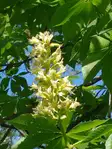 Ohio buckeye Aesculus glabra Fire-resistant
 -
 little bluestem Schizachyrium scoparium Keep away
Questions
What list did Ohio forget it had?
OSU Extension Bulletin 921, Firewise Landscaping (T. Davis Sydnor, Larry Steward, Aaron Kloss; copyright 2006, 3/06). Eight rated plant tables plus a mulch table on a VL / L / M / H / VH scale. The ratings are the result of the authors’ experience and that of others. Live Ohioline for Bulletin 921 returned HTTP 404 this session. The copy opened here is the 14 July 2007 Wayback capture of firewise.org/usa/files/ohio_plantlist.pdf. This directory currently stores 352 plant records citing osu-b921.
Is B921 a second vote beside the Fire Performance Plant Selector?
No. Co-author Larry Steward of Ohio State ATI is the FPS prototype rater. B921 and FPS share lineage ufifas-srs-tree on this site. The Steward rule is the vote-counting page. This page opens the bulletin itself.
Are B921’s three zones the same as IBHS 0–5 / 5–30 / 30–100?
No. Bulletin 921 Zone 1 is the house to 5 feet (nothing flammable, including bark mulch). Zone 2 is 5 to 10 feet (well-kept lawn; avoid evergreens; any trees at least 10 feet from the house). Zone 3 is 10 to 30 feet (thin to at least 30 feet; 100 feet downhill on a slope). Those are not NFPA’s 30/100 bands and not a permit to plant in the first five feet.
Is this an Ohio doorway page?
No. The object is a 2006 rated Midwest bulletin that left the live catalog, recovered from Wayback, and 352 stored rows. The place relationship is explicit because the source itself discusses Ohio conditions; the state page keeps its historical fire-evidence scope separate from USDA occurrence and current legal status.