United States / Grow / stonecrop

stonecrop (Sedum)
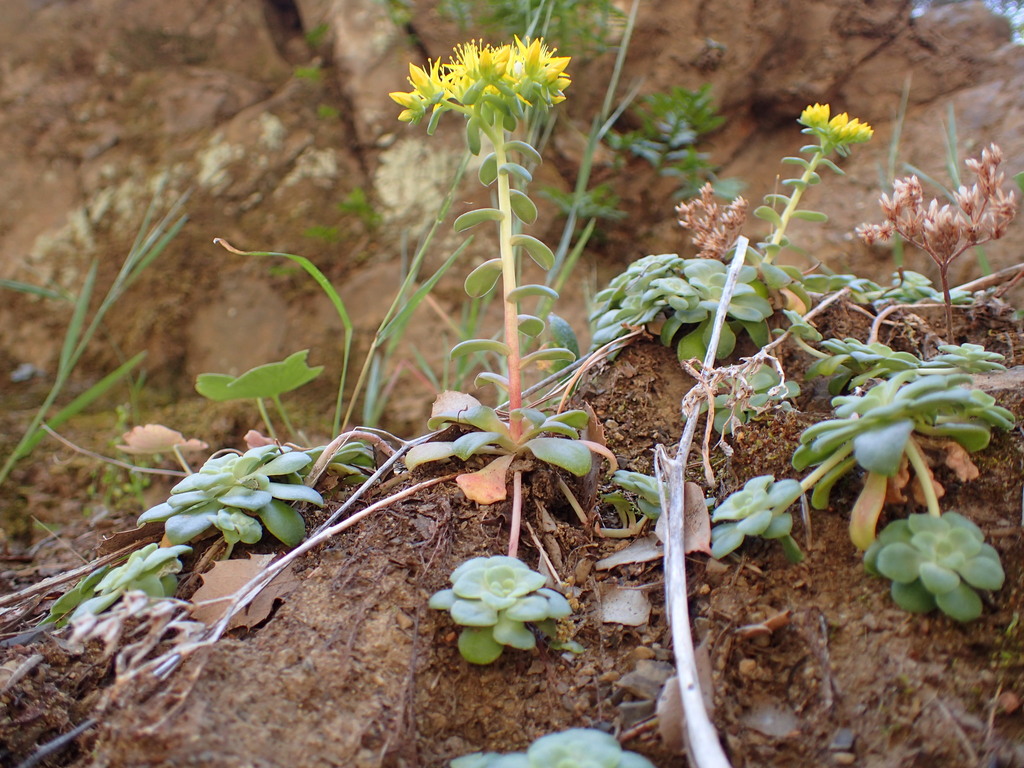
Photo: (c) George Williams, some rights reserved (CC BY) (CC BY), via iNaturalist. Species-typical, not necessarily this cultivar.

stonecrop

Sedum · Crassulaceae · all Sedum records · also called Sedum · Wikipedia

View Saved

Is this one for your yard?

Enter your ZIP to see whether this is legal to plant in your state, and whether it survives your winter.

Yes, stonecrop (Sedum) is consistently rated fire resistant for home landscaping.

Oregon State, Washington State, and University of Idaho extension services include stonecrop in their fire-resistant plant recommendations. It also appears in FireSmart BC's approved fire-resistant plant chart and the University of Tennessee Extension's Firewise plant tables. The LSU AgCenter also recommends Sedum for firewise landscaping in Louisiana. Those findings span the Pacific Northwest, British Columbia, Tennessee, and Louisiana.

The more detailed ratings point the same way. Ohio State places stonecrop in the low-flammability band of its five-point scale, a band it recommends, and describes the foliage as fire resistant. It also calls the plant drought tolerant and shade intolerant. Virginia Cooperative Extension likewise gives stonecrop a low rating on its three-point scale, describing it as drought tolerant and maintenance free.

Stonecrop is a groundcover in the Crassulaceae family, with a listed hardiness range of USDA zones 3a through 9b. The sources use different systems, from expert flammability scales to approved-plant lists, yet none raises a conflicting verdict. Taken together, they provide a clear and unusually consistent case for treating stonecrop as fire resistant.

Form
groundcover
Rated in
British Columbia; Catalonia, Spain; Colorado / Rocky Mountain Front Range; Fremont County, Wyoming +22
On this lot

1. Fire evidence and conditions

Fire evidence
Fire-resistant — location does not change the cited classification.
Fire-performance conditions
2 conditions stated in cited fire-evidence rows.
Placement evidence
13 source placement records; source schemes remain separate.
Evidence regions
British Columbia; Catalonia, Spain; Colorado / Rocky Mountain Front Range; Fremont County, Wyoming; Georgetown, Texas; Georgia; Louisiana; Marin County, California; Maryland, New Jersey, and West Virginia; Montana / Northern Rockies; Nevada / Great Basin; New Mexico; OR/WA/ID; Ohio / Midwest; Oklahoma; Oregon; Oregon (Willamette Valley); Pacific Northwest (Oregon / Washington / Idaho); South Carolina; Southeast US; Tennessee; Utah / Intermountain West; Virginia / Mid-Atlantic; Yavapai County, Arizona; southern Idaho / Intermountain; western WA
Typed publication scope: 23 scopes across 21 cited fire sources
  • Ignition-Resistant Landscape Plants (Fact Sheet 6.305) · Official scoped edition
    • CO; partial normalized coverage · 2025-07-01

      Colorado State University Extension and the Colorado State Forest Service publish Fact Sheet 6.305 for Colorado's WUI and varied ecosystems. FireApproved exposes all 114 exact source owners at Colorado publication scope while retaining score, elevation, water, and Idaho-carrier lineage. Publication scope is not suitability for every Colorado site or zone.

  • Fire-Resistant Plants Common to Marin County · Official scoped edition
    • Marin County (CA footprint); partial normalized coverage · 2019-01-01

      The publication is explicitly limited to plants common to Marin County. FireApproved publishes 104 exact owners as Marin regional context while retaining its placement, spacing, irrigation, and maintenance boundary. It is not statewide California guidance or parcel suitability.

  • Fremont County Firewise Plant List · Official scoped edition
    • Fremont County (WY footprint); partial normalized coverage · 2011-02-25

      The source identifies itself as the Fremont County Firewise Plant List. FireApproved publishes its 92 exact source owners as Fremont County regional context. No methodology, current county endorsement, statewide Wyoming scope, or site-specific suitability is inferred.

  • Fire Resistance of Plants Master Database · Official scoped edition
    • Southern Idaho (ID footprint); partial normalized coverage · 2013-11-08

      The official database labels itself "For Southern Idaho" and describes Idaho residents at the urban-rangeland interface. FireApproved publishes 419 existing plant owners that cite its scored rows. This bounded Southern Idaho scope is regional context, not statewide coverage or a conclusion that the score transfers unchanged to every Idaho site.

  • Firewise Plants for the Puget Sound Basin · Official scoped edition
    • Puget Sound Basin (WA footprint); partial normalized coverage · 2011-01-01

      King County's current wildfire page links this list for the Puget Sound Basin. FireApproved publishes 82 exact source owners as basin context, not statewide Washington guidance or a site-specific recommendation.

  • Firewise Landscaping (Hammond Research Station) · Official scoped edition
    • LA; partial normalized coverage · 2008-12-02

      LSU AgCenter calls these 31 ornamentals commonly used in Louisiana and recommended for Louisiana firewise landscaping efforts. FireApproved publishes 31 exact source owners, mostly at the source's genus grain. Undocumented curation remains corroborative and is not site suitability.

  • Firewise Landscaping Plants (Maryland, New Jersey, and West Virginia editions) · Official scoped edition
    • MD; partial normalized coverage · 2015-01-08

      Maryland Forest Service says the list contains plants that can be grown in Maryland and identifies Maryland natives. FireApproved publishes 169 exact source owners from the 180 printed rows; an unrepresentable form and duplicate-owner rows are not broadened. The list calls itself non-comprehensive and does not establish suitability for every Maryland site.

    • NJ; partial normalized coverage

      New Jersey DEP publishes a state edition saying the listed plants can be grown in New Jersey and are relatively resistant to fire. Its same 180 printed taxon occurrences map to the 169 conservative owners already normalized for the template family. The list is non-comprehensive and does not establish suitability for every New Jersey site or override the Pinelands Commission's separate placement and fuel-break rules.

    • WV; partial normalized coverage · 2026-08-26

      West Virginia Division of Forestry publishes a state edition saying the listed plants can be grown in West Virginia and are relatively resistant to fire. Its same 180 printed taxon occurrences map to the 169 conservative owners already normalized for the template family. The list is non-comprehensive and provides no comparative or site-specific rating.

  • Fire-Resistant Plants for Montana Landscapes (MontGuide MT200101AG) · Official scoped edition
    • MT; partial normalized coverage · 2022-04-01

      The April 2022 MontGuide explicitly presents fire-resistant species adapted to Montana. FireApproved publishes 92 exact plant records from the source while retaining excluded genus, family, and unresolved rows; the guide itself says not every listed species grows in every part of the state.

  • FireWise Plant List for New Mexico · Official scoped edition
    • NM; partial normalized coverage · 2003-10-08

      New Mexico Forestry Division publishes this as its FireWise Plant List for New Mexico. FireApproved accounts for all 140 printed rows and publishes 95 exact same-rank owners already represented in the directory; 29 exact taxa without an existing record, 14 unresolved spellings or higher-rank matches, one compound taxon cell, and one species row whose only apparent owner has an infraspecific printed identity remain held. Every published row retains the source's Y, N, ?, or blank elevation cells. Publication scope does not erase those elevation limits or establish suitability for every New Mexico site.

  • Firewise Plantings Can Help Protect Property · Official scoped edition
    • OK; partial normalized coverage · 2022-08-28

      Oklahoma State University Extension frames the article around statewide Oklahoma heat, drought, wildfire, and plant selection and publishes five unambiguous genus owners. Ambiguous common names remain excluded, and the prose examples do not establish suitability for every Oklahoma site.

  • Firewise Landscaping (OSU Extension Bulletin 921) · Official scoped edition
    • OH; partial normalized coverage · 2006-03-01

      Ohio State University Extension Bulletin 921 is an Ohio publication that describes Ohio fire seasons and landscape conditions and labels nativity to Ohio. FireApproved publishes 352 exact source-owning plant records from its eight rated tables. This historical publication scope does not assert current extension endorsement or that a listed plant suits every Ohio site.

  • Fire-resistant Landscape Plants for the Willamette Valley (EM 9103) · Official scoped edition
    • Willamette Valley (OR footprint); partial normalized coverage · 2015-02-01

      OSU Extension says EM 9103 highlights fire-resistant plants that thrive under Willamette Valley growing conditions. FireApproved publishes 172 exact owners only as valley context. The guide shares the PNW 590 lineage and is not a second independent vote or statewide site clearance.

  • Fire-Resistant Plants for Home Landscapes (PNW 590) · Official scoped edition
    • ID, OR, WA; partial normalized coverage · 2023-10-01

      The October 2023 joint Pacific Northwest Extension publication explicitly names Oregon, Washington, and Idaho and publishes more than 150 plant profiles. FireApproved has normalized 155 exact plant records from the source; publication scope does not assert that every listed plant suits every site within the three states.

  • Landscaping Can Be Attractive & FIREWISE (Fire Smart Plant List for SC) · Official scoped edition
    • SC; partial normalized coverage

      South Carolina Forestry Commission publishes this explicitly as its Fire Smart Plant List for South Carolina. FireApproved publishes 63 exact genus owners from 72 unique common-name labels; unsafe common-name mappings and duplicates are not broadened. The brochure calls the list non-inclusive and does not establish species-level or site-specific suitability.

  • Firewise Plant Guide · Official scoped edition
    • Sun City Texas, Georgetown (TX footprint); partial normalized coverage · 2015-01-14

      The guide is authored for the Sun City Texas community in Georgetown. FireApproved publishes 142 exact owners only as community-level context. It is an archived HOA exhibit with unknown rating lineage, not a current statewide Texas source or an independent Tier 1 determination.

  • Firescaping: Wildfire-Resistant Landscaping in Georgia · Official scoped edition
    • GA; partial normalized coverage

      UGA Warnell's WSFNR-20-96A is explicitly firescaping guidance for Georgia. FireApproved publishes the five exact genus owners named in its Immediate Zone examples while retaining the source's maintenance and quantity conditions. This is partial example coverage, not a statewide planting list.

  • A Compilation of Good Plant Choices for Nevada's High Fire Hazard Areas (SP-05-16) · Official scoped edition
    • NV; partial normalized coverage · 2005-01-01

      University of Nevada Cooperative Extension compiled plants suited to Nevada climate zones and reported favorably by at least two upstream firewise lists. FireApproved publishes 126 exact source owners at Nevada publication scope. The source explicitly makes no independent flammability determination, so these rows remain corroborative.

  • Firewise Plants for Utah Landscapes (NR/FF/002) · Official scoped edition
    • UT; partial normalized coverage · 2005-02-01

      Utah State University Extension states that this fact sheet selects examples for Utah landscapes and that they require proper placement and maintenance. FireApproved publishes 83 exact source owners at Utah publication scope. The table is not a site-specific planting clearance.

  • Landscaping Guidelines to Protect Your Home from Wildfire (SP685) · Official scoped edition
    • TN; partial normalized coverage · 2006-10-24

      University of Tennessee Extension SP685 is Tennessee landscape guidance and publishes 78 represented plant owners. Most table rows are a carrier of Virginia Firescapes rather than an independent rating; Tennessee source scope does not change that lineage or establish site suitability.

  • Virginia Firescapes — Firewise Landscaping for Woodland Homes (430-300) · Official scoped edition
    • VA; partial normalized coverage · 2009-04-15

      Virginia Cooperative Extension's publication opens with Virginia wildfire conditions, identifies its Virginia Firewise Landscaping Task Force, and labels plants native to Virginia. FireApproved publishes 306 exact source owners. Publication scope does not establish parcel suitability or current endorsement of this archived 2009 list.

  • Fire-Resistant and Fire-Prone Plants Common to Yavapai County (Bulletin 34) · Official scoped edition
    • Yavapai County (AZ footprint); partial normalized coverage · 2025-03-14

      University of Arizona Cooperative Extension authors Bulletin 34 for Yavapai County. FireApproved publishes 198 exact source owners from its resistant and prone tables and keeps the county boundary visible. County publication scope is regional Arizona context, never statewide scope.

2. Why this plant is relevant here

State distribution
Documented in GA, ID, OR, WA.
USDA hardiness
2 applicable cited hardiness statements overlap but have different boundaries; compare each complete source row.

3. Legal, ecological, and broader status

How to read this page

The status above is computed from the cited rows below: independent recommendations can support a fire-resistant result, an avoid row can produce keep-away, and disagreement stays visible as conflict. Placement notes preserve each source’s own scheme rather than translating unlike rules into one scale. This is evidence about a plant, not permission to plant it in every part of the defensible space; Zone 0 remains noncombustible.

Plant hardiness evidence

These values describe the plant source. Your ZIP zone comes from the separate 2023 USDA Plant Hardiness Zone Map. Whole-zone values stay whole-zone, and a single unresolved value is not treated as a tolerance range. Different source boundaries stay separate: overlapping statements are compared independently, while only ranges with no shared zone are called a conflict.

Conditions in the fire evidence

These describe tested or rated plant material. They are not horticultural maintenance instructions.

Where its sources say to plant it

Placement rules below use each source's own distances or named zones, tied to its rating. They are not interchangeable with the directory's current Zone 0 guidance.

The evidence

Grouped by what each source concluded. Primary evidence rated the plant itself (a lab, field program, or original curation); corroboration compiled or republished another source's rating and resolves to its root lineage.

Recommends (26)

Corroboration (12 rows from 12 sources)
  • FireSmart BC Plant Program — fire-resistant plant chart — FireSmart BC · original source Corroboration Compilation lineage: pnw590-tree resolves to Fire-Resistant Plants for Home Landscapes (PNW 590)

    “FireSmart-approved fire-resistant plant”

  • Landscaping Guidelines to Protect Your Home from Wildfire (SP685) — University of Tennessee Extension · original source Corroboration Compilation lineage: ufifas-srs-tree resolves to Virginia Firescapes — Firewise Landscaping for Woodland Homes (430-300)

    “listed Firewise plant”

  • Firewise Landscaping (Hammond Research Station) — LSU AgCenter (Bracy, Owings, Orr, Chen) · c. 2005-2010 · original source Corroboration Compilation lineage: unknown

    “recommended for firewise landscaping in Louisiana”

  • Fire-Resistant Plants Common to Marin County — Fire Safe Marin · 2019 · original source Corroboration Expert-curated lineage: partially-independent

    “listed as fire-resistant” · condition: irrigated

    Fire Safe Marin lists this taxon among fire-resistant plants common to Marin County.

  • A Compilation of Good Plant Choices for Nevada's High Fire Hazard Areas (SP-05-16) — University of Nevada Cooperative Extension · SP-05-16 (2005) · original source Corroboration Compilation lineage: unr-tree

    “listed by at least two cited sources”

    Compilation marks: UCFPL 1997, CSU 6.305, UI Bulletin 67, MT200101AG, OSU FRN 6, USU NR/FF/002.

  • Firescaping: Wildfire-Resistant Landscaping in Georgia — University of Georgia Warnell School of Forestry and Natural Resources · WSFNR-20-96A · original source Corroboration Compilation lineage: ufifas-srs-tree

    “can grow in this area if carefully maintained and limited in quantity”

    The Immediate Zone paragraph names Sedum spp. among “low-growing, low-flammability succulents”.

  • Fremont County Firewise Plant List — Fremont County Firewise · web page (server last-modified 2011-02-25) · original source Corroboration Compilation lineage: unknown

    “Fremont County Firewise Plant List — Sedum spp. — Stonecrop”

    Listed in the source's Ground Covers section; the page describes its listed Firewise plants as generally low-growing, low-debris, and relatively moist.

  • Fire-Resistant and Fire-Prone Plants Common to Yavapai County (Bulletin 34) — University of Arizona Cooperative Extension, Yavapai County · v1.2 · original source Corroboration Expert-curated lineage: unknown

    “Fire-Resistant Plants”

    Listed as Sedum (stonecrop) — Sedum sp.. The bulletin says fire-resistant plants tend to resist ignition when irrigated and maintained, while fire-prone plants may ignite readily and burn intensely.

  • Landscaping Can Be Attractive & FIREWISE (Fire Smart Plant List for SC) — South Carolina Forestry Commission · 2005 brochure · original source Corroboration Compilation lineage: unknown

    “LESS Flammable Plants with some fire resistance”

    Listed as Stonecrop. The source says highly flammable plants ignite faster and burn readily; less flammable plants have some fire resistance.

  • Firewise Plant Guide — Sun City Texas Firewise Group · updated January 14, 2015 · original source Corroboration HOA exhibit lineage: unknown

    “low”

    The table rates Sedum — Sedum species low for flammability hazard, defined as the ease a plant can burn at high temperatures for a prolonged time.

  • Firewise Landscaping Plants (Maryland, New Jersey, and West Virginia editions) — Maryland DNR, New Jersey DEP, and West Virginia Division of Forestry · 2015 archived PDF · original source Corroboration Compilation lineage: md-nj-wv-template-family

    “relatively resistant to fire”

    Listed as Sedum spp. (Sedum, Stonecrop); Sedum spp. (Sedum, Stonecrop). The source says listed species exhibit stronger resistance to ignition by wildfires. Source comments: Drought tolerant and maintenance free

  • FireWise Plant List for New Mexico — New Mexico Energy, Minerals and Natural Resources Department, Forestry Division · 2003 Forestry Division PDF · original source Corroboration Compilation lineage: csu-nmsu-firewise

    “FireWise Plant List for New Mexico”

    Listed as Sedum spp. (Stonecrop) in Flowers and Ground Covers. Printed elevation cells: 4,000 ft=Y, 5,000 ft=Y, 6,000 ft=Y, 7,000 ft=Y, 8,000 ft=Y, 9,000+ ft=Y. Water need: L-M; sun/shade: S/PS; mature height: 1-1.5; approximate bloom: Jul-Aug.
Guides that discuss this plant

Last verified 2026-08-23. JSON (CC BY 4.0)

Profiles: USDA PLANTS · GBIF · iNaturalist · Wikidata · Wikipedia · ITIS

Sedum (Stonecrop, Sedum). FireApproved. https://fireapproved.com/plants/sedum/. Last verified 2026-08-23.