Enter your ZIP to see whether this is legal to plant in your state, and whether it survives your winter.
Yes, black elderberry is rated fire resistant for landscaping.
For Arizona elevations above 3,000 feet, black elderberry appears among the FIREWISE plant materials recommended by University of Arizona Cooperative Extension. Under Black Elder or Common Elder, Oregon State University Extension Service recommends the species for fire-resistant landscaping in Willamette Valley growing conditions.
The Diputació de Girona and Bombers de la Generalitat de Catalunya rate Sambucus nigra “muy recomendada,” assuming species-specific care. Their garden-suitability judgment weighs origin, invasiveness, maintenance, and fuel structure alongside fire-resistance literature and fire-service experience. NFPA Firewise Communities also places it in a table of Firewise trees, shrubs, and groundcovers that homeowners can choose, noting that it tolerates wet and dry soils.
A separate experiment stored in the FLAMITS database measured a maximum flame temperature of about 518°C from predried branches tested on a grill. That figure reports the hottest flame recorded under those experimental conditions. It does not assign the species a safety verdict because FLAMITS does not impose one threshold across unlike variables, devices, and plant parts.
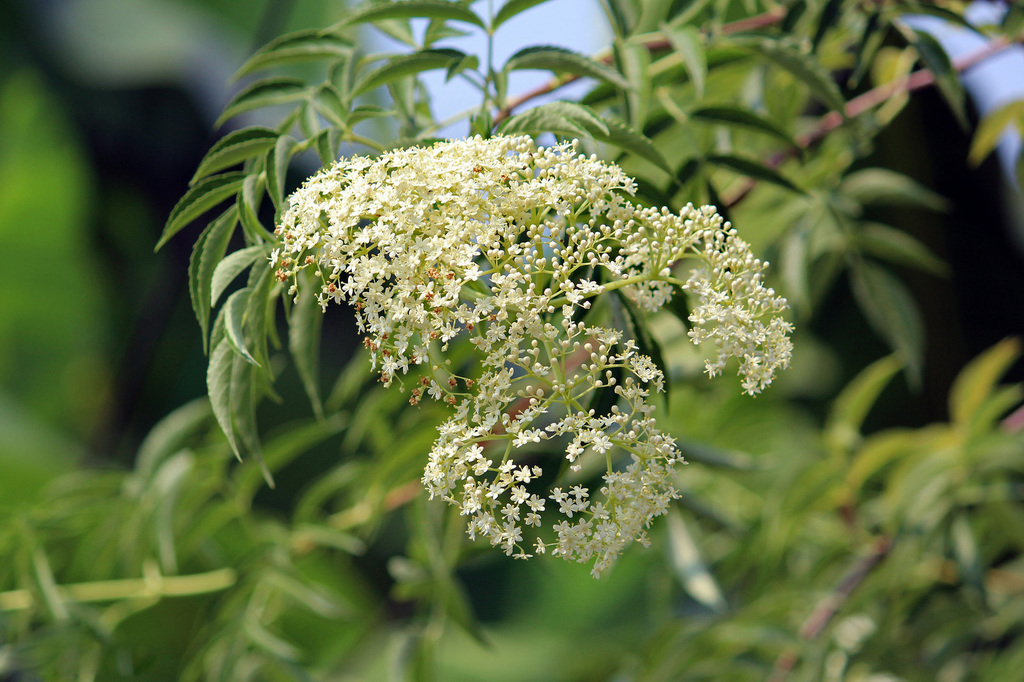
Black elderberry is a tree in the Viburnaceae family. The recommendations point clearly toward fire resistance, though their settings still matter: the Arizona finding applies above 3,000 feet, while Oregon’s applies to Willamette Valley growing conditions.
Willamette Valley (OR footprint); partial normalized coverage · 2015-02-01
OSU Extension says EM 9103 highlights fire-resistant plants that thrive under Willamette Valley growing conditions. FireApproved publishes 172 exact owners only as valley context. The guide shares the PNW 590 lineage and is not a second independent vote or statewide site clearance.
Arizona at or above 3,000 feet (AZ footprint); partial normalized coverage · 2011-12-01
AZ1289 is explicitly limited to Arizona elevations of 3,000 feet and higher. FireApproved publishes 69 exact owners as regional Arizona context, retaining every water and elevation condition. It is never promoted to statewide low-desert guidance or an independent Tier 1 vote.
2. Why this plant is relevant here
State distribution
Documented in AZ.
Native range
Introduced / established
3 sourced range or established records. This is not an invasive warning.
USDA hardiness
Documented range 5–8.
3. Legal, ecological, and broader status
Legal-list status
Seed-list status
Reported invasive here
Broader regional context
Federal context
How to read this page
The status above is computed from the cited rows below: independent recommendations can support a fire-resistant result, an avoid row can produce keep-away, and disagreement stays visible as conflict. Placement notes preserve each source’s own scheme rather than translating unlike rules into one scale. This is evidence about a plant, not permission to plant it in every part of the defensible space; Zone 0 remains noncombustible.
Native and introduced range evidence
These are exact U.S. botanical-area records from the cited range source. Native and
introduced describe biogeographic relationship, not fire performance or planting approval.
Doubtful and extinct rows stay visible but do not count as current presence.
The lossless worldwide derivative is retained once in the research corpus; object pages repeat only exact U.S. areas needed by the local lens. The JSON twin carries the same page assertions.
Plant hardiness evidence
These values describe the plant source. Your ZIP zone comes from the separate 2023 USDA
Plant Hardiness Zone Map. Whole-zone values stay whole-zone, and a single unresolved value
is not treated as a tolerance range. Different source boundaries stay separate: overlapping
statements are compared independently, while only ranges with no shared zone are called a conflict.
5–8 explicit range · whole zone precision · source stated
Source taxon: Sambucus nigra · exact match.
Source location: Black Elder or Common Elder profile (PDF page 111).
Where its sources say to plant it
Placement rules below use each source's own distances or named zones, tied to its rating.
They are not interchangeable with the directory's current Zone 0 guidance.
Guía de pirojardinería: suitable inside or outside the 25-metre maximum-risk zone [girona-2020-iuf-25m-suitability] (with its recommendation)
Fire-resistant Landscape Plants for the Willamette Valley: Black Elder or Common Elder profile (PDF page 111) [osu-em-9103-profile] (with its recommendation)
FireWise Plants offer colorful choices for Fire Safe Gardens: Scientific name / Common name / Comments table [arkansas-firewise-table] (with its recommendation)
The evidence
Grouped by what each source concluded. Primary evidence rated the plant itself
(a lab, field program, or original curation); corroboration compiled or
republished another source's rating and resolves to its root lineage.
Sambucus nigra is rated “MUY RECOMENDADA” by the guide's qualitative IUF garden-suitability method. The method assumes species-specific care and integrates fire evidence with fuel structure, maintenance, origin, invasiveness, and expert fire-service experience.
3 cited rows from this source; its identity, lineage and tier are stated once.
Primary study Pacheco2022: Pacheco, A. S., Goodman, H. D., Hankenson, L., Fisk, J. J., Ortiz, A., Marinace, H. M., ... Tng, D. Y. P. (2022). Fighting fire with food: Assessing the flammability of crop plant species for building fire resilient agroforestry systems. in review, preprint.
Shared row context: plant part branches; fuel all; predrying yes; device grill; site Pacheco2022-1; sampling october to november 2022.