Home / Plants / Grow / Bracken Fern
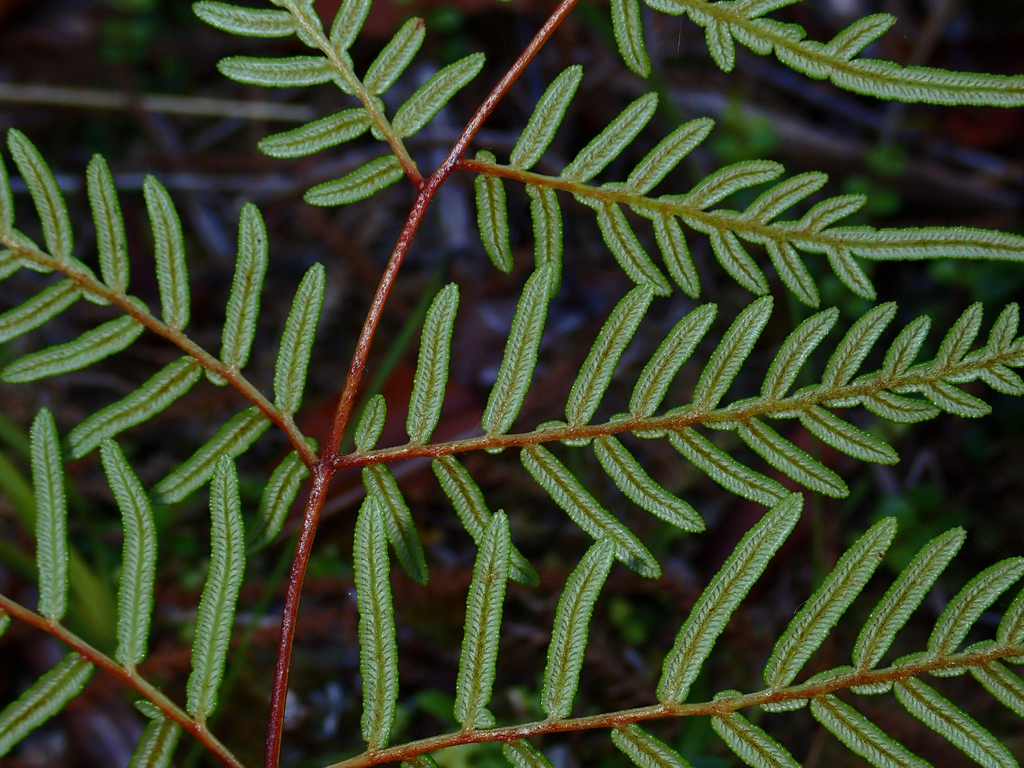
Bracken Fern
Pteridium esculentum
Your local evidence lens
Separate evidence questions, never one approval badge
A genus split is not a placement verdict. Set a ZIP to read the local documented split.
1. Fire evidence and conditions
- Fire evidence
- Highly flammable — location does not change the cited classification.
- Fire-performance conditions
- No test or rating condition is normalized.
- Fire ecology context
- No section-reviewed fire-ecology context is normalized.
- Placement evidence
- 1 source placement record; source schemes remain separate.
- Evidence regions
- Global; New Zealand; Tasmania, Australia
- Maintenance
- No sourced horticultural maintenance assertion is normalized; fire-test conditions do not supply maintenance advice.
2. Why this plant is relevant here
- State distribution
- No state distribution is normalized.
- Native range
- No current cited or legacy state native range is normalized.
- Introduced / established
- No introduced or established row is normalized; that does not prove native status.
- USDA hardiness
- No hardiness value is normalized.
3. Legal, ecological, and broader status
- Legal-list status
- Set a location for an exact legal-list result; source silence is not clearance.
- Seed-list status
- Set a location to compare the separate state noxious-weed seed layer.
- Reported invasive here
- No ecological invasive report is normalized; that does not prove noninvasiveness.
- Broader regional context
- Aggregate AK, HI, and L48 evidence is shown only as regional context, never as an exact-state finding.
- Federal context
- Federal designations remain separate from state legal-list results.
How to read this page
The status above is computed from the cited rows below: independent recommendations can support a fire-resistant result, an avoid row can produce keep-away, and disagreement stays visible as conflict. Placement notes preserve each source’s own scheme rather than translating unlike rules into one scale. This is evidence about a plant, not permission to plant it in every part of the defensible space; Zone 0 remains noncombustible.
- Form
- perennial
- Region
- Australia; New Zealand; Tasmania, Australia
- Rated in
- Global; New Zealand; Tasmania, Australia
- Family
- Dennstaedtiaceae
- Evidence
- 20 cited sources
Where its sources say to plant it
- Fire Resisting Garden Plants for the Urban Fringe and Rur…: should be avoided in the Building Protection Zone
The evidence
Avoids (1)
-
Low Flammability Plants directory
“High flammability”
High flammability classification. Flagged poisonous in the FENZ directory.
Mid-scale / conditional (2)
-
Fire Resisting Garden Plants for the Urban Fringe and Rural Areas
“Moderate Flammability”
-
A quantitative assessment of shoot flammability for 60 tree and shrub species
“Moderate/high flammability category (Fig. 2)”
Shoot category from the paper's cluster analysis; samples were air-dried for 24 hours before testing.
Listed without a rating (17)
-
FLAMITS: FLAMmability plant traiTS database
-
“ignition frequency (%): 100”
FLAMITS record 1489; Ignitability measurement; plant part branches; fuel all; predrying yes; device grill; site Cui2020a-1; sampling ND. Primary study Cui2020a: Cui, X., Paterson, A. M., Wyse, S. V., Alam, M. A., Maurin, K. J. L., Pieper, R., ... Curran, T. J. (2020a). Shoot flammability of vascular plants is phylogenetically conserved and related to habitat fire-proneness and growth form. Nature Plants, 6, 355-359.
-
“maximum sample temperature (°C): 507.7”
FLAMITS record 1683; Combustibility measurement; plant part branches; fuel all; predrying yes; device grill; site Cui2020a-1; sampling ND. Primary study Cui2020a: Cui, X., Paterson, A. M., Wyse, S. V., Alam, M. A., Maurin, K. J. L., Pieper, R., ... Curran, T. J. (2020a). Shoot flammability of vascular plants is phylogenetically conserved and related to habitat fire-proneness and growth form. Nature Plants, 6, 355-359.
-
“burning duration (s): 24.9”
FLAMITS record 1877; Sustainability measurement; plant part branches; fuel all; predrying yes; device grill; site Cui2020a-1; sampling ND. Primary study Cui2020a: Cui, X., Paterson, A. M., Wyse, S. V., Alam, M. A., Maurin, K. J. L., Pieper, R., ... Curran, T. J. (2020a). Shoot flammability of vascular plants is phylogenetically conserved and related to habitat fire-proneness and growth form. Nature Plants, 6, 355-359.
-
“estimated burnt biomass (%): 28.6”
FLAMITS record 2071; Consumability measurement; plant part branches; fuel all; predrying yes; device grill; site Cui2020a-1; sampling ND. Primary study Cui2020a: Cui, X., Paterson, A. M., Wyse, S. V., Alam, M. A., Maurin, K. J. L., Pieper, R., ... Curran, T. J. (2020a). Shoot flammability of vascular plants is phylogenetically conserved and related to habitat fire-proneness and growth form. Nature Plants, 6, 355-359.
-
“calorific value (kcal/kg): 4568.35”
FLAMITS record 2903; Combustibility measurement; plant part leaves; fuel dead; predrying yes; device calorimeter; site Dickinson1985-1; sampling winter. Primary study Dickinson1985: Dickinson, K. J. M., & Kirkpatrick, J. B. (1985). The flammability and energy content of some important plant-species and fuel components in the forests of Southeastern Tasmania. Journal of Biogeography, 12, 121-134.
-
“rate of burning spread (cm/s): 0.25”
FLAMITS record 2915; Sustainability measurement; plant part leaves; fuel dead; predrying yes; device calorimeter; site Dickinson1985-1; sampling winter. Primary study Dickinson1985: Dickinson, K. J. M., & Kirkpatrick, J. B. (1985). The flammability and energy content of some important plant-species and fuel components in the forests of Southeastern Tasmania. Journal of Biogeography, 12, 121-134.
-
“calorific value (kcal/kg): 4646.74”
FLAMITS record 2936; Combustibility measurement; plant part leaves; fuel live; predrying yes; device calorimeter; site Dickinson1985-1; sampling winter. Primary study Dickinson1985: Dickinson, K. J. M., & Kirkpatrick, J. B. (1985). The flammability and energy content of some important plant-species and fuel components in the forests of Southeastern Tasmania. Journal of Biogeography, 12, 121-134.
-
“temperature at smoke (°C): 156.96”
FLAMITS record 8506; Ignitability measurement; plant part leaves; fuel live; predrying yes; device muffle furnace; site Mason2016-13; sampling summer. Primary study Mason2016: Mason, N. W. H., Frazao, C., Buxton, R. P., & Richardson, S. J. (2016). Fire form and function: evidence for exaptive flammability in the New Zealand flora. Plant Ecology, 217, 645-659.
-
“temperature at smoke (°C): 269.4”
FLAMITS record 8507; Ignitability measurement; plant part leaves; fuel live; predrying yes; device muffle furnace; site Mason2016-13; sampling summer. Primary study Mason2016: Mason, N. W. H., Frazao, C., Buxton, R. P., & Richardson, S. J. (2016). Fire form and function: evidence for exaptive flammability in the New Zealand flora. Plant Ecology, 217, 645-659.
-
“temperature at flaming (°C): 236.52”
FLAMITS record 8721; Ignitability measurement; plant part leaves; fuel live; predrying yes; device muffle furnace; site Mason2016-13; sampling summer. Primary study Mason2016: Mason, N. W. H., Frazao, C., Buxton, R. P., & Richardson, S. J. (2016). Fire form and function: evidence for exaptive flammability in the New Zealand flora. Plant Ecology, 217, 645-659.
-
“temperature at flaming (°C): 371.2”
FLAMITS record 8722; Ignitability measurement; plant part leaves; fuel live; predrying yes; device muffle furnace; site Mason2016-13; sampling summer. Primary study Mason2016: Mason, N. W. H., Frazao, C., Buxton, R. P., & Richardson, S. J. (2016). Fire form and function: evidence for exaptive flammability in the New Zealand flora. Plant Ecology, 217, 645-659.
-
“temperature increase rate (°C/s): 24.47”
FLAMITS record 8936; Combustibility measurement; plant part leaves; fuel live; predrying yes; device muffle furnace; site Mason2016-13; sampling summer. Primary study Mason2016: Mason, N. W. H., Frazao, C., Buxton, R. P., & Richardson, S. J. (2016). Fire form and function: evidence for exaptive flammability in the New Zealand flora. Plant Ecology, 217, 645-659.
-
“temperature increase rate (°C/s): 14.69”
FLAMITS record 8937; Combustibility measurement; plant part leaves; fuel live; predrying yes; device muffle furnace; site Mason2016-13; sampling summer. Primary study Mason2016: Mason, N. W. H., Frazao, C., Buxton, R. P., & Richardson, S. J. (2016). Fire form and function: evidence for exaptive flammability in the New Zealand flora. Plant Ecology, 217, 645-659.
-
“ignition frequency (%): 100”
FLAMITS record 14373; Ignitability measurement; plant part branches; fuel all; predrying yes; device grill; site Wyse2016-3; sampling ND. Primary study Wyse2016: Wyse, S. V., Perry, G. L. W., O'Connell, D. M., Holland, P. S., Wright, M. J., Hosted, C. L., ... Curran, T. J. (2016). A quantitative assessment of shoot flammability for 60 tree and shrub species supports rankings based on expert opinion. International Journal of Wildland Fire, 25, 466-477.
-
“maximum sample temperature (°C): 469.6”
FLAMITS record 14433; Combustibility measurement; plant part branches; fuel all; predrying yes; device grill; site Wyse2016-3; sampling ND. Primary study Wyse2016: Wyse, S. V., Perry, G. L. W., O'Connell, D. M., Holland, P. S., Wright, M. J., Hosted, C. L., ... Curran, T. J. (2016). A quantitative assessment of shoot flammability for 60 tree and shrub species supports rankings based on expert opinion. International Journal of Wildland Fire, 25, 466-477.
-
“burning duration (s): 18.1”
FLAMITS record 14493; Sustainability measurement; plant part branches; fuel all; predrying yes; device grill; site Wyse2016-3; sampling ND. Primary study Wyse2016: Wyse, S. V., Perry, G. L. W., O'Connell, D. M., Holland, P. S., Wright, M. J., Hosted, C. L., ... Curran, T. J. (2016). A quantitative assessment of shoot flammability for 60 tree and shrub species supports rankings based on expert opinion. International Journal of Wildland Fire, 25, 466-477.
-
“estimated burnt biomass (%): 13.8”
FLAMITS record 14553; Consumability measurement; plant part branches; fuel all; predrying yes; device grill; site Wyse2016-3; sampling ND. Primary study Wyse2016: Wyse, S. V., Perry, G. L. W., O'Connell, D. M., Holland, P. S., Wright, M. J., Hosted, C. L., ... Curran, T. J. (2016). A quantitative assessment of shoot flammability for 60 tree and shrub species supports rankings based on expert opinion. International Journal of Wildland Fire, 25, 466-477.
-