Enter your ZIP to see whether this is legal to plant in your state, and whether it survives your winter.
Yes, Chinese magnolia is rated fire resistant by five forestry, extension, and government sources.
The USDA Forest Service and state Firewise programs gave it Firewise 1, the favorable end of their four-part scale. Ohio State placed it in the low-flammability band of a five-point system, while Virginia Tech also rated it low on its three-point scale. Michigan State included Chinese magnolia among wildfire-resistant plants recommended for Michigan’s climate, and the Australian Capital Territory government marks it fire retardant. These assessments use different scales, yet all reach a favorable judgment.
That agreement is more useful than treating any one label as universal. “Firewise,” “low flammability,” “wildfire-resistant,” and “fire retardant” are not identical technical categories. They are each the source’s own way of identifying plants suitable for fire-conscious landscaping. In this case, none of the five sources places Chinese magnolia on the unfavorable side.
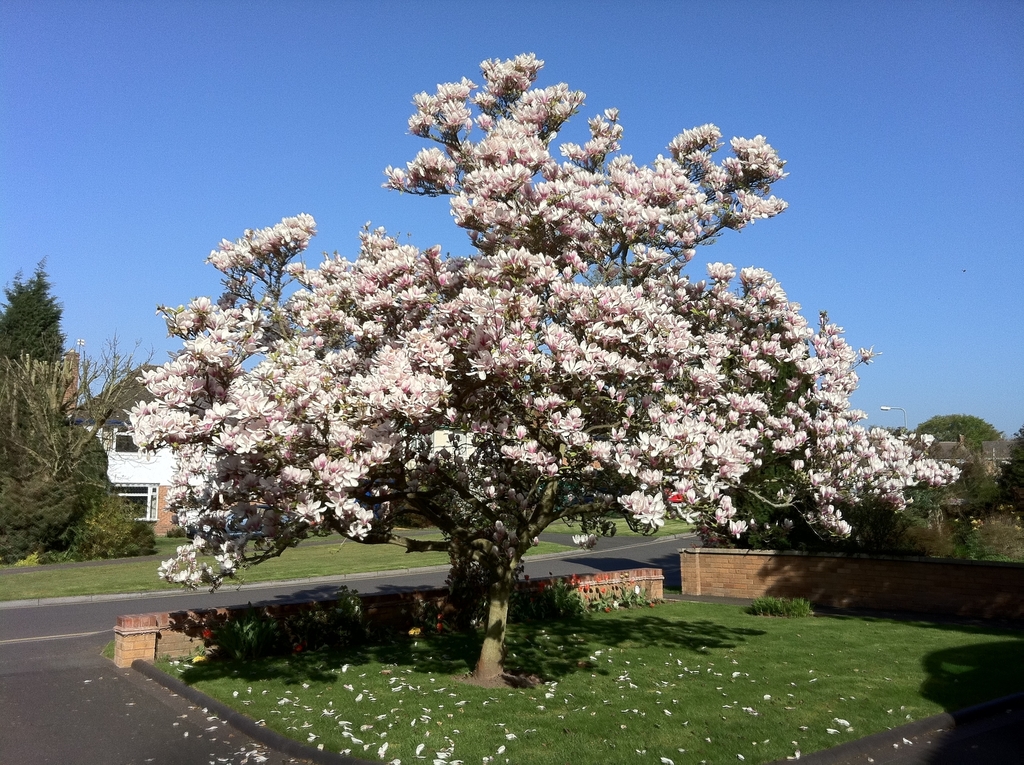
Chinese magnolia is a tree in the magnolia family, reaching about 25 feet at maturity and growing in part sun. It is hardy to USDA zone 5a. The practical conclusion is reassuring: across the available regional guidance, Chinese magnolia is consistently treated as a fire-resistant landscape choice.
Form
tree
Mature height
~25 ft
Light
Part sun
Rated in
Australian Capital Territory, Australia; Michigan / Great Lakes; Ohio / Midwest; Virginia / Mid-Atlantic +1
On this lot
1. Fire evidence and conditions
Fire evidence
Fire-resistant — location does not change the cited classification.
Michigan State University Extension Bulletin E2948 is explicitly a list of wildfire-resistant landscape plants for Michigan and includes a Michigan-native field. FireApproved publishes 221 exact GBIF owners from 226 represented source rows and holds 15 complex or non-exact rows. This dated publication scope is not a current site-suitability determination.
Ohio State University Extension Bulletin 921 is an Ohio publication that describes Ohio fire seasons and landscape conditions and labels nativity to Ohio. FireApproved publishes 352 exact source-owning plant records from its eight rated tables. This historical publication scope does not assert current extension endorsement or that a listed plant suits every Ohio site.
Virginia Cooperative Extension's publication opens with Virginia wildfire conditions, identifies its Virginia Firewise Landscaping Task Force, and labels plants native to Virginia. FireApproved publishes 306 exact source owners. Publication scope does not establish parcel suitability or current endorsement of this archived 2009 list.
2. Why this plant is relevant here
State distribution
Documented in DC, DE, MD, NJ, OH, PA, WV.
Native range
Introduced / established
1 sourced range or established record. This is not an invasive warning.
USDA hardiness
Documented range 4–9.
3. Legal, ecological, and broader status
Legal-list status
Seed-list status
Reported invasive here
Broader regional context
Federal context
How to read this page
The status above is computed from the cited rows below: independent recommendations can support a fire-resistant result, an avoid row can produce keep-away, and disagreement stays visible as conflict. Placement notes preserve each source’s own scheme rather than translating unlike rules into one scale. This is evidence about a plant, not permission to plant it in every part of the defensible space; Zone 0 remains noncombustible.
Plant hardiness evidence
These values describe the plant source. Your ZIP zone comes from the separate 2023 USDA
Plant Hardiness Zone Map. Whole-zone values stay whole-zone, and a single unresolved value
is not treated as a tolerance range. Different source boundaries stay separate: overlapping
statements are compared independently, while only ranges with no shared zone are called a conflict.
Source prints 5 · single-value meaning unresolved · whole zone precision · source stated
Source taxon: Magnolia x soulangiana · exact match.
Source location: Cold Hardiness Zone field in the recovered selector record.
Not used for comparison: The recovered selector prints one Cold Hardiness Zone value but does not define it as a minimum threshold or a one-zone range.
4–9 explicit range · whole zone precision · source stated
Source taxon: Magnolia xsoulangiana · accepted name match.
Source location: Table 1, tree row.
Where its sources say to plant it
Placement rules below use each source's own distances or named zones, tied to its rating.
They are not interchangeable with the directory's current Zone 0 guidance.
Eastern United States Fire Performance Plant Selector: Landscape Zone 3 — 10–30 ft from the structure; thin vegetation, remove debris, and minimize plant massing [Fire Performance Plant Selector landscape zone] (with its recommendation)
Canberra Plant Selector: filtered result page 18 [canberra-selector] (with its recommendation)
The evidence
Grouped by what each source concluded. Primary evidence rated the plant itself
(a lab, field program, or original curation); corroboration compiled or
republished another source's rating and resolves to its root lineage.