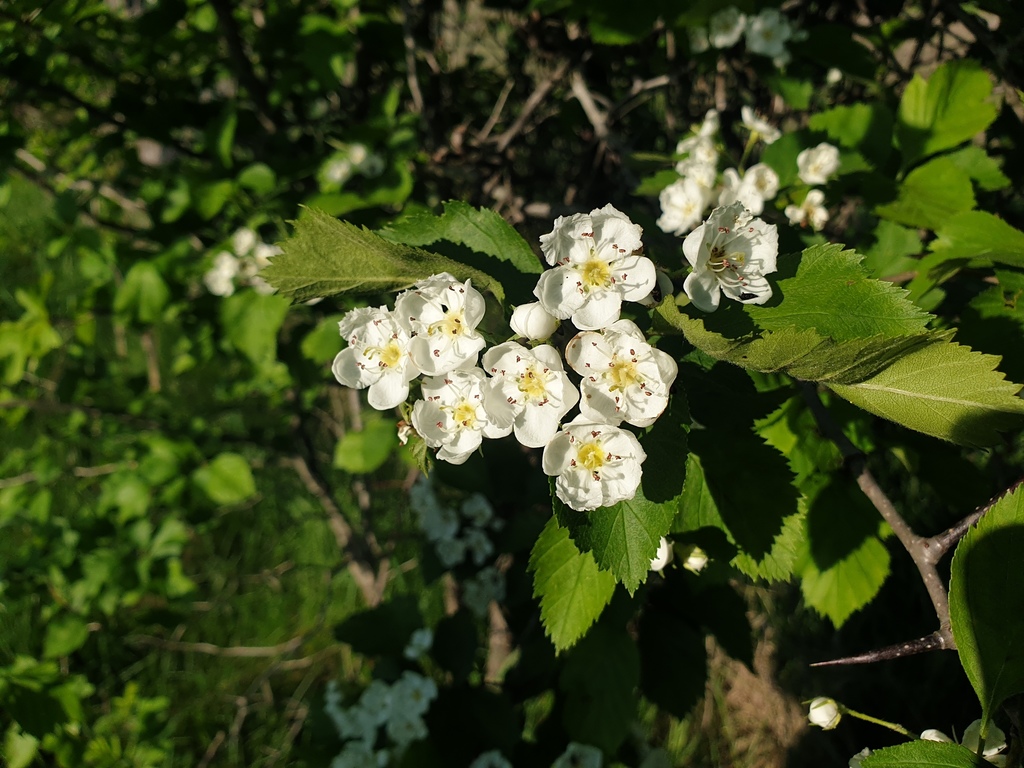
Enter your ZIP to see whether this is legal to plant in your state, and whether it survives your winter.
Hawthorn is fire resistant, with six North American plant programs reaching the same practical conclusion.
The Pacific Northwest extension services list hawthorn as fire resistant, while NC State places it in the low-flammability class of its three-part scale. FireSmart BC approves it as a fire-resistant plant, and extension services in Tennessee, Louisiana, and Michigan recommend hawthorn for Firewise or wildfire-resistant landscaping. The Louisiana list offers supporting agreement rather than equal proof because it cites no methodology.
This consensus is stronger than a repeated label from closely matched sources. NC State classified 202 native plants by flammability, the Pacific Northwest universities used an expert-curated recommendation list, and Michigan State compiled a separate list for Great Lakes conditions. FireSmart BC adds a Canadian program organized around suitability within different parts of the Home Ignition Zone. Different regional programs and classification systems all place hawthorn on the favorable side.
Hawthorn is a tree in the rose family, Rosaceae. The Pacific Northwest extension guide assigns it a hardiness range of USDA zones 4a through 7b, a range that belongs to that guide rather than every region represented. For a homeowner selecting within suitable growing conditions, the broad agreement supports treating hawthorn as a fire-resistant landscape choice.
Form
tree
Rated in
Black Hills, South Dakota; British Columbia; Fremont County, Wyoming; Louisiana +8
On this lot
1. Fire evidence and conditions
Fire evidence
Fire-resistant — location does not change the cited classification.
Black Hills, South Dakota; British Columbia; Fremont County, Wyoming; Louisiana; Maryland, New Jersey, and West Virginia; Mediterranean southeast France; Michigan / Great Lakes; North Carolina; OR/WA/ID; Pacific Northwest (Oregon / Washington / Idaho); Tennessee; Yavapai County, Arizona
Maintenance
Typed publication scope: 11 scopes across 9 cited fire sources
Black Hills (SD footprint); partial normalized coverage
The page explicitly limits itself to the Black Hills, and NFPA Firewise's archived 2006 plant-list index files it under South Dakota. FireApproved publishes 47 exact genus or species owners from 48 printed rows. This is bounded Black Hills context, not statewide South Dakota coverage or a finding that a plant suits a particular site.
Fremont County (WY footprint); partial normalized coverage · 2011-02-25
The source identifies itself as the Fremont County Firewise Plant List. FireApproved publishes its 92 exact source owners as Fremont County regional context. No methodology, current county endorsement, statewide Wyoming scope, or site-specific suitability is inferred.
LSU AgCenter calls these 31 ornamentals commonly used in Louisiana and recommended for Louisiana firewise landscaping efforts. FireApproved publishes 31 exact source owners, mostly at the source's genus grain. Undocumented curation remains corroborative and is not site suitability.
Maryland Forest Service says the list contains plants that can be grown in Maryland and identifies Maryland natives. FireApproved publishes 169 exact source owners from the 180 printed rows; an unrepresentable form and duplicate-owner rows are not broadened. The list calls itself non-comprehensive and does not establish suitability for every Maryland site.
NJ; partial normalized coverage
New Jersey DEP publishes a state edition saying the listed plants can be grown in New Jersey and are relatively resistant to fire. Its same 180 printed taxon occurrences map to the 169 conservative owners already normalized for the template family. The list is non-comprehensive and does not establish suitability for every New Jersey site or override the Pinelands Commission's separate placement and fuel-break rules.
WV; partial normalized coverage · 2026-08-26
West Virginia Division of Forestry publishes a state edition saying the listed plants can be grown in West Virginia and are relatively resistant to fire. Its same 180 printed taxon occurrences map to the 169 conservative owners already normalized for the template family. The list is non-comprehensive and provides no comparative or site-specific rating.
Michigan State University Extension Bulletin E2948 is explicitly a list of wildfire-resistant landscape plants for Michigan and includes a Michigan-native field. FireApproved publishes 221 exact GBIF owners from 226 represented source rows and holds 15 complex or non-exact rows. This dated publication scope is not a current site-suitability determination.
The complete three-table AG-874 plant list is explicitly for North Carolina and contains 202 low-, medium-, or high-flammability rows. FireApproved accounts for all source rows under its strict taxonomy and lineage rules; source scope does not establish local suitability at a particular North Carolina site.
The October 2023 joint Pacific Northwest Extension publication explicitly names Oregon, Washington, and Idaho and publishes more than 150 plant profiles. FireApproved has normalized 155 exact plant records from the source; publication scope does not assert that every listed plant suits every site within the three states.
University of Tennessee Extension SP685 is Tennessee landscape guidance and publishes 78 represented plant owners. Most table rows are a carrier of Virginia Firescapes rather than an independent rating; Tennessee source scope does not change that lineage or establish site suitability.
Yavapai County (AZ footprint); partial normalized coverage · 2025-03-14
University of Arizona Cooperative Extension authors Bulletin 34 for Yavapai County. FireApproved publishes 198 exact source owners from its resistant and prone tables and keeps the county boundary visible. County publication scope is regional Arizona context, never statewide scope.
2. Why this plant is relevant here
State distribution
Documented in ID, OR, WA.
Native range
Introduced / established
USDA hardiness
Documented range 4–7.
3. Legal, ecological, and broader status
Legal-list status
Seed-list status
Reported invasive here
Broader regional context
Federal context
How to read this page
The status above is computed from the cited rows below: independent recommendations can support a fire-resistant result, an avoid row can produce keep-away, and disagreement stays visible as conflict. Placement notes preserve each source’s own scheme rather than translating unlike rules into one scale. This is evidence about a plant, not permission to plant it in every part of the defensible space; Zone 0 remains noncombustible.
Plant hardiness evidence
These values describe the plant source. Your ZIP zone comes from the separate 2023 USDA
Plant Hardiness Zone Map. Whole-zone values stay whole-zone, and a single unresolved value
is not treated as a tolerance range. Different source boundaries stay separate: overlapping
statements are compared independently, while only ranges with no shared zone are called a conflict.
4–7 explicit range · whole zone precision · source stated
Source taxon: Crataegus spp. · exact match.
Source location: Hawthorn profile, USDA hardiness zones field.
Where its sources say to plant it
Placement rules below use each source's own distances or named zones, tied to its rating.
They are not interchangeable with the directory's current Zone 0 guidance.
FireSmart BC Plant Program: suitable for HIZ extended zone (30-100 m) [FireSmart BC Home Ignition Zone] (with its recommendation)
Firewise Landscaping Plants: Deciduous Trees [Maryland Firewise plant-form tables] (with its recommendation)
Firewise Plant Material for the Black Hills: Large shrubs & trees [black-hills-plant-form-table] (with its recommendation)
The evidence
Grouped by what each source concluded. Primary evidence rated the plant itself
(a lab, field program, or original curation); corroboration compiled or
republished another source's rating and resolves to its root lineage.
“Fremont County Firewise Plant List — Crataegus spp, — Hawthorn (Several Native)”
Listed in the source's Large Shrubs and Trees section; the page describes its listed Firewise plants as generally low-growing, low-debris, and relatively moist.
Listed as Hawthorn — Crataegus sp.. The bulletin says fire-resistant plants tend to resist ignition when irrigated and maintained, while fire-prone plants may ignite readily and burn intensely.
Listed as Crataegus spp. (Hawthorn). The source says listed species exhibit stronger resistance to ignition by wildfires. Source comments: Not drought resistant
The fiche's overall sensitivity combines experimental-bench inflammability, intensity, and combustion measurements with foresters' observations of fire damage.