Enter your ZIP to see whether this is legal to plant in your state, and whether it survives your winter.
Atlas cedar is not reliably fire resistant: three guides advise against it, while one laboratory index rates it favorably.
The USDA Forest Service and state Firewise programs call it “Not Firewise,” the least favorable point on their four-level scale. Virginia Cooperative Extension gives it high flammability, though every evergreen tree and shrub in that publication receives the same rating. Assuming care suited to the species, Diputació de Girona and Bombers de la Generalitat de Catalunya rate Atlas cedar very inadvisable for fire-adapted gardens. Origin and invasiveness enter that judgment alongside maintenance, fuel structure, fire research, and fire-service experience.
The favorable result comes from INRA’s Mediterranean testing. Atlas cedar scored no higher than 2 on a monthly inflammability scale of 0 to 5, including from July through September. On that system, a fire-season maximum from 0 to 2 supports a recommendation. This test measured ignition frequency and average ignition delay under an epiradiator, so it answers a narrower question than the landscape guides.
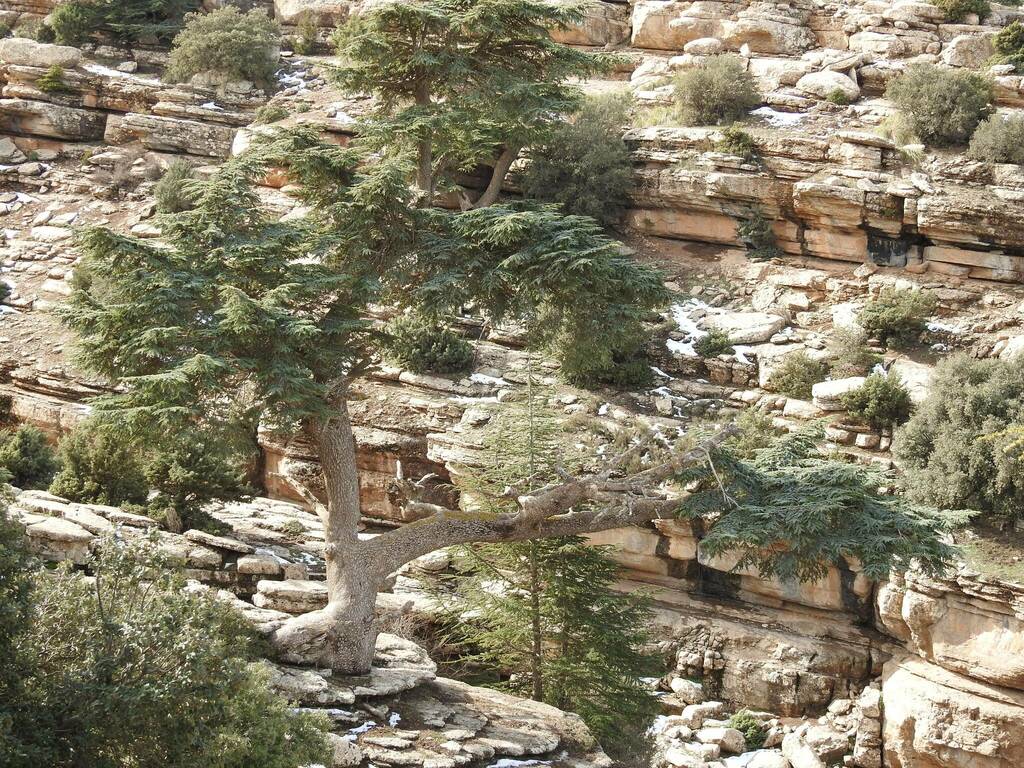
Other tests do not resolve the disagreement. Cape Town researchers measured fresh and dry leaves, finding much faster ignition when dry, and observed Atlas cedar partially burned in the 2021 fire. Live twigs tested without prior drying flamed after three seconds under an epiradiator; FLAMITS sets no common threshold for turning such measurements into a recommendation. Atlas cedar, a roughly 50-foot tree in the pine family, therefore has mixed findings rather than a dependable fire-resistant designation.
Virginia Cooperative Extension's publication opens with Virginia wildfire conditions, identifies its Virginia Firewise Landscaping Task Force, and labels plants native to Virginia. FireApproved publishes 306 exact source owners. Publication scope does not establish parcel suitability or current endorsement of this archived 2009 list.
2. Why this plant is relevant here
State distribution
Documented in DC, DE, MD, NJ, OH, PA, WV.
Native range
Introduced / established
USDA hardiness
Only uncertain or inapplicable hardiness rows are cited; no primary zone is projected.
3. Legal, ecological, and broader status
Legal-list status
Seed-list status
Reported invasive here
Broader regional context
Federal context
How to read this page
The status above is computed from the cited rows below: independent recommendations can support a fire-resistant result, an avoid row can produce keep-away, and disagreement stays visible as conflict. Placement notes preserve each source’s own scheme rather than translating unlike rules into one scale. This is evidence about a plant, not permission to plant it in every part of the defensible space; Zone 0 remains noncombustible.
Plant hardiness evidence
These values describe the plant source. Your ZIP zone comes from the separate 2023 USDA
Plant Hardiness Zone Map. Whole-zone values stay whole-zone, and a single unresolved value
is not treated as a tolerance range. Different source boundaries stay separate: overlapping
statements are compared independently, while only ranges with no shared zone are called a conflict.
Source prints 6 · single-value meaning unresolved · whole zone precision · source stated
Source taxon: Cedrus atlantica · exact match.
Source location: Cold Hardiness Zone field in the recovered selector record.
Not used for comparison: The recovered selector prints one Cold Hardiness Zone value but does not define it as a minimum threshold or a one-zone range.
Where its sources say to plant it
Placement rules below use each source's own distances or named zones, tied to its rating.
They are not interchangeable with the directory's current Zone 0 guidance.
Eastern United States Fire Performance Plant Selector: Landscape Zone 3 — 10–30 ft from the structure; thin vegetation, remove debris, and minimize plant massing [Fire Performance Plant Selector landscape zone] (with its avoid rating)
Guía de pirojardinería: not suitable inside or outside the 25-metre maximum-risk zone [girona-2020-iuf-25m-suitability] (with its avoid rating)
Time to extinguish the exotic flame: Lessons from the 202…: Urban zone; Table 1 and deposited raw workbook [macalister-2025-leaf-flammability] (mid-scale rating)
The evidence
Grouped by what each source concluded. Primary evidence rated the plant itself
(a lab, field program, or original curation); corroboration compiled or
republished another source's rating and resolves to its root lineage.
Cedrus atlantica is rated “MUY DESACONSEJADA” by the guide's qualitative IUF garden-suitability method. The method assumes species-specific care and integrates fire evidence with fuel structure, maintenance, origin, invasiveness, and expert fire-service experience.
5 cited rows from this source; its identity, lineage and tier are stated once.
Primary study Hachmi2011: Hachmi, M. H., Sesbou, A., Benjelloun, H., El Handouz, N., & Bouanane, F. (2011). A Simple Technique to Estimate the Flammability Index of Moroccan Forest Fuels. Journal of Combustion, 2011, 1-11.
Shared row context: plant part twigs; fuel live; predrying no; device epiradiator; site Hachmi2011-1; sampling ND.
FLAMITS record 13340; Ignitability measurement; plant part leaves; fuel live; predrying no; device epiradiator; site Valette1990-1; sampling june to september. Primary study Valette1990: Valette, J.-C. (1990). Flammabilities of Mediterranean forest species. Effects on the combustibility of the forest communities inflammabilités des espèces forestières méditerranéennes. Conséquences sur la combustibilité des formations forestières. Revue forestière française, 42, 76-92.