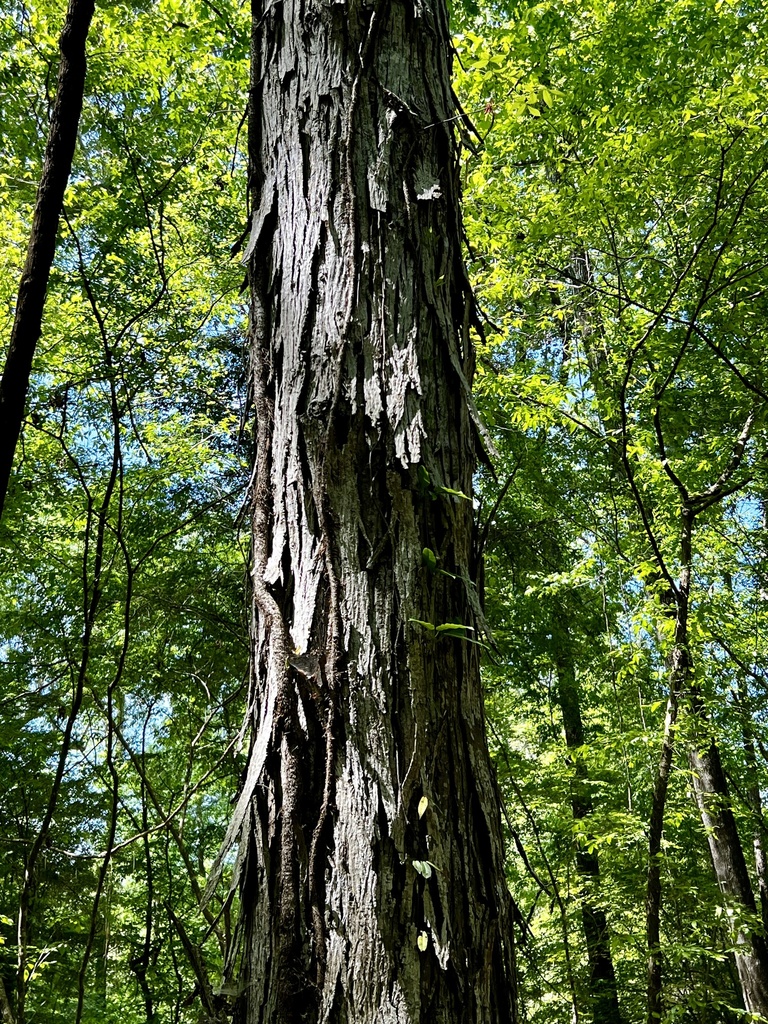
shagbark hickory
Carya ovata
A genus split is not a placement verdict.
Is this one for your yard?
Enter your ZIP to see whether this is legal to plant in your state, and whether it survives your winter.
Shagbark hickory is rated fire resistant, supported by five extension and Firewise assessments.
The USDA Forest Service and state Firewise programs gave it their most favorable Firewise rating on a four-point scale. North Carolina extension sources rated it low flammability in 2005 and again in 2025. Ohio State University Extension assigned the L band on its five-point scale, one step above VL, while Virginia Cooperative Extension and Virginia Tech gave it the low category on their three-point scale. Though the scales differ, each rating supports its use as a fire-resistant choice.
The FLAMITS database also reports a flame height of 69 centimeters for shagbark hickory litter. Flame height describes one aspect of burning, but the database does not set a common threshold for turning measurements from different plant parts, devices, and variables into recommendations. The 69-centimeter figure therefore adds detail without changing the extension assessments.
Shagbark hickory is a tree in the walnut family, reaching about 50 feet at maturity. It is native in the Southeastern, Northeastern, North-Central, and South-Central United States and is hardy to USDA zone 5a. Its shaggy, peeling bark is noted by several sources, but they do not identify that bark as the reason for their ratings. The supported conclusion is simply that several authorities place shagbark hickory on the fire-resistant side.
- Form
- tree
- Mature height
- ~50 ft
- Light
- Full sun
- Water need
- moderate
- Rated in
- Global; NC; North Carolina; Ohio / Midwest +2