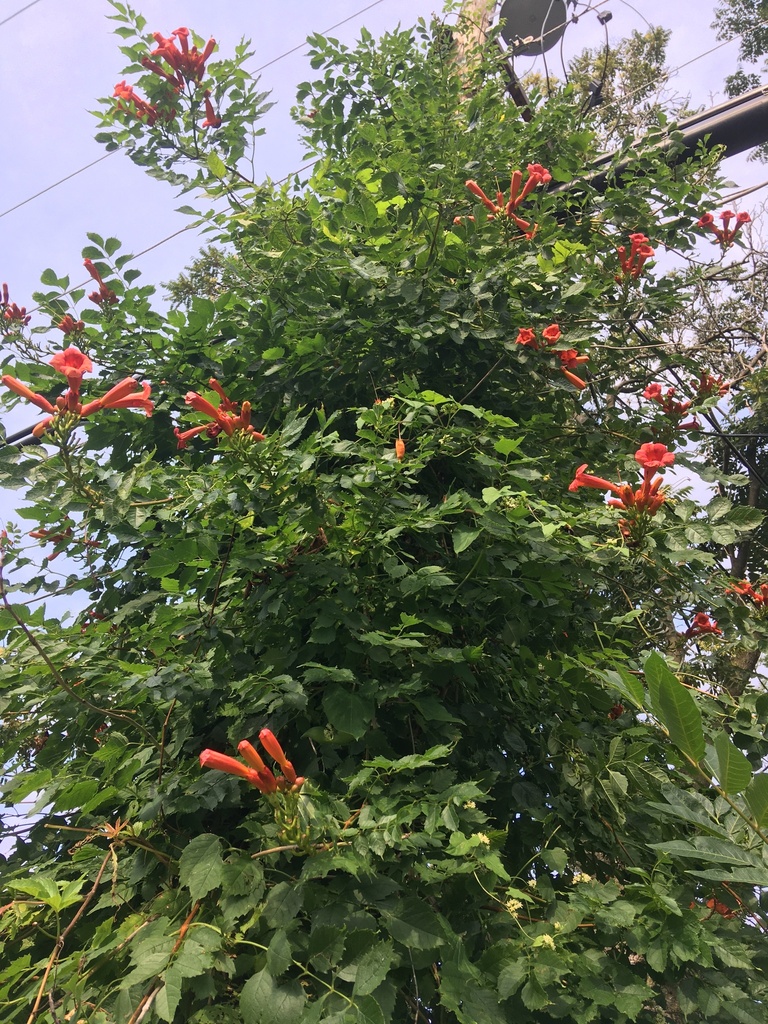
trumpet creeper
Campsis radicans
A genus split is not a placement verdict.
Is this one for your yard?
Enter your ZIP to see whether this is legal to plant in your state, and whether it survives your winter.
Trumpet creeper is classified as fire resistant overall, but four of six sources advise against it in fire-wise landscaping.
The warnings are substantial but not identical. The eastern U.S. selector assigns its least favorable category, “Not Firewise,” and notes that the vine rapidly overtakes and shades other plants. Ohio State University Extension gives it H, the fourth band on a five-band flammability scale. NC State University and its partners rated it extreme in 2005, while NC State Extension rated it high in 2025 after the newer scale dropped the extreme category. That change reflects a revised scale, not a finding that the plant became less flammable.
FireSmart BC reaches the opposite conclusion by approving trumpet creeper as a fire-resistant plant. The Generalitat Valenciana also recommends it as a low-flammability climber for wildland-urban-interface gardens. These are regional planting classifications rather than results from one shared measurement, so their labels cannot be treated as directly interchangeable. British Columbia and Valencia place the vine on the favorable side, while guidance from North Carolina, Ohio, and the eastern United States does not.
Trumpet creeper is a low-water vine for full sun, with a mature height of about 40 feet. The overall answer is therefore a qualified yes: it carries a fire-resistant classification, but several U.S. programs give it unfavorable ratings that matter when choosing plants for a particular region.
- Form
- vine
- Mature height
- ~40 ft
- Light
- Full sun
- Water need
- low
- Rated in
- British Columbia; California; Michigan / Great Lakes; NC +10